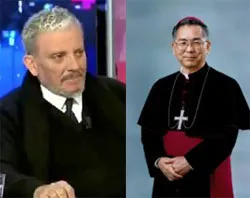
Bishop: Vatican-approved group has caused 'problems', 'chaos' Japanese bishop's statement on Neocatechumenal Way comes after Vatican meeting
The president of the Catholic Bishops’ Conference of Japan (CBCJ) has called for the cooperation of priests and laypeople to confront “problems” with the Neocatechumenal Way, which he says has had a negative effect in the country.
“In those places touched by the Neocatechumenal Way, there has been rampant confusion, conflict, division, and chaos,” the Jesuit Archbishop of Osaka, Leo Jun Ikenaga, said in a statement published in Katorikku Shimbun, the Catholic Weekly of Japan, yesterday.
“In Japan, the net effect has been negative,” said Ikenaga in his statement. “We bishops, in light of our apostolic pastoral responsibility, could not ignore the damage.”
Pope Benedict XVI refused a request from four Japanese bishops, including Ikenaga, in Rome Dec. 13 to suspend the international organization’s activities in Japan for five years.
The Neocatechumenal Way is dedicated to the Christian formation of adults. It was given definitive approval by the Vatican in 2008 and has an estimated 1 million members worldwide, in around 40,000 small, parish-based communities.
A few weeks before the Rome meeting, the Japanese episcopal conference announced that it would suspend the activities of the movement in Japan.
Ikenaga’s statement suggests that the bishops are unwilling to let the matter rest there.
“Until now, the CBCJ has engaged with both the Holy See and the Neocatechumenal Way. But now the time has come to gain the participation of the laypeople of Japan,” he wrote in the statement dated Dec. 20.
Ikenaga said that the pope plans to send an envoy to Japan soon.
He said that the bishops hope that those who have come into personal contact with the actions of the Neocatechumenal Way will relate their experiences to the pope’s envoy.
“The fact is, it’s very difficult for the real state of affairs to be conveyed to a place as far away as Rome,” he wrote.
“We hope that they [the Neocatechumenal Way] will take a hard look at why things haven’t worked out here so far and, for the first time, help us root out the cause of the problems, so that we can find the path to a solution.”
The meeting in Rome was attended by the pope, the Vatican’s Secretary of State Cardinal Tarcisio Bertone, five other cardinals and one archbishop.
The Japanese delegation included Bishops Osamu Mizobe of Takamatsu, Ryoji Miyahara of Fukuoka, and Isao Kikuchi of Niigata. The 86 year-old Bishop Takaaki Hirayama, who is retired in Rome, also attended.
The Neocatechumenal Way set up in Japan around 1970 in the Diocese of Hiroshima. In 1990, an affiliated Redemptoris Mater seminary was built in the Takamatsu diocese, which has the smallest number of resident Catholics of any Japanese diocese -- only 5,000 are registered there.
ADDRESS OF HIS HOLINESS POPE BENEDICT XVI TO THE MEMBERS OF THE DIPLOMATIC CORPS
Regia Hall Monday, 10 January 2011
Your Excellencies, Ladies and Gentlemen,
I am pleased to welcome you, the distinguished representatives of so many countries, to this meeting which each year assembles you around the Successor of Peter. It is a deeply significant meeting, since it is a sign and illustration of the place of the Church and of the Holy See in the international community. I offer my greetings and cordial good wishes to each of you, and particularly to those who have come for the first time. I am grateful to you for the commitment and interest with which, in the exercise of your demanding responsibilities, you follow my activities, those of the Roman Curia and thus, in some sense, the life of the Catholic Church throughout the world. Your Dean, Ambassador Alejandro Valladares Lanza, has interpreted your sentiments and I thank him for the good wishes which he has expressed to me in the name of all. Knowing how close-knit your community is, I am certain that today you are also thinking of the Ambassador of the Kingdom of the Netherlands, Baroness van Lynden-Leijten, who several weeks ago returned to the house of the Father. I prayerfully share your sentiments.
As a new year begins, our own hearts and the entire world continue to echo the joyful message proclaimed twenty centuries ago in the night of Bethlehem, a night which symbolizes humanity’s deep need for light, love and peace. To the men and women of that time, as to those of our own day, the heavenly hosts brought the good news of the coming of the Saviour: “The people who walked in darkness have seen a great light; those who dwelt in a land of deep darkness, on them has light shined” (Is 9:1). The mystery of the Son of God who became the son of man truly surpasses all human expectations. In its absolute gratuitousness this saving event is the authentic and full response to the deep desire of every heart. The truth, goodness, happiness and abundant life which each man and woman consciously or unconsciously seeks are given to us by God. In longing for these gifts, each person is seeking his Creator, for “God alone responds to the yearning present in the heart of every man and woman” (Post-Synodal Apostolic Exhortation Verbum Domini, 23). Humanity throughout history, in its beliefs and rituals, demonstrates a constant search for God and “these forms of religious expression are so universal that one may well call man a religious being” (Catechism of the Catholic Church, 28). The religious dimension is an undeniable and irrepressible feature of man’s being and acting, the measure of the fulfilment of his destiny and of the building up of the community to which he belongs. Consequently, when the individual himself or those around him neglect or deny this fundamental dimension, imbalances and conflicts arise at all levels, both personal and interpersonal.
This primary and basic truth is the reason why, in this year’s Message for World Day of Peace, I identified religious freedom as the fundamental path to peace. Peace is built and preserved only when human beings can freely seek and serve God in their hearts, in their lives and in their relationships with others.
Ladies and Gentlemen, your presence on this solemn occasion is an invitation to survey the countries which you represent and the entire world. In this panorama do we not find numerous situations in which, sadly, the right to religious freedom is violated or denied? It is indeed the first of human rights, not only because it was historically the first to be recognized but also because it touches the constitutive dimension of man, his relation with his Creator. Yet is this fundamental human right not all too often called into question or violated? It seems to me that society, its leaders and public opinion are becoming more and more aware, even if not always in a clear way, of this grave attack on the dignity and freedom of homo religiosus, which I have sought on numerous occasions to draw to the attention of all.
I did so during the past year in my Apostolic Journeys to Malta, Portugal, Cyprus, the United Kingdom and Spain. Above and beyond the diversity of those countries, I recall with gratitude their warm welcome. The Special Assembly for the Middle East of the Synod of Bishops, which took place in the Vatican in October, was a moment of prayer and reflection in which our thoughts turned insistently to the Christian communities in that part of the world which suffer greatly because of their fidelity to Christ and the Church.
Looking to the East, the attacks which brought death, grief and dismay among the Christians of Iraq, even to the point of inducing them to leave the land where their families have lived for centuries, has troubled us deeply. To the authorities of that country and to the Muslim religious leaders I renew my heartfelt appeal that their Christian fellow-citizens be able to live in security, continuing to contribute to the society in which they are fully members. In Egypt too, in Alexandria, terrorism brutally struck Christians as they prayed in church. This succession of attacks is yet another sign of the urgent need for the governments of the region to adopt, in spite of difficulties and dangers, effective measures for the protection of religious minorities. Need we repeat it? In the Middle East, Christians are original and authentic citizens who are loyal to their fatherland and assume their duties toward their country. It is natural that they should enjoy all the rights of citizenship, freedom of conscience, freedom of worship and freedom in education, teaching and the use of the mass media” (Message to the People of God of the Special Assembly for the Middle East of the Synod of Bishops, 10). I appreciate the concern for the rights of the most vulnerable and the political farsightedness which some countries in Europe have demonstrated in recent days by their call for a concerted response on the part of the European Union for the defence of Christians in the Middle East. Finally, I would like to state once again that the right to religious freedom is not fully respected when only freedom of worship is guaranteed, and that with restrictions. Furthermore, I encourage the accompaniment of the full safeguarding of religious freedom and other humans rights by programmes which, beginning in primary school and within the context of religious instruction, will educate everyone to respect their brothers and sisters in humanity. Regarding the states of the Arabian Peninsula, where numerous Christian immigrant workers live, I hope that the Catholic Church will be able to establish suitable pastoral structures.
Among the norms prejudicing the right of persons to religious freedom, particular mention must be made of the law against blasphemy in Pakistan: I once more encourage the leaders of that country to take the necessary steps to abrogate that law, all the more so because it is clear that it serves as a pretext for acts of injustice and violence against religious minorities. The tragic murder of the governor of Punjab shows the urgent need to make progress in this direction: the worship of God furthers fraternity and love, not hatred and division. Other troubling situations, at times accompanied by acts of violence, can be mentioned in south and south-east Asia, in countries which for that matter have a tradition of peaceful social relations. The particular influence of a given religion in a nation ought never to mean that citizens of another religion can be subject to discrimination in social life or, even worse, that violence against them can be tolerated. In this regard, it is important for interreligious dialogue to favour a common commitment to recognizing and promoting the religious freedom of each person and community. And, as I remarked earlier, violence against Christians does not spare Africa. Attacks on places of worship in Nigeria during the very celebrations marking the birth of Christ are another sad proof of this.
In a number of countries, on the other hand, a constitutionally recognized right to religious freedom exists, yet the life of religious communities is in fact made difficult and at times even dangerous (cf. Dignitatis Humanae, 15) because the legal or social order is inspired by philosophical and political systems which call for strict control, if not a monopoly, of the state over society. Such inconsistencies must end, so that believers will not find themselves torn between fidelity to God and loyalty to their country. I ask in particular that Catholic communities be everywhere guaranteed full autonomy of organization and the freedom to carry out their mission, in conformity with international norms and standards in this sphere.
My thoughts turn once again to the Catholic community of mainland China and its pastors, who are experiencing a time of difficulty and trial. I would also like to offer a word of encouragement to the authorities of Cuba, a country which in 2010 celebrated seventy-five years of uninterrupted diplomatic relations with the Holy See, that the dialogue happily begun with the Church may be reinforced and expanded.
Turning our gaze from East to West, we find ourselves faced with other kinds of threats to the full exercise of religious freedom. I think in the first place of countries which accord great importance to pluralism and tolerance, but where religion is increasingly being marginalized. There is a tendency to consider religion, all religion, as something insignificant, alien or even destabilizing to modern society, and to attempt by different means to prevent it from having any influence on the life of society. Christians are even required at times to act in the exercise of their profession with no reference to their religious and moral convictions, and even in opposition to them, as for example where laws are enforced limiting the right to conscientious objection on the part of health care or legal professionals.
In this context, one can only be gratified by the adoption by the Council of Europe last October of a resolution protecting the right to conscientious objection on the part of medical personnel vis-à-vis certain acts which gravely violate the right to life, such as abortion.
Another sign of the marginalization of religion, and of Christianity in particular, is the banning of religious feasts and symbols from civic life under the guise of respect for the members of other religions or those who are not believers. By acting in this way, not only is the right of believers to the public expression of their faith restricted, but an attack is made on the cultural roots which nourish the profound identity and social cohesion of many nations. Last year, a number of European countries supported the appeal lodged by the Italian government in the well-known case involving the display of the crucifix in public places. I am grateful to the authorities of those nations, as well as to all those who became involved in the issue, episcopates, civil and religious organizations and associations, particularly the Patriarchate of Moscow and the other representatives of the Orthodox hierarchy, as well as to all those – believers and non-believers alike – who wished to show their sympathy for this symbol, which bespeaks universal values.
Acknowledging religious freedom also means ensuring that religious communities can operate freely in society through initiatives in the social, charitable or educational sectors. Throughout the world, one can see the fruitful work accomplished by the Catholic Church in these areas. It is troubling that this service which religious communities render to society as a whole, particularly through the education of young people, is compromised or hampered by legislative proposals which risk creating a sort of state monopoly in the schools; this can be seen, for example, in certain countries in Latin America. Now that many of those countries are celebrating the second centenary of their independence – a fitting time for remembering the contribution made by the Catholic Church to the development of their national identity – I exhort all governments to promote educational systems respectful of the primordial right of families to make decisions about the education of their children, systems inspired by the principle of subsidiarity which is basic to the organization of a just society.
Continuing my reflection, I cannot remain silent about another attack on the religious freedom of families in certain European countries which mandate obligatory participation in courses of sexual or civic education which allegedly convey a neutral conception of the person and of life, yet in fact reflect an anthropology opposed to faith and to right reason.
Ladies and Gentlemen, on this solemn occasion, allow me to state clearly several principles which inspire the Holy See, together with the whole Catholic Church, in its activity within the intergovernmental International Organizations for the promotion of full respect for the religious freedom of all. First, the conviction that one cannot create a sort of scale of degrees of religious intolerance. Unfortunately, such an attitude is frequently found, and it is precisely acts of discrimination against Christians which are considered less grave and less worthy of attention on the part of governments and public opinion. At the same time, there is a need to reject the dangerous notion of a conflict between the right to religious freedom and other human rights, thus disregarding or denying the central role of respect for religious freedom in the defence and protection of fundamental human dignity. Even less justifiable are attempts to counter the right of religious freedom with other alleged new rights which, while actively promoted by certain sectors of society and inserted in national legislation or in international directives, are nonetheless merely the expression of selfish desires lacking a foundation in authentic human nature. Finally, it seems unnecessary to point out that an abstract proclamation of religious freedom is insufficient: this fundamental rule of social life must find application and respect at every level and in all areas; otherwise, despite correct affirmations of principle, there is a risk that deep injustice will be done to citizens wishing to profess and freely practise their faith.
Promoting the full religious freedom of Catholic communities is also the aim of the Holy See in signing Concordats and other agreements. I am gratified that states in different parts of the world, and of different religious, cultural and juridical traditions, choose international conventions as a means of organizing relations between the political community and the Catholic Church, thus establishing through dialogue a framework of cooperation and respect for reciprocal areas of competence. Last year witnessed the signing and implementation of an Agreement for the religious assistance of the Catholic faithful in the armed forces in Bosnia and Herzegovina, and negotiations are presently under way with different countries. We trust that they will have a positive outcome, ensuring solutions respectful of the nature and freedom of the Church for the good of society as a whole.
The activity of the Papal Representatives accredited to states and international organizations is likewise at the service of religious freedom. I would like to point out with satisfaction that the Vietnamese authorities have accepted my appointment of a Representative who will express the solicitude of the Successor of Peter by visiting the beloved Catholic community of that country. I would also like to mention that in the past year the diplomatic presence of the Holy See was expanded in Africa, since a stable presence is now assured in three countries without a resident Nuncio. God willing, I will once more travel to that continent, to Benin next November, in order to consign the Apostolic Exhortation which will gather the fruits of the labours of the second Special Assembly for Africa of the Synod of Bishops.
Before this distinguished assembly, I would like once more to state forcefully that religion does not represent a problem for society, that it is not a source of discord or conflict. I would repeat that the Church seeks no privileges, nor does she seek to intervene in areas unrelated to her mission, but simply to exercise the latter with freedom. I invite everyone to acknowledge the great lesson of history: “How can anyone deny the contribution of the world’s great religions to the development of civilization? The sincere search for God has led to greater respect for human dignity. Christian communities, with their patrimony of values and principles, have contributed much to making individuals and peoples aware of their identity and their dignity, the establishment of democratic institutions and the recognition of human rights and their corresponding duties. Today too, in an increasingly globalized society, Christians are called, not only through their responsible involvement in civic, economic and political life but also through the witness of their charity and faith, to offer a valuable contribution to the laborious and stimulating pursuit of justice, integral human development and the right ordering of human affairs” (Message for the Celebration of World Peace Day, 1 January 2011, 7).
A clear example of this was Blessed Mother Teresa of Calcutta: the centenary of her birth was celebrated at Tirana, Skopje and Pristina as well as in India, and a moving homage was paid to her not only by the Church but also by civil authorities and religious leaders, to say nothing of people of all religions. People like her show the world the extent to which the commitment born of faith is beneficial to society as a whole.
May no human society willingly deprive itself of the essential contribution of religious persons and communities! As the Second Vatican Council recalled, by guaranteeing just religious freedom fully and to all, society can “enjoy the benefits of justice and peace which result from faithfulness to God and his holy will” (Declaration Dignitatis Humanae, 6).
For this reason, as we exchange good wishes for a new year rich in concord and genuine progress, I exhort everyone, political and religious leaders and persons of every walk of life, to set out with determination on the path leading to authentic and lasting peace, a path which passes through respect for the right to religious freedom in all its fullness.
On this commitment, whose accomplishment calls for the involvement of the whole human family, I invoke the blessing of Almighty God, who has reconciled us with himself and with one another through his Son Jesus Christ our peace (Eph 2:14).
The bishops of Japan recently made a decision to outlaw the "Neocatechumenal Way" for five years in their country. Their reason for doing so was the "Way's" secretive activities and divisive methodology. After a meeting with Pope Benedict XVI in mid-December, the Vatican decided to overrule the Japanese bishops completely.
This is the kind of control that the Vatican maintains over its various episcopates. Some people erroneously believe that each country's bishops are independent of Vatican authority. Meanwhile, nothing could be further from the truth as this story indicates.
This article comes from Zenit. -------------------------------------
Neocatechumenal Way Will Not Be Suspended in Japan
Secretariat of State Sends Letter to Movement
MADRID, Spain, JAN. 7, 2011 (Zenit.org).- The Neocatechumenal Way will not be suspended in Japan for five years, as was previously announced by the country's episcopal conference, reports the lay movement.
According to a spokesman of movement, Alvaro de Juana, this decision was communicated recently in writing by the Vatican Secretariat of State to the Neocatechumenal Way founders: Kiko Arguello, Carmen Hernandez and Mario Pezzi.
De Juana informed ZENIT that the letter came after Benedict XVI presided at a Dec. 13 meeting with a representation of several Japanese bishops, among them the president of the episcopal conference, Archbishop Leo Ikenaga of Osaka, to address some aspects of the Neocatechumenal Way in Japan.
A few weeks earlier, the Japanese episcopal conference announced that it would suspend the activities of the movement in Japan for five years.
De Juana explained that "the Holy See has made a series of decisions," which were revealed in Cardinal Bertone's letter.
"The first indicates that the suspension of the Neocatechumenal Way in Japan for five years -- as attempted by the country's Episcopal Conference -- is not admissible," he said.
On the other hand, the spokesman added, it specified that "the dialogue between the bishops of Japan and the Neocatechumenal Way must be taken up again as soon as possible with the help of a competent delegate who loves the Way and respects the problems of the bishops."
"Finally, if necessary, the latter must give concrete indications to the Way for each of its own dioceses, avoiding pronouncements of the episcopal conference," explained De Juana.
"The Holy See points out in addition that the Secretariat of State will be in charge of giving the necessary instructions and will address, in contact with the Congregation for the Evangelization of Peoples, the questions referring to the presence of the Way in said country," concluded the spokesman.
The Neocatechumenal Way began in Spain in 1964, initiated by painter Argüello, a convert from atheistic existentialism, and Hernández, a missionary. They worked among prostitutes, gypsies and ex-convicts in a novel approach to the evangelization of the "fallen away."
Archbishop Casimiro Morcillo of Madrid was the first prelate to support the movement, on his return from the Second Vatican Council. The first communities were born in the parishes of Zamora, Madrid and Rome. Today they are active in some 5,000 parishes worldwide.
Most people do not realize that the Vatican is fiercely opposed to separation of church and state. Although it will generally toe the line when operating in a secular nation, the Catholic hierarchy constantly advocates for breaking down the barrier.
This article comes from Zenit. ------------------------------------------------
Envoy: Church, State Teamwork Makes for Happy Citizens
Cardinal Dias Leads Conclusion of Vietnam Jubilee
HUE, Vietnam, JAN. 7, 2011 (Zenit.org).- Cardinal Ivan Dias, prefect of the Congregation for the Evangelization of Peoples, represented Benedict XVI on Thursday at the closing of a jubilee year marking the 350th anniversary of the establishment of Vietnam's first two apostolic vicariates at Dang Trong and Dang Ngoai.
The Tuesday through Thursday celebrations, which also marked the 50th anniversary of the establishment of the Catholic hierarchy, brought to a close a year-long jubilee. The events were held at the Marian shrine of LaVang.
Benedict XVI's Latin-language letter in which he named Cardinal Dias as his envoy was made public Dec. 28.
During Wednesday's events, Cardinal Dias compared Church-state cooperation to the parents of a family, according to UCANews. When the parents live in harmony, he said, then the children are happy.
“I hope God allows that between the local Church and State in this country,” the cardinal said in French, with translation to Vietnamese provided by Monsignor Barnabew Nguyen Van Phuong.
Church-state relations in Vietnam are troubled; though Catholics make up the second-largest religious group in the country according to a 1999 census, they are still only about 7% of the population. Almost 10% of Vietnam's near 90 million citizens are Buddhist, and the vast majority (80%) claim no religion.
According to the U.S. State Department's report on religious freedom, in the past year there were instances of local government officials occasionally harassing and using force against religious groups. Other problems included delays in approving registrations of Protestant congregations, and the continuing lack of approval by the government to translate the Bible into H'mong, after five years of waiting for permission.
The report also noted that there were accounts of harsh treatment of detainees who were accused of initiating violence during a protest over the closure of a cemetery in the Catholic Con Dau parish.
Nevertheless, there are some signs of improvement for religious freedom in the nation and after a meeting in June, the Holy See and Vietnam reported "positive developments" with regard to the advancement of diplomatic relations between the two entities.
At Wednesday's celebration -- attended by some 60 cardinals and bishops and 1,000 priests, as well as government officials -- Cardinal Dias noted that the presence of Vietnamese politicians was a "good sign for the future," UCANews reported.
He emphasized that the Church in Vietnam does not request special favors for itself, but only asks for freedom to fulfill its mission, seeking human dignity and the common good.
According to statistics provided by AsiaNews, the Church in Vietnam today counts almost 8 million members divided in 26 dioceses and 2,228 parishes. They are served by some 2,900 priests, 1,500 men religious, 10,000 women religious, 1,500 seminarians and 40,000 catechists.
This article comes from Asia News. -------------------------------------------
Da Nang bishop says no to violence and lies about Con Dau Catholics
According to a party newspaper, the bishop backs the crackdown against Catholics. Concerns are mounting that another wave of repression against the population is going to take place after local residents lost their homes and the church cemetery to a government land grab.
By Emily Nguyen
Da Nang (AsiaNews) – The Vietnamese government is cracking down again against Con Dau Catholics after fraudulently taking away their cemetery to build a tourist resort. Media have claimed that the local bishop agrees with the government but Mgr Chau slammed the false information, telling AsiaNews that as a pastor I “shall never agree to something that runs against the legitimate interests of my people.”
Last Saturday, the newspaper representing the provincial committee of the Communist Party in Da Nang wrote that a day earlier, Christmas Eve, the committee’s secretary Nguyen Ba Thanh met with Mgr Chau Ngoc Tri, bishop of Da Nang.
According to the newspaper, Tranh “showed the bishop the city’s socio-economic development plans and informed him of its urban planning orientation, especially in relation to Con Dau parish.” The paper claimed that “Mgr Chau Ngoc Tri thanked city authorities for the visit and expressed his full support for the city’s policy as well as his regrets for what happened in Con Dau.”
Speaking to AsiaNews, the prelate criticised the lies contained in the article. “As a pastor, I have the right to protect my flock. I have never been and shall never agree to something that runs against the legitimate interests of my people.”
Since the start of the year, Con Dau Catholics have resisted a government order to seize all the houses in the area as well as the local cemetery in order to build a luxury tourist resort. The order itself falls far short of providing adequate compensation for the seized property.
In May, 500 police beat parishioners who tried to bury a woman in the cemetery, arresting some of those present. A few days before their trial, their lawyers were banned from representing them in court. They were sentenced to 12 months in prison (see Emily Nguyen, “Harsh sentences for six Con Dau parishioners,” in AsiaNews, 28 October 2010).
According to some Catholics, Tranh’s visit and the newspaper article are a prelude to fresh violence.
This article comes from the Associated Press. ---------------------------------------
China says Vatican must repair rift over bishops
The Vatican bears responsibility for restoring dialogue with China's government-backed church after its criticism of leadership changes here frayed ties, a Chinese church official said Friday.
China's official Catholic church named new leaders at a conference not recognized by the Vatican, which last week condemned the election as a violation of religious freedom and human rights.
China on Wednesday called those comments harmful to the Catholic church's development in China. The exchange left Vatican-China relations at their lowest point in years.
Liu Bainian, the outgoing head of Beijing's powerful church oversight body, said the Holy See had never before objected to the twice-a-decade conference and its unwelcome comments this time warranted a strong response.
"We can't just not hold the meeting because the Vatican opposes. People wouldn't accept it and it would be akin to turning China into a colony," Liu said at his office on Christmas Eve. His new role will be as honorary chairman of the Chinese Catholic Patriotic Association that oversees the church in China.
Repairing ties that had been gradually improving in recent years was now the responsibility of officials in Rome, he said.
"It's not the Chinese government or the Chinese church that is affecting China-Vatican relations," Liu said. "I urge the Vatican to be proactive because it's they who created the problem."
China forced its Roman Catholics to cut ties with the Vatican in 1951 shortly after the communist seizure of power. Dialogue has been used to ease tensions, but a main sticking point has been the Chinese church's insistence that it — not Rome — has the right to appoint bishops.
The sides had come to a fragile accommodation in recent years whereby Rome tacitly approved the bishops nominated by Beijing. That appeared to break down last month when the Chinese church ordained a bishop who did not have the pope's approval, a move it said it was forced to take because of a lack of response from the Vatican.
The frictions worsened after this month's meeting of about 300 bishops, priests and laymen in Beijing, at which Bishop Ma Yinglin — who is not recognized by the Holy See — was chosen as head of the Bishops' Conference of the Catholic Church of China. Liu said the bishop's conference is purely an administrative organ and that no theological conflicts exist with the Holy See.
"The bishops are all clear. On matters of faith, God gives the right to the Pope. On matters of politics, God gives the right to each country's government," said Liu.
Despite China's lack of diplomatic ties with the Vatican, the Catholic church has thrived in China over recent decades alongside Protestant sects that are also closely regulated by the government.
Although only state-backed Catholic churches are recognized, millions of other Chinese belong to unofficial congregations loyal to Rome.
Officially, China has more than 6 million Catholics, up from just over 2 million before the 1949 revolution. About 100,000 join the church every year, Liu said, with Christmas being a particularly productive period for attracting converts.
"In the past, only Catholics and Protestants celebrated Christmas. Now many university students, young people and intellectuals have become interested and Christmas services are packed so tightly some churches have to issue tickets to attend," Liu said.
"So for China it is the best time to spread the good news."
China says Vatican criticism 'imprudent', 'dangerous'
By Boris Cambreleng (AFP) – 12/22/10
BEIJING — China on Wednesday fired a fierce broadside at the Vatican, slamming its criticism of the country's state-sanctioned Catholic church, which is not recognised by the pope, as "imprudent" and "dangerous".
The comments from China's State Administration for Religious Affairs came after the Vatican accused Beijing of "unacceptable and hostile acts", following a high-level meeting earlier this month of state-approved bishops.
"The Vatican's behaviour is very imprudent and ungrounded," a spokesman for the administration said in a statement, adding the remarks from the Holy See constituted an "attack on religious freedom in China".
"The Vatican's position is well-known. It works to promote political ideas under the pretext of religious belief, which is very dangerous and will seriously harm the healthy development of Chinese Catholicism in China."
The Chinese bishops elected a new chairman -- Bishop Fang Xingyao -- of the Chinese Patriotic Catholic Association, which controls the state-backed church, as well as a new leader of the council of Chinese bishops.
The Holy See had also criticised the ordination last month of a priest in the northern Chinese city of Chengde, which it had not approved.
Last week, the Vatican said in a statement that both incidents had "unilaterally damaged the dialogue and climate of trust that had been established" between the Holy See and China.
The Vatican said the meeting had been "imposed on numerous bishops, priests, religious and lay faithful," describing China's "persistent desire to control the most intimate area of citizens' lives" as "a sign of fear and weakness."
While the Holy See reaffirmed its "own wish to dialogue honestly," it said the meeting was a sign of the state church's "intransigent intolerance" and condemned the "grave violation of the human rights" of those forced to attend.
The state religious body fired back on Wednesday that the Vatican's statement was a "brutal trampling of and contempt for" the will of the Chinese Catholic church.
"Chinese citizens enjoy freedom of religion and at the same time, religious organisations should not be influenced by foreign forces," it said.
The Chinese Patriotic Chinese Association does not acknowledge the authority of Pope Benedict XVI and is fiercely opposed to clergy in China who are loyal to the Vatican.
"China's Catholics have the right to elect their own bishops. The Vatican does not understand China's situation," the association's vice-president Liu Bainian told AFP at the conclusion of its bishops' meeting earlier this month.
The Vatican and China have not had formal diplomatic ties since 1951, when the Holy See angered Mao Zedong's Communist government by recognising the Nationalist Chinese regime as the legitimate government of China.
The Nationalists fled to Taiwan after losing a civil war with the Communists in 1949. As such, the Vatican is one of the few states that recognises the island, which Beijing considers part of its own territory.
The State Administration for Religious Affairs said China had acted with the "utmost sincerity" in talks in recent years to improve relations with the Holy See, but blamed "some people at the Vatican" for disrupting those negotiations.
Official tallies put the number of Catholics in China at 5.7 million, including members of both the unofficial and official churches.
Human rights groups say that those who remain loyal to the Vatican often suffer persecution, with detentions of bishops common.
Some readers wonder why I keep posting updates on the situation of the Catholic church in China. The truth is, most people (even people who watch the Vatican) don't pay much attention to what's happening in the Far East. It just seems too far away to matter.
The truth is that China is an incredibly important part of the Vatican's global agenda. The Chinese, unlike most governments, know that behind the Vatican's innocuous facade lies an aggressive political power with global ambition. China's response to this ambition was a slap in the face. Now the Vatican has turned its big guns on Beijing. This epic confrontation (each entity stands at the head of a billion people) is actually a good case study in how the Vatican sets about destabilizing a nation that opposes its influence.
Who will break first? Based on over a thousand years of documentation, my bet is Beijing. In the meantime, I will continue following this "cold war" as it unfolds.
VATICAN CITY, 17 DEC 2010 (VIS) - At midday today the Holy See Press Office released the following English-language communique concerning the Eighth Assembly of Chinese Catholic Representatives, which took place in Beijing from 7 to 9 December.
"With profound sorrow, the Holy See laments the fact that from 7 to 9 December there was held in Beijing the Eighth Assembly of Chinese Catholic Representatives. This was imposed on numerous bishops, priests, religious and lay faithful. The manner in which it was convoked and its unfolding manifest a repressive attitude with regard to the exercise of religious liberty, which it was hoped had been consigned to the past in present-day China. The persistent desire to control the most intimate area of citizens' lives, namely their conscience, and to interfere in the internal life of the Catholic Church does no credit to China. On the contrary, it seems to be a sign of fear and weakness rather than of strength; of intransigent intolerance rather than of openness to freedom and to effective respect both of human dignity and of a correct distinction between the civil and religious spheres.
"On several occasions the Holy See had let it be known, first and foremost to the bishops, but also to all the faithful, and publicly, that they should not take part in the event. Each one of those who were present knows to what extent he or she is responsible before God and the Church. The bishops in particular and the priests will also have to face the expectations of their respective communities, who look to their own pastor and have a right to receive from him sure guidance in the faith and in the moral life.
"It is known, moreover, that many bishops and priests were forced to take part in the assembly. The Holy See condemns this grave violation of their human rights, particularly their freedom of religion and of conscience. Moreover, the Holy See expresses its deepest esteem for those who, in different ways, have borne witness to their faith with courage and it invites the others to pray, to do penance and, through their works, to reaffirm their own will to follow Christ with love, in full communion with the universal Church.
"Addressing those whose hearts are full of dismay and profound suffering, those who are wondering how it is possible that their own bishop or their own priests should have taken part in the assembly, the Holy See asks them to remain steadfast and patient in the faith; it invites them to take account of the pressures experienced by many of their pastors and to pray for them; it exhorts them to continue courageously supporting them in the face of the unjust impositions that they encounter in the exercise of their ministry.
"During the assembly, among other things, the leaders of the so-called Episcopal Conference and of the Chinese Catholic Patriotic Association were appointed. Concerning these two entities, and concerning the assembly itself, the words written by Pope Benedict XVI in his 2007 Letter to the Church in China continue to apply.
"In particular, the present college of Catholic bishops of China cannot be recognised as an episcopal conference by the Apostolic See: the 'clandestine' bishops, those not recognised by the government but in communion with the Pope, are not part of it; it includes bishops who are still illegitimate, and it is governed by statutes that contain elements incompatible with Catholic doctrine. It is deeply deplorable that an illegitimate bishop has been appointed as its president.
"Furthermore, regarding the declared purpose to implement the principles of independence and autonomy, self-management and democratic administration of the Church, it should be remembered that this is incompatible with Catholic doctrine, which from the time of the ancient Creeds professes the Church to be 'one, holy, catholic and apostolic'. It is therefore lamentable also that a legitimate bishop has been appointed president of the Chinese Catholic Patriotic Association.
"This is not the path that the Church must follow in the context of a great and noble nation, which attracts the attention of world opinion for its significant achievements in so many spheres, but still finds it hard to implement the demands of genuine religious freedom, despite the fact that it professes in its Constitution to respect that freedom. What is more, the assembly has rendered more difficult the path of reconciliation between Catholics of the 'clandestine communities' and those of the 'official communities', thereby inflicting a deep wound not only upon the Church in China but also upon the universal Church.
"The Holy See profoundly regrets the fact that the celebration of the abovementioned assembly, as also the recent episcopal ordination without the indispensable papal mandate, have unilaterally damaged the dialogue and the climate of trust that had been established in its relations with the government of the People's Republic of China. The Holy See, while reaffirming its own wish to dialogue honestly, feels bound to state that unacceptable and hostile acts such as those just mentioned provoke among the faithful, both in China and elsewhere, a grave loss of the trust that is necessary for overcoming the difficulties and building a correct relationship with the Church, for the sake of the common good.
"In the light of what has happened, the Holy Father's invitation - addressed on 1 December 2010 to all the Catholics of the world to pray for the Church in China which is going through a particularly difficult time - remains pressing".
China to choose Catholic heads; Vatican ties tense
BEIJING (AP) — China's bishops opened a meeting Tuesday to choose leaders of the government-backed Catholic church amid tensions with the Vatican after it denounced the recent ordination of a bishop who did not have the pope's approval.
The meeting in Beijing to elect new heads of the Chinese Patriotic Catholic Association and the Council of Chinese Bishops will be another source of friction because the Vatican disapproves of such assemblies, saying both organizations run counter to Catholic doctrine.
If clerics more interested in shoring up Communist Party control are elected into top positions, it will likely hinder the tentative efforts at outreach made by Pope Benedict XVI.
Chinese authorities also are pressuring some bishops to attend the Beijing meeting, a Vatican-affiliated agency said.
Ties between China and the Vatican already were strained because of a dispute over the Nov. 20 ordination of Rev. Joseph Guo Jincai as bishop. The Vatican also slammed Chinese authorities for forcing Vatican-approved bishops to attend that ordination ceremony.
Communist China forced its Roman Catholics to cut ties with the Vatican in 1951, and worship is allowed only in state-backed churches, although millions of Chinese belong to unofficial congregations loyal to Rome.
The National Congress of Chinese Catholic Representatives runs until Thursday and will be attended by bishops, priests and believers, said Liu Bainian, vice chairman of the Patriotic Association, which supervises the Catholic church, including overseeing the appointment of all of China's bishops.
"It's just an election of a new round of leadership, like the election of the leadership of the National People's Congress," Liu said, referring to the country's rubberstamp legislature. He declined further comment.
The Patriotic Association has for years been a stumbling block to formal ties between the Holy See and Beijing. Run by hard-liners, it does Beijing's bidding, not the Vatican's.
The last chairman of the Patriotic Association, Bishop Fu Tieshan, was a hard-liner who clashed with Rome over Beijing's right to independently appoint bishops without papal approval and the Vatican's diplomatic ties with Taiwan, which China claims as its territory.
Ahead of the conclave, Chinese police sought out at least two bishops in an effort to ensure their attendance, according to AsiaNews, a Vatican-affiliated missionary news agency that closely covers the church in China.
Monsignor Feng Xinmao, bishop of Hengshui, a city in Hebei, was removed from his official residence despite efforts by parishioners and priests to hold back officers, AsiaNews said. He was then taken to an isolated location outside the city southwest of Beijing, it said.
Separately, the bishop of Hebei's Cangzhou city, Monsignor Li Lianggui, had gone into hiding, leading police to say they may issue a nationwide arrest warrant, AsiaNews said.
The meeting has been put off a few times in recent years, perhaps due to the Vatican's objections, said Anthony Lam, a researcher at the church-affiliated Holy Spirit Study Center in Hong Kong. "They know they cannot postpone it forever, so they are trying to do it now as a low-key event," he said.
The two organizations' top positions have been vacant since Bishop Fu's death in 2007. He was head of the Patriotic Association from 1998 and served as acting head of the Bishops' Conference for about two years. Fu's simultaneous control of both bodies underscored the government's tight grip on the official church.
Lam said that despite the recent setback, Beijing still wants to normalize ties with the Vatican.
"For them, a harmonious situation is one of the most important things now in China and so if they can give certain degree of freedom to the church people in return for their loyalty, they would like to do that," Lam said.
Calls to police, government religious affairs bureaus, and Catholic churches in Hengshui and Cangzhou either rang unanswered or were answered by people who said they either had no information or were not authorized to comment. Staff at the Patriotic Association in Beijing said they could not receive telephoned inquiries and Vice Chairman Liu's mobile phone was shut off.
The meeting also comes as about 100 Catholic students at a seminary in Shijiazhuang, capital of Hebei, ended a two-week strike over the appointment of a government official as vice rector of the school, the Bangkok-based Union of Catholic Asian News said. Provincial authorities withdrew the appointment, prompting students to return to classes.
In recent years under Benedict, China-Vatican relations have improved and Benedict has said that restoring diplomatic relations with Beijing is a priority. Disputes over appointments in China's official church have been avoided by quietly conferring on candidates, leading to several ordinations of bishops with the Holy See's blessing.
The ordination of Rev. Guo was the first without papal approval in almost five years, and the Holy See had warned reconciliation efforts would be set back if bishops were forced to attend.
The Vatican blasted the government for allowing the Patriotic Association, and in particular vice chairman Liu, "to adopt attitudes that gravely damage the Catholic Church."
"It Offends the Holy Father, the Church in China and the Universal Church"
VATICAN CITY, NOV. 24, 2010 (Zenit.org).- Here is an English-language communiqué published today by the Vatican regarding an episcopal ordination that took place Saturday at Chengde, China.
* * *
With regard to the episcopal ordination of the Reverend Joseph Guo Jincai, which took place last Saturday, November 20, information has been gathered about what happened and it is now possible to state clearly the following.
1. The Holy Father received the news with deep regret, because the above-mentioned episcopal ordination was conferred without the apostolic mandate and, therefore, constitutes a painful wound upon ecclesial communion and a grave violation of Catholic discipline (cf. Letter of Benedict XVI to the Church in China, 2007, n. 9).
2. It is known that, in recent days, various Bishops were subjected to pressures and restrictions on their freedom of movement, with the aim of forcing them to participate and confer the episcopal ordination. Such constraints, carried out by Chinese government and security Authorities, constitute a grave violation of freedom of religion and conscience. The Holy See intends to carry out a detailed evaluation of what has happened, including consideration of the aspect of validity and the canonical position of the Bishops involved.
3. In any case, this has painful repercussions, in the first case, for the Reverend Joseph Guo Jincai who, because of this episcopal ordination, finds himself in a most serious canonical condition before the Church in China and the universal Church, exposing himself also to the severe sanctions envisaged, in particular, by canon 1382 of the Code of Canon Law.
4. This ordination not only does not contribute to the good of the Catholics of Chengde, but places them in a very delicate and difficult condition, also from the canonical point of view, and humiliates them, because the Chinese civil Authorities wish to impose on them a Pastor who is not in full communion, either with the Holy Father or with the other Bishops throughout the world.
5. Several times, during this current year, the Holy See has communicated clearly to the Chinese Authorities its opposition to the episcopal ordination of the Reverend Joseph Guo Jincai. In spite of this, the said Authorities decided to proceed unilaterally, to the detriment of the atmosphere of respect that had been created with great effort with the Holy See and with the Catholic Church through the recent episcopal ordinations. This claim to place themselves above the Bishops and to guide the life of the ecclesial community does not correspond to Catholic doctrine; it offends the Holy Father, the Church in China and the universal Church, and further complicates the present pastoral difficulties.
6. Pope Benedict XVI, in the above-mentioned Letter of 2007, expressed the Holy See's willingness to engage in a respectful and constructive dialogue with the Authorities of the People's Republic of China, with the aim of overcoming the difficulties and normalizing relations (n. 4). In reaffirming this willingness, the Holy See notes with regret that the Authorities allow the leadership of the Chinese Catholic Patriotic Association, under the influence of Mr. Liu Bainian, to adopt attitudes that gravely damage the Catholic Church and hamper the aforesaid dialogue.
7. The Catholics of the entire world are following with particular attention the troubled journey of the Church in China: the spiritual solidarity with which they accompany the vicissitudes of their Chinese brothers and sisters becomes a fervent prayer to the Lord of history, so that He may be close to them, increase their hope and fortitude, and give them consolation in moments of trial.
Chengde: Illicit Episcopal Ordination, the First in Four Years
By Zhen Yuan
Beijing (AsiaNews) - The vice-president of the Patriotic Association, Liu Bainain confirmed to the media that the ordination of Fr Joseph Guo Jincai as Bishop of Chengde (Hebei) will take place tomorrow November 20. The ordination of the 42-year old priest, the first in the last four years, and the obligation of certain bishops to attend were criticized by the Vatican yesterday as "serious violations of freedom of religion and conscience" and "harmful" to the constructive relations between China and the Holy See.
Liu Bainian said the ordination is "for the good of the Church". Speaking to the Associated Press he said that "we waited two years for [the view of the Vatican] and we can not wait any longer ... If this will damage relations between China and the Vatican, this is not an issue that concerns us”.
In an interview with Hong Kong based Sing Tao Liu said that he did not know the Holy See's approval of Guo’s ordination, since China and the Vatican have no diplomatic relations and he was not aware of the intentions of the Holy See.
The Vatican press office released a statement yesterday stating that the ordination of Fr Guo is not approved by the Holy See and therefore, if it takes place, it will be illegal.
Fr. Guo, born in Chengde, Hebei, was ordained a priest in 1992. In the early '90s he directed Faith Press publishing house and is now deputy secretary general of the national Patriotic Association a member of the National People's Congress.
According to the Vatican yearbook, the diocese is referred to as Jehol. Fr. Guo is the first bishop of the new diocese which has 20 thousand faithful, 15 priests and six nuns.
In March last, the Vatican gave specific indication to the bishops in communion with the Pope not to participate in acts (such as assemblies or ordinations of bishops) that are in contradiction with their communion with the pope.
According to AsiaNews sources, other bishops are under pressure to participate in tomorrow’s ordination and at least three bishops have been forcibly seized to compel them to take part.
In recent days, Mgr. Paul Pei Junmin of Liaoning was in the Diocese of Chifeng (Inner Mongolia) to ordain some priests. On 17 November, members of the Religious Affairs Bureau of Liaoning began phoning him to encourage him to attend the Chengde ordination, but Mgr. Pei refused. That night, the representatives of the government arrived in Chifeng, to the hotel where Mgr. Pei was staying. AsiaNews sources say that the bishop "is under enormous pressure and in great difficulty”. Mgr. Li Liangui of Cangzhou and Mgr. Feng Xinmao Hengshui have also been seized by government representatives to force them to ordain the new bishop of Chengde.
A Catholic from Hengshui told AsiaNews that Mgr. Feng has been missing since Nov. 14. "One of our priests - he continued - has managed to contact Mgr. Feng, who said he was taken by members of the Religious Affairs and was discussing with them not to attend the ordination of Chengde. Until now we have no other information about him”.
Other sources in Hebei told AsiaNews that Mgr. Li was taken a few days ago by government representatives and has not been heard of since.
According to sources contacted by AsiaNews, the Catholics of Chengde are "nervous and confused. This ordination is very mysterious. There has been no announcement of the date, place, or ordaining bishop. The local priests are inaccessible and have turned off their cell phones or do not respond".
"The fact that the ordination is not approved by the Holy See – the source adds - it's like a time bomb for the faithful: some want to escape from Chengde, so as not to participate, others are concerned that the new bishop seems too close to the government and Patriotic Association, but far from the local and universal Church.
In Hebei, a non-Catholic points out that in Chinese society there is a great need for religion and it is sad that Catholics are subjected to this instability and insecurity.
This article comes from AsiaNews. ---------------------------------------
Lay Catholics in Asia: a "sleeping giant" that is waking up
By Bernardo Cervella
Seoul (AsiaNews) - Lay Catholics in Asia have been likened to a "sleeping giant", held back by too many commitments within the clerical structures. It is now time to awaken them to their specific mission, which is to live in the world like a leaven, transforming it, showing the diversity of their life of faith so as to arouse admiration and questions in those who are non-believers . This is a summary of the contents of discussions and conversations held today, the second day of the Congress of Asian Catholic laity here in Seoul which has stressed the present moment as one of transition to an all encompassing lay mission, in family life, the workplace, media in politics.
An authoritative support for this thrust towards the world was founding the intervention of Mgr. Josef Clemens, secretary of the Pontifical Council for the Laity. Thanks to his personal experience as a close collaborator of Josef Ratzinger until his election as Pope (he was his personal secretary), Mgr. Clemens highlighted many of Ratzinger's interventions in defense of a lay commitment "not in church structures, but as leaders in society", in contact with the world.
He also outlined the continuing relevance of the Apostolic Exhortation Christifideles laici asking for its implementation, 22 years on from its promulgation.
But the contributions that have aroused most interest were those of the first two Asians to speak to the Congress.
The first, Mgr. Dao Dinh Duc, a professor at the Seminary in Xuan Loc (Vietnam) emphasized that any commitment of the Church that does not include the mission ad gentes (to non-Christians) is not a true ecclesial commitment. This commitment is borne mainly by lay people, who live in daily contact with the world. What is to be feared, he said, is to have lay people who "are only in the structures of the Church and are insignificant in society".
The mission in the world should not rely on abused slogans, but tend to enliven the faith in culture. For this, he added, it is not enough to "serve the poor": we must ensure that the Gospel reaches "even the rich, the powerful, the intellectuals, policy makers, university students because the fate of the poor also depends on them."
The second person, the first Asian layman to make an address, was Jess Estanislao, who was actively involved in the world of politics, as a member of the Philippine government and former entrepreneur. A member of Opus Dei, Estanislao presented the scope of lay mission: professionalism and perfection in the workplace, commitment to family and life (he still battles alongside the Filipino Church against the law to control population that the government in Manila would like to see approved); freedom and personal responsibility in social decisions, fighting so that priests do not engage directly in political life, friendship with all; cultivating friends in the media. In this regard, as an example, he spoke of how important it is to maintain good relations with the authors of the television soap operas in the Philippines, full of sex, ambiguity and ignorance towards Christianity. "Only through these friendships - he said - can we help these authors to change their work and fill it with new values."
Every intervention stressed the importance of formation of the laity, placing of value on study and understanding of the Catechism of the Catholic Church and the Compendium of the Social Doctrine of the Church.
Among the signs of a "new approach" in the commitment of the laity, Mgr. Martinus Situmorang, bishop of Padang (Indonesia), cited two instances: a rural school in his diocese, founded by the laity without any "cue" from priests, the commitment of a Christian businessman who wants to structure his mines giving a better and more dignified life for its miners.
The first morning of the Congress was marked by a strong typhoon that passed off the coast of Seoul, which caused high winds and rain, but did not stop the work.
This article comes from Chiesa. -----------------------------------------------------------
Vietnam: The Price of a Diplomatic Accord
By Sandro Magister
ROME, August 3, 2010 – The desire of the political authorities to supervise and determine the appointment of Catholic bishops is not the sole prerogative of China, as wwww.chiesa showed in a recent article. It is also seen in Vietnam.
The difference is that in Vietnam, this procedure is codified in an accord with the Holy See. When a diocese is vacant, Rome presents three candidates, among whom the Vietnamese authorities exclude the ones they don't like.
This year, one glaring replacement concerned the diocese of Hanoi. Archbishop Joseph Ngo Quang Kiet (in the photo), who had been in conflict with the government for some time, resigned, although he is only 58 years old, officially for reasons of health, and in his place was installed another bishop seen as more docile toward the regime.
Not only that. A few weeks later, the Holy See announced, in agreement with the Vietnamese authorities, that it will soon appoint a representative of its own with the government of Vietnam. A step interpreted by all as a prelude to the establishment of official diplomatic relations between the Church of Rome and that country.
The proximity of the two events led many to interpret the replacement of the bishop of Hanoi as a price paid by Rome to sweeten the deal. Vietnam is one of the few countries that do not have diplomatic relations with the Holy See, together with China and Saudi Arabia.
In reality, the game is more complex than that. And it is all the more crucial in that it concerns an Asian country in which the presence of the Church is strong and vital. There are more than 6 million Catholics in Vietnam, 8 percent of the 84 million inhabitants. And their numbers are on the rise, with thousands of adult baptisms each year and numerous new religious and monastic vocations.
Moreover, Vietnamese Catholics are very active in the public sphere. But here they meet with the reaction of the communist regime, which already subjects them to stiff limitations.
In recent years, Catholics have intensified their action, always peaceful, consisting of vigils, processions, prayers. But international public opinion is very poorly informed on these, despite the fact that they mobilize hundreds of thousands of people, many more, for example, than the Buddhist processions in Burma a while ago, which were more publicized by far.
To this silence is added the extreme caution with which the Vatican authorities operate. Although it is rich with international information, "L'Osservatore Romano" is completely silent on the public demonstrations by Catholics in Vietnam. In 2008, cardinal secretary of state Tarcisio Bertone wrote to the bishop of Hanoi to keep his faithful in check, in order to avoid harming "the dialogue with the authorities."
For a deeper analysis, here is an article published in the latest issue of "Mondo e Missione," the magazine of the Pontifical Institute for Foreign Missions.
Some time ago www.chiesa published an extensive report from Vietnam by the same author.
_______________
ROME AND HANOI CLOSER TO EACH OTHER? THE STEPS OF PATIENCE
by Lorenzo Fazzini
The long march of the Church in Vietnam took a new step when, at the end of June, Rome and Hanoi agreed that the Vatican may appoint a non-resident representative of its own to the government of that country.
All of this precisely while in Hanoi, the controversy has still not died down over the appointment of the new archbishop of the city, in the person of the current president of the episcopal conference, Pierre Nguyen Van Nhon, in the place of the outgoing Joseph Ngo Quang Kiet, 58, a combative champion of freedom for the Church. In recent years, Kiet had exerted himself personally on the issue of ecclesiastical property confiscated by the government and never returned to the Catholic community. A man of culture, who studied in Paris, Kiet confided to me two years ago, in his office in Hanoi, that the controversy over ecclesiastical property "was not a mere property dispute," but "the litmus test of the violation of human rights in today's Vietnam."
It is too early to say if the agreement is the prelude to a new season, or simple a form of political "etiquette." Let's look at the facts. Last June 26, after a two-day meeting in Rome, the Vatican press office issued an account of the activity of the joint working group of the Holy See and the Vietnamese government, an organism instituted in 2008 as the result of a long journey of reconciliation between the two sides. A route undertaken in the 1990's, advanced by Cardinal Roger Etchegaray with his trips to Vietnam on the tide of the season of "doi moi," the political and economic renewal launched by the sixth congress of the communist party in 1987. A rapprochement sealed by the visit of the president of the republic, Nguyen Minh Triet, to Benedict XVI at the Vatican in 2009, the first in history.
So then, the statement revealed that the working group "agreed that, as a first step, a non-resident representative of the Holy See for Vietnam will be appointed by the pope," in order to "deepen the relations between the Holy See and Vietnam, as well as the bonds between the Holy See and the local Catholic Church." The only blemish on this historic step was highlighted by "Asia News," being a sort of marginalization of the local Vietnamese Church from the dialogue between the state and the Holy See. "The bishops of the 26 Vietnamese dioceses and the episcopal conference had no voice in the meeting of the joint working group of Vietnam and the Holy See," the online agency of the Pontifical Institute for Foreign Missions pointed out in a dispatch commenting on the accord.
But does such a move constitute a sort of preamble in view of official diplomatic relations? The archbishop of Ho Chi Minh City, formerly Saigon, Cardinal Jean Baptiste Pham Minh Man, was rather cautious in his reply when asked about this by "Mondo e Missione": "I don't think that diplomatic relations will move forward rapidly. This will take place when there is unity and peace within the country, among the leaders themselves, and with their main allies."
This statement must be put into context. When the cardinal speaks of "unity and peace in the country," one might think of the case of Kiet, or the decision of the archbishop of Hanoi to resign, a decision that stirred up a hornet's nest of controversy. As for the nod to "unity among the leaders themselves" and with their "main allies," the reference is twofold: above all, to the infighting among the Vietnamese leadership, which is split between a pro-Western faction and another that is still very guarded. The other component is the relationship with China, Hanoi's "main ally." As demonstrated by various observers, the Vietnamese leadership still looks to Bejing in determining its own foreign policy. And relations with the Vatican are not exempt from this.
So prudence is mandatory on what is happening between Rome and Hanoi. This is also confirmed by Joseph Vu Van Thien, bishop of Hai Phong, the place in the north famous for its splendid bay in high demand among foreign tourists, who explains to "Mondo e Missione": "I am sure that the Holy Spirit always intervenes in the Church. The Vatican is very prudent with the decision to appoint a non-permanent delegate for Vietnam. This will be the first step, but also a wise attempt to move forward on this issue. It is a good thing to demand that the Vietnamese government accept the activity of the Catholic Church in various social areas, for example education, a field in which the Church has no schools, except for kindergartens, or charity, seeing that there is no Catholic hospital. Moreover the Church cannot buy land to construct parishes for new communities."
And in fact, in the statement on June 26 the Holy See "asked" the government "that further conditions be established so that the Church may participate effectively in the development of the country, especially in the spiritual, educational, healthcare, social and charitable fields." But that isn't all: as Bishop Van Thien explains, "One very thorny questions has been left out: the restitution to the Church of the property confiscated by the state."
So the fundamental quandary of complete freedom for the Church remains unsolved. The case of Kiet has demonstrated this once again. When the Vatican announced last April the appointment of a coadjutor bishop for Hanoi in the person of Bishop Von Nhonn, until then the bishop of Dalat, seen as more "diplomatic" than Kiet toward the public authorities, and afterward, on May 22, the resignation of Kiet, in Vietnam (and not only there) the search was on for the real reason for this replacement.
Within the local episcopate, Kiet had distinguished himself by his firm and convinced defense of the Church's freedom. In the fall of 2008, Kiet had to remain confined to the archbishop's residence because of the disorder with which gangs of thugs – recruited by the communist party – had reacted to the "prayer rallies." That was the name given to the vigils and processions of Catholics in Hanoi to ask for the restitution to the Church of the site of the former apostolic nunciature in the capital, a site on which the authorities wanted to build a restaurant.
Two agencies that are highly informed on the Vietnamese situation, "Asia News" and "Eglises d'Asie," have given voice in recent weeks to various critical views impugning the resignation of Bishop Kiet as a price paid by the Vatican to obtain diplomatic relations with Vietnam. But an effort to defuse these speculations was made by Cardinal Phan Minh Man and by Bishop Kiet himself. In his "Farewell Letter" to the diocese of Hanoi, which he left on May 12, Kiet specified that he had resigned from the diocese "for the greater good of the Church, and more concretely, of our archdiocese of Hanoi." In the same text, the outgoing archbishop recalls that he had gone through "stormy times" when "our life was threatened." And he considered his departure "in keeping with the will of God," convinced that "it will constitute a good for me and for you." Nonetheless – and this is a fact that deserves attention – in his letter Kiet made no mention of the health reasons commonly adopted to justify his resignation from the leadership of a diocese as important as Hanoi is.
For his part, Cardinal Man, in an interview with "Eglises d'Asie," explained that, after meeting in Rome with officials of the secretariat of state and of Propaganda Fide, he was able to assure the faithful that the departure of Kiet had been a personal choice of the pope "to respect the intrinsic wishes of the one who had made this request," meaning the outgoing prelate. In this way, the cardinal wanted to silence those voices which "attributed the responsibility for what happened to the congregation for the evangelization of peoples. There has been talk of an agreement with the secretariat of state, of the connivance of certain Church figures for reasons of personal interest, of naivete on the part of the Vatican. Because of this, a group of bishops asked me to search out the 'true' truth." Which, in the end, remains the "official" explanation: Kiet resigned for health reasons.
The fact is that the goal of complete religious freedom in the country is still a long way off. In the latest report of the commission for religious liberty of the United States Congress, published last April, Vietnam appears on the list of 13 countries that prompt "particular concern" because of the lack of respect for believers. The issue of diplomatic relations between Hanoi and the Vatican, therefore, cannot help but take this into account, as the bishop of Hai Phong explains with conviction: "I think that the road is still a long one. As a Vietnamese, I truly would like these relations to represent a reason for our people to be proud, but as a Catholic, I also want respect for the conditions for the development of the Church and of human rights. In practice, we hope that there will truly be religious freedom in Vietnam."
As for a trip by Benedict XVI to Vietnam, the idea surfaces from time to time in the mass media, most recently in the monthly magazine "30 Days." But in the light of the political and ecclesial situation in Vietnam, the conjecture appears remote, in spite of the fact that a highly significant historical occasion is taking place this year.
In 2010, in fact, the Vietnamese Church is observing a jubilee year in which two important anniversaries for local Catholics are being celebrated: the country's first two apostolic vicariates were created 350 years ago, while on November 24, 1960, John XXIII established a full-fledged ecclesial hierarchy there. The jubilee year began on November 24, 2009, the feast of the holy martyrs of Vietnam, and will conclude on January 6, 2011. The official opening took place in Hanoi, and the closing will be conducted with a pilgrimage to the national Marian shrine of La Vang, in the center of the country. In November of 2010, a grand ecclesial assembly will be held in Hanoi, with representatives from all of the dioceses.
Precisely the feast of the Epiphany in 2011 had been hypothesized on various sides as the date for a trip by Benedict XVI to Vietnam. But the cardinal of Ho Chi Minh City maintains this is improbable: "Two years ago, we had great hope for a visit from the pope on that date. But in the present situation, it seems to me that this hope is evaporating little by little." He is echoed by the bishop of Hai Phong: "At the current moment, no visit of the pope to Vietnam is expected."