Showing posts with label Vatican Economics. Show all posts

Thursday, March 24, 2011

L.A. Archbishop: Immigration Laws Should Conform to Catholic Social Teaching


Catholic social teaching must inform immigration debate, says LA archbishop
 
By Benjamin Mann

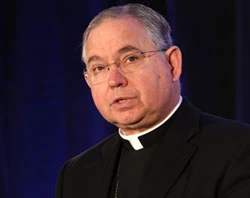
.- At a conference on U.S.-Mexico relations on March 21, Archbishop Jose H. Gomez of Los Angeles explained that the Catholic Church's social teaching can provide essential guidance on the question of immigration, and other dilemmas presented by a globalized economy.

The Mexican-born archbishop, who is also a U.S. citizen, addressed participants gathered at the Catholic University of America in Washington, D.C. for a conference on the Church's role in the immigration debate.

He encouraged audience members – including Mexico's ambassador to the U.S., Arturo Sarukhan, and the U.S. Assistant Secretary of State Eric Schwartz – to consider both the large-scale economic factors driving immigration, and the rights and needs of individuals caught up in these economic changes.

“Globalization has expanded opportunities for businesses and for workers,” Archbishop Gomez acknowledged. “But it has also created new problems in the relationships between our nations.”

“The biggest problem is that while we have developed laws and policies to govern the flow of capital and money, we have no standards for the movement of laborers.”

“Money, capital, and other resources now flow more freely between our nations,” he noted. “But human beings — the men and women who do the work — cannot.”

Archbishop Gomez also spoke frankly about the need to deal realistically and humanely with the reality of unauthorized immigration.

He emphasized that he was interested in the immigration question not primarily as a matter of politics or diplomacy, but as a spiritual and moral issue affecting millions of people.

“I am not a politician or a diplomat or an expert in the global economy,” said the archbishop. “My concern is to be faithful to the Gospel of Jesus Christ, and to defend and promote the dignity of the human person who is made in the image of God.”

He spoke eloquently of the spiritual toll that immigration often takes on those who lack opportunities in their homeland but are exploited or even hated in their new country.

“It gets harder every day to hold onto your cultural identity, your moral compass, your religion, your dignity,” he observed. “You start to believe what people say about you — that you are no good.”

Archbishop Gomez went on to propose a series of measures to address the root causes of immigration, while respecting the human needs and rights of those who have entered the U.S. illegally.

Many aspects of the problem, the archbishop said, arose from underdevelopment within Mexico – a problem that has no instantaneous solution, but demands urgent action.

“We need to find ways to target economic development,” he said, “so that far fewer Mexicans will feel compelled to leave their homes to seek jobs and money in other countries.”

Archbishop Gomez also indicated that the prosperity of nations and transnational corporations must not be placed above the good of the individuals who make such prosperity possible. He strongly urged his fellow U.S. Catholics to consider the human dignity of immigrants, even as they seek to ensure the rule of law.

“Our current policies of enforcement — detentions, and deportations — are a humanitarian tragedy,” he stated. “We are destroying families in the name of enforcing our laws.”

He pointed out that a nation's immigration laws, however important, could not be given absolute priority over the bonds of family – which precede the state itself, according to the natural law.

“Practically speaking,” he stated, “I would like to see a moratorium on new state and local immigration legislation. And, as the U.S. bishops have called for, I would like to see an end to the severe deportation policies.”

Archbishop Gomez also noted that children and women are the “most vulnerable migrants,” who “often fall prey to unscrupulous traffickers” and others seeking to exploit or harm them. He urged policymakers to consider the safety of these populations, and also to remember the needs of all immigrants who are seeking to be reunited with family members by attaining a U.S. visa.

“All of these measures,” said the archbishop, “would make a real difference in the lives of millions of people.

“But they are only temporary,” he noted. “We need to muster the political will to fix our broken immigration system.”

Vatican Enacts New Financial Reform Law


This article comes from the Chiesa website.
----------------------------------------

Vatican and Finance. The April Revolution

Full power of control for Cardinal Nicora and his sidekicks De Pasquale and Condemi. The IOR will become a bank like many others, with the same rules and restrictions, in a competitive scenario. Will it succeed in keeping its traditional clientele?

by Sandro Magister

ROME, March 21, 2011 – Starting at the beginning of April, the Holy See will return to using a sanction that had practically fallen into disuse in the practice of canon law: prison.

This penalty is provided for by law no. 127 of the state of Vatican City, promulgated last December 30, which will go into effect next April 1.  A law aimed against money laundering and the financing of terrorism.

But beyond this, the new norm will bring much more substantial novelties in the practices of the Vatican institutes that operate in the financial field, beginning with the one that most resembles a bank, the Institute for Works of Religion (IOR).

*

Until now, the IOR has enjoyed broad autonomy of action. It worked outside of the international norms that regulate, standardize, and supervise the activities of the banks in various countries.

For the depositors of the IOR, mainly dioceses and religious institutes, this autonomy was seen as an advantage. The procedures for depositing and managing money were simple and confidential, like in a family. Secrecy was guaranteed. Interest rates were higher than in other financial institutions.

This absence of external supervision enjoyed by the IOR was, however, also very attractive to less virtuous subjects, tempted to use the Vatican bank for illicit operations, using religion as a cover, disguising themselves as benefactors or exploiting the naivety of depositors.

One suspected case of wrongful use of the IOR is, for example, the one that has been under investigation by the Roman authorities since last summer. At issue are operations totaling 23 million euro, in an IOR account deposited with an Italian bank, Credito Artigiano. First Credito Artigiano itself, then the Bank of Italy which it informed, and finally the public prosecutor's office in Rome suspected that the operation was intended to launder money from illicit sources. The 23 million euro were confiscated, and the president and director general of the IOR were put under judicial investigation.

The paradox of the affair is that Ettore Gotti Tedeschi, the banker who has been head of the IOR since September 23, 2009, was called to this role by Cardinal Tarcisio Bertone, the Vatican secretary of state, precisely in order to complete the work of cleaning up and modernizing the IOR undertaken by his predecessor, Angelo Caloia, removing the last stains, real or suspected.

Evidently, the operational machinery of the IOR does not yet meet these criteria. It still continues to function, in part, according to the old logic detached from any supervision.

But this is precisely what is about to end.

*

The first act of this change goes back to December 17, 2009. It is the convention with the European Union by which the state of Vatican City took the euro as its own currency. The act required the Vatican to adhere to European norms on financial instruments and the circulation of money.

The second act is from December 30, 2010, and is precisely the execution of the commitment made one year earlier. Benedict XVI, with an apostolic letter in the form of a "motu proprio," instituted a Financial Information Authority with full powers of supervision over all the institutes and offices of the Holy See, the Roman curia, and Vatican City, including the IOR. And he imposed four laws on these institutes and offices, promulgated on the same day and intended to prevent and combat money laundering and the financing of terrorism.

These laws are similar to the ones already in effect in the "White List," meaning the states most diligent in preventing and combating financial crimes. They will go into effect in the state of Vatican City next April 1.

In the meantime, the new Financial Information Authority which will have to oversee the application of these laws has become operational, with the appointment of a president, a director, and four board members.

So all of the instruments have been provided so that the state of Vatican City may also be admitted onto the "White List" and that as a result the IOR may conform its activities to international standards and controls.

*

The president of the new Financial Information Authority is Cardinal Attilio Nicora, who also remains president of the Administration of the Patrimony of the Apostolic See, a person of proven competence in the legal and financial fields.

The four board members are Marcello Condemi, Giuseppe Dalla Torre, Claudio Bianchi, and Cesare Testa.

Of the four, the first is the key man. Condemi is a professor of banking law, has worked as an appeals attorney with the Bank of Italy, and was a member of the Italian delegation to the GAFI, the Financial Action Task Force against money laundering, which is the institution that will evaluate the Holy See's request for admission onto the "White List."

The director of the new Vatican organism is Francesco De Pasquale, appeals attorney, also a leading expert on financial irregularities.

Condemi and De Pasquale are the authors of the directory that the Bank of Italy published in 2008 on the matter, entitled "Lineamenti della disciplina internazionale di prevenzione e contrasto del riciclaggio e del finanziamento del terrorismo [Features of the international discipline on prevention and opposition of money laundering and the financing of terrorism]."

Their book was condensed in 2010 by another expert in the field, Manlio d'Agostino, in a manual of practical guidance for use by bank employees, published by the Italian Banking Association: "Antiriciclaggio. Vademecum per l'operatore [Anti-laundering Employee Handbook]."

Manlio d'Agostino is national vice-president of the Unione Cristiana Imprenditori Dirigenti and president of its youth section.

In reading his manual, one intuits that the application of international anti-laundering standards will involve a small revolution not only for the IOR, but for all Vatican administrative offices.

Every operation, in fact, even the smallest, must be subjected to very stringent controls and verifications. And the slightest suspicion of irregularity must be reported immediately to the Financial Information Authority headed by Cardinal Nicora.

This, in turn, is endowed with very broad powers, which no official secret can resist.

For the IOR, it will be the end of its autonomy. It will have in the organism headed by Nicora a permanent "tutor," which will watch over every one of its operations.

That is, what happens inside the Vatican walls will have to be the same as what happens in the countries of the "White List."

Italy is one of these. In the first six months of 2010 – the most recent available data – Italian banks sent the Guardia di Finanza 10,347 notifications of suspected money laundering operations. Another 2,622 notifications were sent from financial intermediaries, another 1,759 from post offices, and another 200 from professional offices and insurance companies.

Of this mass of notifications, the Guardia di Finanza has investigated 9,752. In 447 of these, it has identified illicit operations for 3.2 billion euro. 447 people have gone to jail.

*

Against the background of this obligatory and increased supervision in  Italian banks against suspected money laundering operations, one can perhaps reinterpret – and better understand – the departure of board member Giovanni De Censi from the supervisory board of the IOR.

De Censi is president of Credito Valtellinese, which in turn is the owner of Credito Artigiano. For the IOR, Credito Artigiano has traditionally been a friend. And yet, it was precisely a notification from Credito Artigiano that began the judicial investigation referred to above, which is now pending against the Vatican bank for suspected laundering.

The chronology of the matter is instructive.

On January 18 of 2010, the Bank of Italy asked Credito Valtellinese and its subsidiary Credito Artigiano – as it did other banks – to demand from the IOR detailed information on the ownership and movements of the accounts deposited with them.

On April 19, Credito Artigiano froze account number 49557 of the IOR, about which it evidently had suspicions that the IOR could not evade. At this date, the account held deposits of 28.3 million euro.

On September 6, with two faxes, the IOR nonetheless ordered Credito Artigiano to make two transfers with the money of that same account, for a total of 23 million.

On September 14, Credito Artigiano informed the Bank of Italy of the transfers ordered by the IOR and of the continuing absence of information about their ownership.

On September 15, the Office of Financial Information of the Bank of Italy notified Roman authorities of a possible violation of anti-laundering norms on the part of the IOR.

On September 20, the magistrature of Rome ordered the preventive confiscation of the entire sum deposited in the account of the IOR,and issued two notices of investigation against the president and director general of the Vatican bank, for omission of the procedures against money laundering.

It was gathered from this that the IOR operated, in this case, in a way different from how the Italian banks have operated since they have adhered to the stringent anti-laundering laws.

Between the traditional "friendship" with the IOR and respect for national and international rules, for Credito Artigiano the choice was obligatory.

Since last summer, De Censi – who has a Salesian brother, Ugo, a missionary in Peru – has not taken part anymore in the board meetings in supervision of the IOR. It was said that this was for health reasons, and it was true. But maybe not only for these.

Today, in fact, De Censi has resumed his activity in full, which includes being president of the Istituto Centrale delle Banche Popolari. In this garb, he has given two extensive interviews, on February 18 and 23, with "Avvenire" and "Corriere della Sera."

To the question about way he left the IOR, he replied:

"My mandate expired on December 31. I have been operated on, triple bypass, and someone, certainly with reason, believed it was opportune for me to rest."

The fact is that in the 2011 edition of the Annuario Pontificoio, released at the beginning of this month of March, De Censi is no longer listed on the supervisory board of the IOR. In his place is Antonio Maria Marocco, 77, from Turin, a notary by profession, administrative board member and president of the supervisory body of Unicredit, one of the biggest Italian banking groups.

*

Last January 15, in the inauguration address of the judicial year, the promoter of justice of the tribunal of the state of Vatican City, Nicola Picardi, dedicated ample space to the new Financial Information Authority headed by Cardinal Nicora.

"It constitutes the hinge of the entire normative framework" against money laundering issued by the Holy See at the end of 2010, he said. "It is invested with very broad powers, including that of conducting verifications and checks on the cash entering or leaving the state." And it will work "in close collaboration with the Vatican judicial authority."

Saturday, January 22, 2011

Vatican Bank Chief Issues Economic Warning


about US, European economic policies

.- Current fiscal and monetary policies in the United States and Europe risk increasing government control over national economies, resulting in weakened political strength throughout “the whole of the western world,” the Vatican’s top banking expert said.

Ettore Gotti Tedeschi has been head of the Vatican's bank, known as the Institute for Religious Works, since 2009. He has a long career in finance, having served as the head of Banco Santander, the largest private bank in Europe, as well as on the boards of some of the continent’s leading financial institutions.

He is known as a staunch capitalist with a deep concern for the Church’s social teaching. He is also a former professor of financial ethics at the Catholic University of Milan.

Writing in the Jan. 14 edition of the Vatican newspaper, L’Osservatore Romano, Tedeschi warned of the growing influence of “Keynesian” economic theory on both sides of the Atlantic.

John Maynard Keynes was a prominent 20th-century economist whose theories were widely embraced by world powers to jump-start their economies after World War II.

Tedeschi cited a 2009 book, "Where Keynes Went Wrong: And Why World Governments keep creating Inflation, Bubbles and Busts," by the American economist and philosopher Hunter Lewis.

He said Lewis had spelled out the "doctrinal errors and practical disasters" of Keynes' theories.
In simple terms, Keynes taught that in times of economic crisis, consumer demand must be stimulated by government investment and an "attitude of saving" must be discouraged,

Tedeschi wrote.

He said Keynes' crisis-averting tactics can be seen in the U.S., where government economic policy has focused on increasing public expenditures – and public debt – in order to stimulate private economic activity, including consumer demand and employment.

In addition, also following Keynesian wisdom, the U.S. is printing more money and has looked at increasing taxes in an effort to generate more public revenues.

Tedeschi warned that these policies are leading to a "nationalization" of private debt in the U.S. He also criticized the government bailouts of private banks that offered too much credit without adequate guarantees. This too is leading to increased government control of the economy in the U.S. — a “nationalization” that is being paid for with newly printed currency.

In Europe, he said, the issue is the opposite. Because of the lack of widespread private debt, a "privatization" effort is being enacted to absorb the large public debt of banks and businesses.

This also is Keynesian policy, which "perseveres against the scorned savings," Tedeschi said.
Governments on both sides of the Atlantic, he said, are committed to Keynes' policy of increasing public debt to sustain levels of economic production, consumption, and employment.

He said artificially low interest rates are another key to the strategy of increasing spending and discouraging saving. With no incentive to keep money in the bank, those who would have otherwise been savers are pushed to spend.

"Zero interest rates factually equal a de facto transfer of wealth from he who was a virtuous saver (although not for Keynes) to he who has become virtuously (for Keynes) indebted," he said.

"Practically, it's about a hidden tax on poor savers, a tax transferred to the wealthy, (that is), over-indebted states, business people and bankers.”

Although the alternative to zero interest in such a situation is economic collapse and eventual default, the zero-rates "are not sustainable and are dangerous," Tedeschi warned.

"They destroy savings, which is an essential resource to create the base for bank credit; they promote speculation on real estate and securities, create illusory artificial values rather than scaling them down; they push consumption to more risky debt; they alter the market with artificial values and thus lead to belief that the very markets do not know how to correct themselves."

The biggest danger, Tedeschi said, is that zero interest rates "permit, or impose governments into management of the economy, without correcting inefficiency and facilitating distortions in the competition."

He warned that the greatest economic impacts may be on the way.

In the future, he said, inflation might be used as the "maneuver" to absorb the enormous debt in both the U.S. and Europe. Debt levels are now three times as large as the gross domestic product in most countries, he observed. Governments have thus far been able to control inflation by controlling consumption rates.

"Someone," he said, "is hoping for new taxes to sustain a new statism that reinforces a rather weak political class in the whole western world."

Friday, January 14, 2011

Vatican Reshapes Socialist Vocabulary for American Audience


The Vatican is committed to promoting Catholic socialism all over the world.  Despite the affirmations of Cardinal Turkson, the Catholic socialism is indeed a form of socialism not very different from other forms.  The only difference is that the Roman Catholic Church holds the nucleus of power as opposed to some politburo or party apparatus.

I encourage my readers to look closely at Benedict XVI's most recent encyclical, Caritas in Veritate, and discern exactly what kind of political and economic world system he preaches. 

This article comes from the Catholic News Agency.
---------------------------------


Vatican official: Church’s justice teachings need new 'vocabulary' for some US audiences
.- When he travels to the United States next month, Cardinal Peter Kodwo Appiah Turkson is aware that he may have to make some adjustments in the way he talks about the Church’s social teaching.

As president of the Pontifical Council for Justice and Peace, the Ghanaian cardinal, 62, is charged with making the Church’s social teaching more widely known and practiced around the world.

He will be in Washington to deliver the plenary address of the 2011 Catholic Social Ministry Gathering, Feb. 13-16. The gathering, on the theme of “Protecting Human Life and Dignity: Promoting a Just Economy,” is sponsored by 19 Catholic organizations, including the U.S. Catholic bishops.

In a recent interview with CNA, Cardinal Turkson said he has learned from past experience that the Church’s justice and peace terminology often needs clarification for an American Catholic audience. Key terms used by the Vatican — such as “social justice” and “gift” — are not always understood the way the Vatican intends, he said.

"We found out that some of the vocabulary which is just taken for granted and used freely may not always have the same sense or may have had some nuances which sometimes are missed because of the way the terms are used in the American political context,” Cardinal Turkson said in a Jan. 12 interview at the council’s offices in Rome.

Pope Benedict XVI appointed Cardinal Turkson to his post in Oct. 2009, just months after the Pope released his blueprint for the Church’s social teaching, “Caritas in Veritate” (Charity in Truth). The council has since made promotion of the Pope’s vision a top priority.

The encyclical outlines Pope Benedict’s plan for "integral human development" in economics, society and politics through the principles of charity and truth.

Cardinal Turkson said the Vatican is pleased by response to the document. But he said reaction from some sections of the audience in the United States was unexpected.

The council has been surprised to find that common terms were misunderstood or misinterpreted. He emphasized that the misunderstanding was not a general or widespread problem among American Catholics. But, he said, "in certain circles ... there is a difficulty."

For instance, the Pope's teaching on themes of "social justice" have been mistakenly connected to "socialism" and "communism." As a result, he indicated, the Pope is mistakenly seen as promoting socialist or big-government solutions to social problems.

The council has also learned that words like "social" and "solidarity" may have been dismissed by American readers for their perceived connection with communist regimes such as the Soviet Union, he said.

Cardinal Turkson explained that in the Church’s thinking, social justice involves citizens’ obligations and responsibilities to ensure fairness and opportunity in their communities and societies.

While this may include the adoption of specific government policies and programs, the emphasis in Catholic social teaching is on the obligations that flow from citizens' relationships in societies.

"Respecting, understanding and fulfilling those demands constitute our justice," he said. "It would be useful if we just observed our sense of justice as our ability to fulfill the demands of the relationships in which we stand."

This is in contrast to socialism, he explained, which is an ideology in which private property and private interests are totally placed in the service of government policies.

What the Pope proposes in “Caritas in Veritate,” said Cardinal Turkson, is "achieving the common good without sacrificing personal, private interests, aspirations and desires."

Cardinal Turkson said the Council was also surprised that the Pope’s concept of the “gift,” was perceived in some circles as encouraging government welfare handouts.

In "Caritas in Veritate," Pope Benedict described the concept of “gift” as a way to understand God’s love for men and women in his gift of life and his gift of Jesus.

"Truth is the light that gives meaning and value to charity," the Pope wrote. "That light is both the light of reason and the light of faith, through which the intellect attains to the natural and supernatural truth of charity: it grasps its meaning as gift, acceptance, and communion."

Gift, Cardinal Turkson explained, is "a very basic, deep theological expression of God's relation or the motivation for whatever God does in the world, and it's not quite the same as a handout."

"If we ever need to talk about this in a society where the sense of gift is that of a handout ... it doesn't quite express the sense of gift in this regard," he added.

While it is too late to add any explanations to the encyclical, the Council might tailor its language differently in future documents.

"We just realized that probably in the future, when ... this dicastery takes up the task of diffusing, presenting and talking about this it might be necessary to provide a footnote in which some of these expressions can be given an awareness of the different senses of expressions in different cultures and settings,” he said. We thought something like that would be useful and helpful to the readers."

Cardinal Turkson urged American Catholics and government and economic leaders to give a conscientious reading of "Caritas in Veritate."

The encyclical, he said, invites us "to go back or to remind about the centrality of the human person, his well being, his common good within everything that we do.”

Another important message, Cardinal Turkson said, is that “we must not sacrifice the good of the human person for anything that we aspire after or want to do with technology, business, economics or whatever."

The key to an authentically human vision of development is to consider the full ethical character of the individual in all decisions, he said.

"In details," he concluded, "it may be for food security and shelter for all persons, but at the end of the day we are looking at whether things that we are doing in the world as government, as a Church and all of that help advance the good of the individual person."

Tuesday, January 11, 2011

Papal Address to the Diplomatic Corps


This speech comes from the official Vatican website.
-----------------------------------------

ADDRESS OF HIS HOLINESS POPE BENEDICT XVI
TO THE MEMBERS OF THE DIPLOMATIC CORPS
Regia Hall
Monday, 10 January 2011


Your Excellencies,
Ladies and Gentlemen,

I am pleased to welcome you, the distinguished representatives of so many countries, to this meeting which each year assembles you around the Successor of Peter. It is a deeply significant meeting, since it is a sign and illustration of the place of the Church and of the Holy See in the international community. I offer my greetings and cordial good wishes to each of you, and particularly to those who have come for the first time. I am grateful to you for the commitment and interest with which, in the exercise of your demanding responsibilities, you follow my activities, those of the Roman Curia and thus, in some sense, the life of the Catholic Church throughout the world. Your Dean, Ambassador Alejandro Valladares Lanza, has interpreted your sentiments and I thank him for the good wishes which he has expressed to me in the name of all. Knowing how close-knit your community is, I am certain that today you are also thinking of the Ambassador of the Kingdom of the Netherlands, Baroness van Lynden-Leijten, who several weeks ago returned to the house of the Father. I prayerfully share your sentiments.

As a new year begins, our own hearts and the entire world continue to echo the joyful message proclaimed twenty centuries ago in the night of Bethlehem, a night which symbolizes humanity’s deep need for light, love and peace. To the men and women of that time, as to those of our own day, the heavenly hosts brought the good news of the coming of the Saviour: “The people who walked in darkness have seen a great light; those who dwelt in a land of deep darkness, on them has light shined” (Is 9:1). The mystery of the Son of God who became the son of man truly surpasses all human expectations. In its absolute gratuitousness this saving event is the authentic and full response to the deep desire of every heart. The truth, goodness, happiness and abundant life which each man and woman consciously or unconsciously seeks are given to us by God. In longing for these gifts, each person is seeking his Creator, for “God alone responds to the yearning present in the heart of every man and woman” (Post-Synodal Apostolic Exhortation Verbum Domini, 23). Humanity throughout history, in its beliefs and rituals, demonstrates a constant search for God and “these forms of religious expression are so universal that one may well call man a religious being” (Catechism of the Catholic Church, 28). The religious dimension is an undeniable and irrepressible feature of man’s being and acting, the measure of the fulfilment of his destiny and of the building up of the community to which he belongs. Consequently, when the individual himself or those around him neglect or deny this fundamental dimension, imbalances and conflicts arise at all levels, both personal and interpersonal.

This primary and basic truth is the reason why, in this year’s Message for World Day of Peace, I identified religious freedom as the fundamental path to peace. Peace is built and preserved only when human beings can freely seek and serve God in their hearts, in their lives and in their relationships with others.

Ladies and Gentlemen, your presence on this solemn occasion is an invitation to survey the countries which you represent and the entire world. In this panorama do we not find numerous situations in which, sadly, the right to religious freedom is violated or denied? It is indeed the first of human rights, not only because it was historically the first to be recognized but also because it touches the constitutive dimension of man, his relation with his Creator. Yet is this fundamental human right not all too often called into question or violated? It seems to me that society, its leaders and public opinion are becoming more and more aware, even if not always in a clear way, of this grave attack on the dignity and freedom of homo religiosus, which I have sought on numerous occasions to draw to the attention of all.

I did so during the past year in my Apostolic Journeys to Malta, Portugal, Cyprus, the United Kingdom and Spain. Above and beyond the diversity of those countries, I recall with gratitude their warm welcome. The Special Assembly for the Middle East of the Synod of Bishops, which took place in the Vatican in October, was a moment of prayer and reflection in which our thoughts turned insistently to the Christian communities in that part of the world which suffer greatly because of their fidelity to Christ and the Church.

Looking to the East, the attacks which brought death, grief and dismay among the Christians of Iraq, even to the point of inducing them to leave the land where their families have lived for centuries, has troubled us deeply. To the authorities of that country and to the Muslim religious leaders I renew my heartfelt appeal that their Christian fellow-citizens be able to live in security, continuing to contribute to the society in which they are fully members. In Egypt too, in Alexandria, terrorism brutally struck Christians as they prayed in church. This succession of attacks is yet another sign of the urgent need for the governments of the region to adopt, in spite of difficulties and dangers, effective measures for the protection of religious minorities. Need we repeat it? In the Middle East, Christians are original and authentic citizens who are loyal to their fatherland and assume their duties toward their country. It is natural that they should enjoy all the rights of citizenship, freedom of conscience, freedom of worship and freedom in education, teaching and the use of the mass media” (Message to the People of God of the Special Assembly for the Middle East of the Synod of Bishops, 10). I appreciate the concern for the rights of the most vulnerable and the political farsightedness which some countries in Europe have demonstrated in recent days by their call for a concerted response on the part of the European Union for the defence of Christians in the Middle East. Finally, I would like to state once again that the right to religious freedom is not fully respected when only freedom of worship is guaranteed, and that with restrictions. Furthermore, I encourage the accompaniment of the full safeguarding of religious freedom and other humans rights by programmes which, beginning in primary school and within the context of religious instruction, will educate everyone to respect their brothers and sisters in humanity. Regarding the states of the Arabian Peninsula, where numerous Christian immigrant workers live, I hope that the Catholic Church will be able to establish suitable pastoral structures.

Among the norms prejudicing the right of persons to religious freedom, particular mention must be made of the law against blasphemy in Pakistan: I once more encourage the leaders of that country to take the necessary steps to abrogate that law, all the more so because it is clear that it serves as a pretext for acts of injustice and violence against religious minorities. The tragic murder of the governor of Punjab shows the urgent need to make progress in this direction: the worship of God furthers fraternity and love, not hatred and division. Other troubling situations, at times accompanied by acts of violence, can be mentioned in south and south-east Asia, in countries which for that matter have a tradition of peaceful social relations. The particular influence of a given religion in a nation ought never to mean that citizens of another religion can be subject to discrimination in social life or, even worse, that violence against them can be tolerated. In this regard, it is important for interreligious dialogue to favour a common commitment to recognizing and promoting the religious freedom of each person and community. And, as I remarked earlier, violence against Christians does not spare Africa. Attacks on places of worship in Nigeria during the very celebrations marking the birth of Christ are another sad proof of this.

In a number of countries, on the other hand, a constitutionally recognized right to religious freedom exists, yet the life of religious communities is in fact made difficult and at times even dangerous (cf. Dignitatis Humanae, 15) because the legal or social order is inspired by philosophical and political systems which call for strict control, if not a monopoly, of the state over society. Such inconsistencies must end, so that believers will not find themselves torn between fidelity to God and loyalty to their country. I ask in particular that Catholic communities be everywhere guaranteed full autonomy of organization and the freedom to carry out their mission, in conformity with international norms and standards in this sphere.

My thoughts turn once again to the Catholic community of mainland China and its pastors, who are experiencing a time of difficulty and trial. I would also like to offer a word of encouragement to the authorities of Cuba, a country which in 2010 celebrated seventy-five years of uninterrupted diplomatic relations with the Holy See, that the dialogue happily begun with the Church may be reinforced and expanded.

Turning our gaze from East to West, we find ourselves faced with other kinds of threats to the full exercise of religious freedom. I think in the first place of countries which accord great importance to pluralism and tolerance, but where religion is increasingly being marginalized. There is a tendency to consider religion, all religion, as something insignificant, alien or even destabilizing to modern society, and to attempt by different means to prevent it from having any influence on the life of society. Christians are even required at times to act in the exercise of their profession with no reference to their religious and moral convictions, and even in opposition to them, as for example where laws are enforced limiting the right to conscientious objection on the part of health care or legal professionals.

In this context, one can only be gratified by the adoption by the Council of Europe last October of a resolution protecting the right to conscientious objection on the part of medical personnel vis-à-vis certain acts which gravely violate the right to life, such as abortion.

Another sign of the marginalization of religion, and of Christianity in particular, is the banning of religious feasts and symbols from civic life under the guise of respect for the members of other religions or those who are not believers. By acting in this way, not only is the right of believers to the public expression of their faith restricted, but an attack is made on the cultural roots which nourish the profound identity and social cohesion of many nations. Last year, a number of European countries supported the appeal lodged by the Italian government in the well-known case involving the display of the crucifix in public places. I am grateful to the authorities of those nations, as well as to all those who became involved in the issue, episcopates, civil and religious organizations and associations, particularly the Patriarchate of Moscow and the other representatives of the Orthodox hierarchy, as well as to all those – believers and non-believers alike – who wished to show their sympathy for this symbol, which bespeaks universal values.

Acknowledging religious freedom also means ensuring that religious communities can operate freely in society through initiatives in the social, charitable or educational sectors. Throughout the world, one can see the fruitful work accomplished by the Catholic Church in these areas. It is troubling that this service which religious communities render to society as a whole, particularly through the education of young people, is compromised or hampered by legislative proposals which risk creating a sort of state monopoly in the schools; this can be seen, for example, in certain countries in Latin America. Now that many of those countries are celebrating the second centenary of their independence – a fitting time for remembering the contribution made by the Catholic Church to the development of their national identity – I exhort all governments to promote educational systems respectful of the primordial right of families to make decisions about the education of their children, systems inspired by the principle of subsidiarity which is basic to the organization of a just society.

Continuing my reflection, I cannot remain silent about another attack on the religious freedom of families in certain European countries which mandate obligatory participation in courses of sexual or civic education which allegedly convey a neutral conception of the person and of life, yet in fact reflect an anthropology opposed to faith and to right reason.

Ladies and Gentlemen, on this solemn occasion, allow me to state clearly several principles which inspire the Holy See, together with the whole Catholic Church, in its activity within the intergovernmental International Organizations for the promotion of full respect for the religious freedom of all. First, the conviction that one cannot create a sort of scale of degrees of religious intolerance. Unfortunately, such an attitude is frequently found, and it is precisely acts of discrimination against Christians which are considered less grave and less worthy of attention on the part of governments and public opinion. At the same time, there is a need to reject the dangerous notion of a conflict between the right to religious freedom and other human rights, thus disregarding or denying the central role of respect for religious freedom in the defence and protection of fundamental human dignity. Even less justifiable are attempts to counter the right of religious freedom with other alleged new rights which, while actively promoted by certain sectors of society and inserted in national legislation or in international directives, are nonetheless merely the expression of selfish desires lacking a foundation in authentic human nature. Finally, it seems unnecessary to point out that an abstract proclamation of religious freedom is insufficient: this fundamental rule of social life must find application and respect at every level and in all areas; otherwise, despite correct affirmations of principle, there is a risk that deep injustice will be done to citizens wishing to profess and freely practise their faith.

Promoting the full religious freedom of Catholic communities is also the aim of the Holy See in signing Concordats and other agreements. I am gratified that states in different parts of the world, and of different religious, cultural and juridical traditions, choose international conventions as a means of organizing relations between the political community and the Catholic Church, thus establishing through dialogue a framework of cooperation and respect for reciprocal areas of competence. Last year witnessed the signing and implementation of an Agreement for the religious assistance of the Catholic faithful in the armed forces in Bosnia and Herzegovina, and negotiations are presently under way with different countries. We trust that they will have a positive outcome, ensuring solutions respectful of the nature and freedom of the Church for the good of society as a whole.

The activity of the Papal Representatives accredited to states and international organizations is likewise at the service of religious freedom. I would like to point out with satisfaction that the Vietnamese authorities have accepted my appointment of a Representative who will express the solicitude of the Successor of Peter by visiting the beloved Catholic community of that country. I would also like to mention that in the past year the diplomatic presence of the Holy See was expanded in Africa, since a stable presence is now assured in three countries without a resident Nuncio. God willing, I will once more travel to that continent, to Benin next November, in order to consign the Apostolic Exhortation which will gather the fruits of the labours of the second Special Assembly for Africa of the Synod of Bishops.

Before this distinguished assembly, I would like once more to state forcefully that religion does not represent a problem for society, that it is not a source of discord or conflict. I would repeat that the Church seeks no privileges, nor does she seek to intervene in areas unrelated to her mission, but simply to exercise the latter with freedom. I invite everyone to acknowledge the great lesson of history: “How can anyone deny the contribution of the world’s great religions to the development of civilization? The sincere search for God has led to greater respect for human dignity. Christian communities, with their patrimony of values and principles, have contributed much to making individuals and peoples aware of their identity and their dignity, the establishment of democratic institutions and the recognition of human rights and their corresponding duties. Today too, in an increasingly globalized society, Christians are called, not only through their responsible involvement in civic, economic and political life but also through the witness of their charity and faith, to offer a valuable contribution to the laborious and stimulating pursuit of justice, integral human development and the right ordering of human affairs” (Message for the Celebration of World Peace Day, 1 January 2011, 7).

A clear example of this was Blessed Mother Teresa of Calcutta: the centenary of her birth was celebrated at Tirana, Skopje and Pristina as well as in India, and a moving homage was paid to her not only by the Church but also by civil authorities and religious leaders, to say nothing of people of all religions. People like her show the world the extent to which the commitment born of faith is beneficial to society as a whole.

May no human society willingly deprive itself of the essential contribution of religious persons and communities! As the Second Vatican Council recalled, by guaranteeing just religious freedom fully and to all, society can “enjoy the benefits of justice and peace which result from faithfulness to God and his holy will” (Declaration Dignitatis Humanae, 6).

For this reason, as we exchange good wishes for a new year rich in concord and genuine progress, I exhort everyone, political and religious leaders and persons of every walk of life, to set out with determination on the path leading to authentic and lasting peace, a path which passes through respect for the right to religious freedom in all its fullness.

On this commitment, whose accomplishment calls for the involvement of the whole human family, I invoke the blessing of Almighty God, who has reconciled us with himself and with one another through his Son Jesus Christ our peace (Eph 2:14).

A Happy New Year to all!

Venezuelan Bishop Criticizes Gov't Land Takings


Thus continues the Vatican's confrontational policy with President Hugo Chavez.  It is almost certain that the United States is supporting this policy behind the scenes.

This article comes from Catholic News Agency.
---------------------------

Venezuelan cardinal: Government land seizure become serious issue

.- Cardinal Jorge Urosa Savino of Caracas, Venezuela warned that some of the government's recent land seizures have not followed procedures outlined in the country's Constitution.

“While it is true that the government has the power to confiscate, it must do so by following the procedures established in the Constitution,” the cardinal said after Mass for the World Day of Peace on Jan. 9. He noted that “this is not happening in some cases.”

Cardinal Urosa acknowledged that there is a great demand for more housing in the country, but that the need – which sharply increased due to the recent flooding – “is not going to be resolved in six months.” 

“The interests and rights of all people must be reconciled, and the government should do so justly,” the cardinal asserted.

New excuse?

In the past week, the Venezuelan government has confiscated numerous buildings and plots claiming they will be used for the construction of homes for those affected by the flooding. However, Rafael Alfonzo, a leading financial analyst, called the move a “new excuse” by Hugo Chavez to take over private lands. Chavez alleged that the measures are necessary to protect the food supply, to “rescue” lands from plantation owners, and to prevent monopolies and market speculation.

The Observatory of Property Rights in Venezuela reported that between 2005 and 2010, some 1,729 violations of private property by the government took place, and that during the last year there were 535 cases of confiscation.  The most controversial one involved 2.2 acres of land belonging to the Antimano child nutrition center.  Chavez said the center would now be known as the “Amatina Socialist Community.” 

On his television program “Alo Presidente” on Jan. 9, Chavez ordered the confiscation of land to “accelerate all over the country, especially south of Maracaibo Lake,” where land belonging to the El Delirio and Dinamarca ranches was recently confiscated.

Tuesday, January 4, 2011

Cuban Economic Reforms Get Vatican Nod


This article comes from SAPA.
-----------------------------------------------

Cuba's economic reforms get Catholic nod

After decades of roller-coaster relations between communist Cuba's government and the Roman Catholic church, Havana on Sunday won the Catholic hierarchy's warm approval of its limited economic reform plans. 

Cardinal Jaime Ortega said in a New Year's mass at Havana cathedral that the government reforms “involve all of us” and require “understanding from the people” whom he called on to size up the changes critically. 

The local church is arguably the most influential non-state actor in Cuba. But its influence is more with the government than the people.

In a Caribbean country of more than 11 million, most Cubans do not identify themselves as believers or go to church.

Ortega offered up a prayer “for the successful implementation of this process of renewal for the good of all the people.”

The cardinal's encouraging tone reflected a growing rapprochement between church and state in Cuba since a landmark 1998 visit by pope John Paul II and his call for Cuba to “open itself to the world.”

President Raul Castro, 79, argues that Cuba's economic model, which has survived two decades since the Soviet Union dissolved, must be “updated” urgently without copying other countries, and without what he sees as “capitalism.”

His proposed reforms are up for debate in April at the Cuban Communist Party Congress, the first since 1997.

The reforms, which include eventually cutting more than a million government jobs, represent a major management shakeup for the communist island.

They encourage some new foreign investment, call for more private self-employment and a reduced government role in the market.

The proposals make efficiency a vital part of economic management, aim to do away with state subsidies, including food rations, and foresee starting a tax system.

But the government still would control the lion's share of the economy. Cubans only earn 17 dollars a month on average, most are state employees and most spend hours a day trying to figure out how to put food on the table.

Ortega also has acted as a de facto mediator in the government's release of some of its political prisoners.

The government, officially atheist until 1992, finds itself under mounting pressure to meet its promises to free more.

In early December, female relatives of jailed political dissidents held an unprecedented protest outside Cuban jails, angry that the government has not met its pledge to do so.

Dissident sources say around 100 political prisoners remain in Cuban prisons. - Sapa-AFP

Friday, December 31, 2010

Pope Sets Up Financial Oversight for Vatican


This article comes from the Catholic News Service.
--------------------------------------


Pope signs new measures to guarantee financial transparency in Vatican

By John Thavis
Catholic News Service

VATICAN CITY (CNS) -- Pope Benedict XVI has instituted a new agency to monitor all Vatican financial operations and make sure they meet international norms against money-laundering and the financing of terrorism.

The pope issued an apostolic letter Dec. 30 that established the Financial Information Authority as an independent agency to oversee the monetary and commercial activities of all Vatican-related institutions, including the Vatican bank.

At the same time, the Vatican promulgated a detailed new law that defined financial crimes and established penalties -- including possible jail time -- for their violation. The list of transgressions includes corruption, market manipulation, fraud and virtually any activity that facilitates or provides funding to acts of terrorism. The new law, which reflects the latest European Union regulations, takes effect April 1.

The pope's brief apostolic letter said the Vatican fully supported the international community's efforts to coordinate a response to financial crimes, which often involve more than one country.

"In our age of increasing globalization, peace is unfortunately threatened by many factors, including an improper use of the market and the economy, and the terrible and destructive violence perpetrated by terrorism, which causes death, suffering, hatred and social instability," the pope said.

The creation of such an oversight agency is unprecedented at the Vatican, where several departments have operated with some degree of financial independence for decades or centuries.

The Vatican spokesman, Jesuit Father Federico Lombardi, described the move as a courageous step that reflects the moral requirement of "transparency, honesty and responsibility" in the Vatican's operations.

"Vatican organizations will be less vulnerable in the face of the continuous risks that inevitably arise in the handling of money. Those errors which so quickly become the cause of 'scandal' for public opinion and the faithful will be avoided," Father Lombardi said.

"In the final analysis, the church will be more credible before the members of the international community, and this is of vital importance for her evangelical mission," he said.

The move came several months after Italian treasury police, in a money-laundering probe, seized 23 million euros (US$30 million) that the Vatican bank had deposited in a Rome bank account. The Vatican criticized the confiscation, saying the deposit was legitimate and that the Vatican bank was committed to "full transparency" in its operations.

The Vatican has been working for some time with Italian and international authorities to comply with procedures that ensure funds are not used for terrorism or money-laundering. The new documents represent the fruit of those efforts.

In addition, the Vatican announced three new laws aimed at curbing counterfeiting of euros and currency fraud.

The Financial Information Authority will operate with full autonomy and monitor all Vatican agencies that have financial dealings or commercial transactions. That includes major institutions like the Vatican City State, the Vatican bank, the Vatican's investment agency (APSA) and the Congregation for the Evangelization of Peoples, and smaller agencies like the Vatican pharmacy, supermarket and the Vatican Museums.

The authority will be headed by a president and a council of four other people, all appointed by the pope. The president will name a director and additional staff. The appointments were expected to be announced in early 2011.

In addition to investigating reports of suspicious activity, the authority is obligated to examine any new business relationships by Vatican agencies and any single transaction involving more than 15,000 euros ($20,000). The authority has access to all financial and administrative records of the agencies; Vatican officials and employees are required to furnish all such information, an exception to the normal rules of secrecy in Vatican institutions.

All Vatican agencies are now required to verify the standing of any potential business partners, keep detailed records of all transactions and report any suspicious transactions. Anyone entering or leaving Vatican City with 10,000 euros or more in cash must now declare it in writing.

If the Financial Information Authority investigates and discovers evidence of financial impropriety, it is to report its findings to the Vatican's judicial system for prosecution. If a conviction results in a prison sentence, it would presumably be served in Italy, in accordance with an agreement between the Vatican and the Italian government.

The Vatican bank handles accounts of religious orders and other Catholic institutions. It was involved in a major Italian banking scandal in the 1980s, when fraud led to the collapse of Italy's Banco Ambrosiano. Although denying wrongdoing, Vatican bank officials made what they called a "good-will payment" of about $240 million to the failed bank's creditors.

Thursday, December 23, 2010

China Fires Back at the Vatican

 
This article comes from AFP.
----------------------------------------

China says Vatican criticism 'imprudent', 'dangerous'
 

BEIJING — China on Wednesday fired a fierce broadside at the Vatican, slamming its criticism of the country's state-sanctioned Catholic church, which is not recognised by the pope, as "imprudent" and "dangerous".

The comments from China's State Administration for Religious Affairs came after the Vatican accused Beijing of "unacceptable and hostile acts", following a high-level meeting earlier this month of state-approved bishops.

"The Vatican's behaviour is very imprudent and ungrounded," a spokesman for the administration said in a statement, adding the remarks from the Holy See constituted an "attack on religious freedom in China".

"The Vatican's position is well-known. It works to promote political ideas under the pretext of religious belief, which is very dangerous and will seriously harm the healthy development of Chinese Catholicism in China."

The Chinese bishops elected a new chairman -- Bishop Fang Xingyao -- of the Chinese Patriotic Catholic Association, which controls the state-backed church, as well as a new leader of the council of Chinese bishops.

The Holy See had also criticised the ordination last month of a priest in the northern Chinese city of Chengde, which it had not approved.

Last week, the Vatican said in a statement that both incidents had "unilaterally damaged the dialogue and climate of trust that had been established" between the Holy See and China.

The Vatican said the meeting had been "imposed on numerous bishops, priests, religious and lay faithful," describing China's "persistent desire to control the most intimate area of citizens' lives" as "a sign of fear and weakness."

While the Holy See reaffirmed its "own wish to dialogue honestly," it said the meeting was a sign of the state church's "intransigent intolerance" and condemned the "grave violation of the human rights" of those forced to attend.

The state religious body fired back on Wednesday that the Vatican's statement was a "brutal trampling of and contempt for" the will of the Chinese Catholic church.

"Chinese citizens enjoy freedom of religion and at the same time, religious organisations should not be influenced by foreign forces," it said.

The Chinese Patriotic Chinese Association does not acknowledge the authority of Pope Benedict XVI and is fiercely opposed to clergy in China who are loyal to the Vatican.

"China's Catholics have the right to elect their own bishops. The Vatican does not understand China's situation," the association's vice-president Liu Bainian told AFP at the conclusion of its bishops' meeting earlier this month.

The Vatican and China have not had formal diplomatic ties since 1951, when the Holy See angered Mao Zedong's Communist government by recognising the Nationalist Chinese regime as the legitimate government of China.

The Nationalists fled to Taiwan after losing a civil war with the Communists in 1949. As such, the Vatican is one of the few states that recognises the island, which Beijing considers part of its own territory.

The State Administration for Religious Affairs said China had acted with the "utmost sincerity" in talks in recent years to improve relations with the Holy See, but blamed "some people at the Vatican" for disrupting those negotiations.

Official tallies put the number of Catholics in China at 5.7 million, including members of both the unofficial and official churches.

Human rights groups say that those who remain loyal to the Vatican often suffer persecution, with detentions of bishops common.

Tuesday, December 21, 2010

Pope Calls for Universal Brotherhood


This article comes from Zenit.

------------------------------------------


Globalization Can't Make Us Brothers, Says Pope
Addresses Ambassadors on Value of Fraternity

VATICAN CITY, DEC. 20, 2010 (Zenit.org) - Though the process of globalization brings human beings closer to one another, it cannot make them brothers, says Benedict XVI.

The Pope made this observation on Thursday when he received letters of credence from the new ambassadors to the Holy See of Nepal, Zambia, Andorra, the Seychelles and Mali.

The Holy Father noted how the international community responds to natural disasters, such as the earthquake in Haiti. This is aid, he said, that "it would be appropriate to continue and to intensify."

Still, he continued, the "beautiful ideal of fraternity [...] has found in the development of philosophical and political thought less resonance compared with other ideals such as liberty, equality, progress and unity. It is a principle that to a large extent has remained a dead letter in modern and contemporary political societies."

For Christians, the Pontiff said, fraternity has a particular meaning, due to God's design of fraternal love revealed by Christ.

"To live worthily, every human being needs respect: he also needs justice to be done, and his rights recognized in a concrete way," Benedict XVI told the ambassadors. "However, this is not enough to lead a fully human life: in fact, a person also has need of fraternity. This is true not only in close relations but also on a global scale.

"However, although the process of globalization under way brings human beings closer to one another, it does not, because of this, make them brothers. It is an important problem because, as my predecessor Pope Paul VI revealed, 'underdevelopment has as its profound cause the lack of fraternity.'"

A gift 

The Pope noted how reason alone is capable of recognizing men as equal, "but it is incapable of instituting fraternity."

"This," he explained, "is a supernatural gift." 


"For her part, the Church sees the realization of human fraternity on earth as a vocation contained in God's creative plan, who wishes that she be ever more faithfully the maker of that fraternity, both in the universal ambit and well as the local ambits," the Holy Father stated.

The Church's concern, he said, is not just for "her disciples," but for all people.

The Church "makes an effort to put love and peace at the base of the many human bonds that relate persons among themselves, as God has willed in his creative wisdom," the Pontiff affirmed.

Gratitude and respect 

Benedict XVI proposed that fraternity finds a "concrete expression in gratitude and respect." This should be manifested even in economics, he added, "one of the areas of greatest cooperation between men." 

The Pope continued: "Every form of gift is, in a word, a sign of the presence of God, because it leads to the fundamental discovery that, at the origin, everything is given. Such an awareness does not make man's conquests less beautiful, but liberates him from the first of all slaveries, that of wishing to create himself.

"On the contrary, in acknowledging what he is given, man can open himself to the action of grace and understand that he is called to develop himself, not against others or at their expense, but with them and in communion with them."

Fraternity, in fact, is "an end in itself," the Holy Father said. "The Church believes in Christ who reveals to us that God is love. She is also convinced that to all those who believe in divine charity, God gives the certainty that 'the way of love is open to all men and that the effort directed to establishing a universal fraternity is not in vain.'"

Tuesday, December 14, 2010

Vatican Bank Let Clergy Act as Front for Mafia


This article comes from The Independent.
----------------------------------------------

Vatican Bank 'allowed clergy to act as front for Mafia'

Victor Simpson

The Vatican Bank is under new scrutiny in a case involving money-laundering allegations that led police to seize €23m (£19.25m) in September.

The Vatican calls the seizure of assets a "misunderstanding" and expresses optimism it will be quickly cleared up. But fresh court documents show that prosecutors say the Vatican Bank deliberately flouted anti-laundering laws "with the aim of hiding the ownership, destination and origin of the capital". The documents also reveal investigators' suspicions that clergy may have acted as fronts for corrupt businessmen and Mafia.

The documents pinpoint two transactions that have not been reported: one in 2009 involving the use of a false name, and another in 2010 in which the Vatican Bank withdrew €650,000 from an Italian bank account but ignored bank requests to disclose where the money was headed.

The new allegations of financial impropriety could not come at a worse time for the Vatican, already hit by revelations that it sheltered paedophile priests. The corruption probe has given new hope to Holocaust survivors who tried unsuccessfully to sue in the United States, alleging that Nazi loot was stored in the Vatican Bank.

Yet the scandal is hardly the first for the bank, already distinguished from other banks by the fact that its cash machines are in Latin and priests use a private entrance.

In 1986, a Vatican financial adviser died after drinking cyanide-laced coffee in prison. Another, Roberto Calvi, was found dangling from a rope under London's Blackfriars Bridge in 1982, his pockets stuffed with money and stones. The incidents blackened the bank's reputation, raised suspicions of ties with the Mafia, and cost the Vatican hundreds of millions of dollars in legal clashes with Italian authorities.

On 21 September, financial police seized assets from a Vatican Bank account. Investigators said the Vatican had failed to furnish information on the origin or destination of the funds as required by Italian law.

The bulk of the money, €20 million, was destined for the American JP Morgan bank branch in Frankfurt, Germany, with the remainder going to Banca del Fucino, an Italian bank.

Prosecutors alleged the Vatican ignored regulations that foreign banks must communicate to Italian financial authorities where their money has come from. All banks have declined to comment.

Friday, November 19, 2010

Pope: All Nations Must Provide Universal Health Care


This article comes from the blog In All Things at America.

Apparently, the pope believes that money grows on trees and that national sovereignty and self-determination is a thing of the past.
It must be nice to sit on the sidelines and make impossible demands.
----------------------------------------------------

Pope Calls for Guaranteed Health Care

By Kerry Weber

VATICAN CITY (CNS) -- Pope Benedict XVI and other church leaders said it was the moral responsibility of nations to guarantee access to health care for all of their citizens, regardless of social and economic status or their ability to pay.

Access to adequate medical attention, the pope said in a written message Nov. 18, was one of the "inalienable rights" of man.

The pope's message was read by Cardinal Tarcisio Bertone, Vatican secretary of state, to participants at the 25th International Conference of the Pontifical Council for Health Care Ministry at the Vatican Nov. 18-19.

The theme of this year's meeting was "Caritas in Veritate - toward an equitable and human health care."

The pope lamented the great inequalities in health care around the globe. While people in many parts of the world aren't able to receive essential medications or even the most basic care, in industrialized countries there is a risk of "pharmacological, medical and surgical consumerism" that leads to "a cult of the body," the pope said.

"The care of man, his transcendent dignity and his inalienable rights" are issues that should concern Christians, the pope said.

Because an individual's health is a "precious asset" to society as well as to himself, governments and other agencies should seek to protect it by "dedicating the equipment, resources and energy so that the greatest number of people can have access."

"Justice in health care should be a priority of governments and international institutions," he said, cautioning that protecting human health does not include euthanasia or promoting artificial reproductive techniques that include the destruction of embryos.

Care for human life from conception to its natural end must be a guiding light in determining health care policy, the pope said.

In his own written statement, Cardinal Bertone had strong words in support of the need for governments to take care of all citizens, especially children, the elderly, the poor and immigrants.

"Justice requires guaranteed universal access to health care," he said, adding that the provision of minimal levels of medical attention to all is "commonly accepted as a fundamental human right."

Governments are obligated, therefore, to adopt the proper legislative, administrative and financial measures to provide such care along with other basic conditions that promote good health, such as food security, water and housing, the cardinal said.

Private health insurance companies, he said, should conform to human rights legislation and see to it that "privatization not become a threat to the accessibility, availability and quality of health care goods and services."

Cardinal Bertone recommended that government leaders in poor countries use their limited resources wisely and for the good of their citizens.

The governments of richer nations with good health care available should practice more solidarity with their own disadvantaged citizens and help developing countries promote health care while trying to avoid a "paternalistic or humiliating" way of assisting, the cardinal said.

Cardinal Bertone warned of the "war of interests" between pharmaceutical companies and developing nations who have little access to medicines because they can't pay for them. He said that those manufacturers should not be driven by "profit as the only objective" in the creation and distribution of medicines.

Archbishop Zygmunt Zimowski, president of the Pontifical Council for Health Care Ministry, said in opening remarks that to have good health "is a natural right" recognized by international institutions.

Despite such recognition, he said, great imbalances persist and developing nations find themselves with inadequate structures and without the ability to provide basic medicines to their people. Wealthier countries, on the other hand, have a "technical" approach to the sick, which ignores "the sick person in his entirety and dignity," Archbishop Zimowski said.

The council, created by Pope John Paul II 25 years ago, will continue the church's mission to serve the sick and promote health for all, the archbishop said.

Friday, November 5, 2010

Pope Wants Social Teaching to Invert World Order


This article comes from the Vatican Information Service.
---------------------------------------------------

Urgent Need to Educate Laity in Church Social Doctrine

VATICAN CITY, 4 NOV 2010 (VIS) - The Pope has sent a Message to Cardinal Peter Kodwo Appiah Turkson, president of the Pontifical Council for Justice and Peace, to mark that body's plenary assembly which is currently benign held in Rome. The assembly is focusing on how the Encyclical "Caritas in veritate" has been received in various communities.
  "Only with charity, supported by hope and illuminated by the light of faith and reason, is it possible to achieve the goals of the integral liberation of man and universal justice", the Holy Father writes.
  Referring to the "fundamental problems affecting the destiny of peoples and of world institutions, as well as of the human family", which are examined in "Caritas in veritate", Benedict XVI points out that social and national inequalities "have by no means disappeared. ... Co-ordination among States - which is often inadequate because, rather than aiming to achieve solidarity, it aims only at a balance of power - leaves the field open to renewed inequalities, to the danger of the predominance of economic and financial groups which dictate - and intend to continue to do so - the political agenda at the expense of the universal common good".
  The Holy Father stresses the urgent need "for commitment to educating Catholic laity in Church social doctrine". Lay Catholics "must undertake to promote the correct ordering of social life, while respecting the legitimate autonomy of worldly institutions".
  "A profound understanding of the social doctrine of the Church is of fundamental importance, in harmony with all her theological heritage and strongly rooted in affirming the transcendent dignity of man, in defending human life from conception to natural death and in religious freedom. ... It is necessary to prepare lay people capable of dedicating themselves to the common good, especially in complex environments such as the world of politics".
  The Pope concludes his Message by expressing the hope that the Pontifical Council for Justice and Peace may continue "to prepare fresh 'aggiornamenti' of Church social doctrine". In order to globalise this doctrine, he writes, "it may be appropriate to create centres and institutions for its study, dissemination and implementation throughout the world".
  "In collaboration with others, seek more effective ways to transmit the contents of social doctrine, not only in the traditional itineraries of Christian formation and education of all kinds and at all levels, but also in the great centres where world thought is forged - such as the organs of the lay press, universities and economic and social study centres - which in recent times have come into being in every corner of the earth".

Tuesday, October 26, 2010

Pope Preaches Universality of Migration


.- Pope Benedict XVI announced the theme of “One Human Family” as the message of the 97th World Day of Migrants and Refugees to be held in January. Echoed by other Vatican officials, the Pontiff stressed the importance of recognizing the “profound link between all human beings” and the need for the rights of all individuals to be protected.

"The World Day of Migrants and Refugees offers the whole Church an opportunity to reflect on a theme linked to the growing phenomenon of migration, to pray that hearts may open to Christian welcome and to the effort to increase in the world justice and charity, pillars on which to build an authentic and lasting peace,” wrote the Pontiff in his opening remarks on Oct. 26.

“All,” he continued, “belong to one family, migrants and the local populations that welcome them, and all have the same right to enjoy the goods of the earth whose destination is universal, as the social doctrine of the Church teaches. It is here that solidarity and sharing are founded.”

However, the Pope added, “States have the right to regulate migration flows and to defend their own frontiers, always guaranteeing the respect due to the dignity of each and every human person. Immigrants, moreover, have the duty to integrate into the host country, respecting its laws and its national identity.”

Addressing the situation of refugees and forced migrants, Pope Benedict said that “those who are forced to leave their homes or their country” should be “helped to find a place where they may live in peace and safety, where they may work and take on the rights and duties that exist in the country that welcomes them, contributing to the common good and without forgetting the religious dimension of life.”

At a press conference this morning announcing the Jan. 16 event, Archbishop Antonio Maria Veglio – president of the Pontifical Council for the Pastoral Care of Migrants and Itinerant People – and secretary Fr. Gabriele Bentoglio stated that there are currently 15 million refugees in the world. 

Fr. Bentoglio added that "the number of internally displaced persons, above all as relates to cases of violation of human rights, stands at around twenty-seven million.”

"The challenge," he said, "consists in creating areas of tolerance, hope, healing and protection, and in ensuring that these dramas and tragedies – too often experienced in the past and in the present – never happen again.”

On the inherent struggles within society in welcoming and assimilating individuals from other cultures, Archbishop Veglio noted that “the Holy Father's Message also reinforces the international community's perception of the importance of dialogue and promotes the recognition of human rights for everyone, combating new forms of racism and discrimination.”

Ultimately the objective, Fr. Bentoglio added, is "to guarantee refugees, asylum seekers and internally displaced persons are given the concrete possibility to develop their human potential.”

Pope Benedict also emphasized in his message on human unity that that “the presence of the Church, as the People of God journeying through history among all the other peoples, is a source of trust and hope.”

“It is the Holy Eucharist in particular that constitutes, in the heart of the Church, an inexhaustible source of communion for the whole of humanity,” he underscored. “It is thanks to this that the People of God includes 'every nation, race, people, and tongue,' not with a sort of sacred power but with the superior service of charity.”