|
|
|---|
Showing posts with label United States. Show all posts
Saturday, April 23, 2011
Vatican May Resist US Court Order
This article comes from the National Catholic Reporter.
----------------------------------------
Vatican may resist judge's order for documents
A ruling on Thursday from a federal judge in Oregon marks the first time that an American court has ever issued an order requiring the Vatican to hand over documents in a sex abuse case.
Whether that actually happens, however, depends on how the Vatican responds, including whether it tries to persuade either the Oregon judge or an appeals court that it shouldn’t have to comply.
U.S. District Judge Michael Mosman on Thursday granted a limited number of requests for discovery put forward by attorney Jeffrey Anderson, representing a man who says he was abused by Andrew Ronan, a former Servite priest who was laicized in 1966 and who died in 1992.
The Survivors Network of those Abused by Priests, the main advocacy group in the United States for victims of clerical abuse, hailed the order as a “historic achievement.”
“Many clergy sex abuse victims are distraught that thousands of Catholic officials who ignore and conceal heinous crimes escape any consequences for their corruption,” said a statement from Joelle Casteix of Newport Beach, California, the western regional director of SNAP.
“We are confident that this court ruling will give many victims some sorely-needed hope,” she said.
Since the core issue in the Oregon case is whether Ronan was an “employee” or “agent” of the Vatican, Mosman limited the requests to documents related to the Vatican’s laicization process, its policies regarding sexual abuse and its regulation of priests’ conduct, as they relate specifically to Ronan.
By granting only those requests, Mosman effectively rejected other requests from Anderson, including the idea of taking depositions from senior Vatican personnel, up to and including Pope Benedict XVI.
Attorney Jeffrey Lena, who represents the Holy See in American civil litigation, released a brief statement Thursday night in response to Mosman’s order.
“As a factual matter, Ronan was not a Holy See employee, and the Holy See was not aware of Ronan's misconduct until after Ronan had abused the plaintiff,” Lena said.
Beyond that, Lena declined to comment on what the Vatican’s strategy might be. In general, the Vatican has resisted such demands for discovery, both on First Amendment grounds and because of its status under international law as a sovereign state. Mosman’s ruling on Thursday didn’t directly address those arguments.
In that light, most observers believe it’s unlikely that the Vatican will simply hand over the requested documents. Instead, it’s likely that the Vatican will either file an objection with Mosman, or perhaps appeal the ruling to a higher court.
In the past, Vatican spokespersons have insisted that their reluctance to turn over documents is a matter of principle. In reality, they say, any documents in their possession would show that Ronan was never supervised by the Vatican and that Rome became aware of the charges against him only after the fact.
In comments to the Associated Press, Anderson nevertheless insisted the ruling is a breakthrough.
“It’s the first time anyone's laid a glove on them to the extent they had to turn documents over,” Anderson said.
Friday, March 25, 2011
'Courtyard of the Gentiles' Seeks Only to Answer Questions
This article comes from Catholic Culture.
-------------------------------
'Courtyard of Gentiles' aims to address ultimate questions, not prompt conversion
A new Vatican initiative to open dialogue with the secular world, the “Courtyard of the Gentiles,” should not be seen as an effort to convert unbelievers, according to the Vatican official responsible for the venture.Cardinal Gianfranco Ravasi, the president of the Pontifical Council for Culture, told the French daily La Croix: “Our task is to conduct a discourse on “ultimate realities.” The dialogue, he said, would involve “not only God, the Word, and transcendence, but also—and this is the program for the Courtyard—the great existential questions: life, love, death…”
The Italian prelate said that even thoroughly secularized societies are finding these questions unavoidable. The interest in New Age ideas, magic, and supernatural claims all testify to the abiding importance of these questions, he said. He observed that important writers like Dostoievski, Pascal, Dante, and Nietzsche all ponder the same ultimate questions.
Asked whether the Courtyard of the Gentiles should be seen as a place for evangelization, however, Cardinal Ravasi answered unequivocally: “Certainly not.” He explains:
We are like Paul at the Areopagua in Athens. We say what we believe, before those who do not believe, and those who will listen to us.
Thursday, March 24, 2011
L.A. Archbishop: Immigration Laws Should Conform to Catholic Social Teaching
This article comes from the Catholic News Agency.
--------------------------------------
Catholic social teaching must inform immigration debate, says LA archbishop
By Benjamin Mann
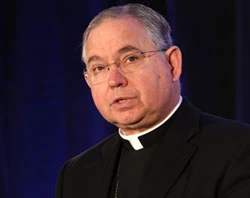
Washington D.C., Mar 23, 2011 / 10:07 am (CNA).- At a conference on U.S.-Mexico relations on March 21, Archbishop Jose H. Gomez of Los Angeles explained that the Catholic Church's social teaching can provide essential guidance on the question of immigration, and other dilemmas presented by a globalized economy.
The Mexican-born archbishop, who is also a U.S. citizen, addressed participants gathered at the Catholic University of America in Washington, D.C. for a conference on the Church's role in the immigration debate.
He encouraged audience members – including Mexico's ambassador to the U.S., Arturo Sarukhan, and the U.S. Assistant Secretary of State Eric Schwartz – to consider both the large-scale economic factors driving immigration, and the rights and needs of individuals caught up in these economic changes.
“Globalization has expanded opportunities for businesses and for workers,” Archbishop Gomez acknowledged. “But it has also created new problems in the relationships between our nations.”
“The biggest problem is that while we have developed laws and policies to govern the flow of capital and money, we have no standards for the movement of laborers.”
“Money, capital, and other resources now flow more freely between our nations,” he noted. “But human beings — the men and women who do the work — cannot.”
Archbishop Gomez also spoke frankly about the need to deal realistically and humanely with the reality of unauthorized immigration.
He emphasized that he was interested in the immigration question not primarily as a matter of politics or diplomacy, but as a spiritual and moral issue affecting millions of people.
“I am not a politician or a diplomat or an expert in the global economy,” said the archbishop. “My concern is to be faithful to the Gospel of Jesus Christ, and to defend and promote the dignity of the human person who is made in the image of God.”
He spoke eloquently of the spiritual toll that immigration often takes on those who lack opportunities in their homeland but are exploited or even hated in their new country.
“It gets harder every day to hold onto your cultural identity, your moral compass, your religion, your dignity,” he observed. “You start to believe what people say about you — that you are no good.”
Archbishop Gomez went on to propose a series of measures to address the root causes of immigration, while respecting the human needs and rights of those who have entered the U.S. illegally.
Many aspects of the problem, the archbishop said, arose from underdevelopment within Mexico – a problem that has no instantaneous solution, but demands urgent action.
“We need to find ways to target economic development,” he said, “so that far fewer Mexicans will feel compelled to leave their homes to seek jobs and money in other countries.”
Archbishop Gomez also indicated that the prosperity of nations and transnational corporations must not be placed above the good of the individuals who make such prosperity possible. He strongly urged his fellow U.S. Catholics to consider the human dignity of immigrants, even as they seek to ensure the rule of law.
“Our current policies of enforcement — detentions, and deportations — are a humanitarian tragedy,” he stated. “We are destroying families in the name of enforcing our laws.”
He pointed out that a nation's immigration laws, however important, could not be given absolute priority over the bonds of family – which precede the state itself, according to the natural law.
“Practically speaking,” he stated, “I would like to see a moratorium on new state and local immigration legislation. And, as the U.S. bishops have called for, I would like to see an end to the severe deportation policies.”
Archbishop Gomez also noted that children and women are the “most vulnerable migrants,” who “often fall prey to unscrupulous traffickers” and others seeking to exploit or harm them. He urged policymakers to consider the safety of these populations, and also to remember the needs of all immigrants who are seeking to be reunited with family members by attaining a U.S. visa.
“All of these measures,” said the archbishop, “would make a real difference in the lives of millions of people.
“But they are only temporary,” he noted. “We need to muster the political will to fix our broken immigration system.”
Monday, March 7, 2011
There Is Power In A Union
Class conflict in the first sucessful Revolutionary Republic?
"About twenty of Madison Wisconsin's bluegrass musicians, as the collective Pickers' Local 608, gathered at Audio For The Arts on Sunday, March 6th 2011, to record their own version of There Is Power In A Union, with special featured guest banjo man Bill Evans! Thanks to Kirsten M. for the camera work! Bluegrass Local 608 includes members of The Oak Street Ramblers, The Malt Liquors, Cork 'N Bottle String Band, The Pints, Spare Time Bluegrass Band, Northern Pikers, and others...
Saturday, February 5, 2011
US Bishops Notify Congress of Policy Goals
This article comes from the National Catholic Reporter.
The bishops want equal access to the Internet for all!
-----------------------------------------------
Letters outline US bishops’ policy priorities
Feb. 03, 2011
By Michael Sean Winters
The U.S. bishops released two letters to members of Congress late last month that outline “principles and priorities that guide the public policy efforts” of the U.S. Conference of Catholic Bishops.
The first letter, signed by the newly installed conference president, Archbishop Timothy Dolan of New York, exhorts the lawmakers to protect human life from conception to natural death. “Our prayers and hopes [are] that this newly elected Congress will advance the common good and defend the life and dignity of all, especially vulnerable and poor persons whose needs are critical in this time of difficult economic and policy choices.”
The letters were dated Jan. 14 and released to the public Jan. 18.
Dolan pledges to “seek ways to work constructively with the administration and the new Congress and others of goodwill to pursue policies which respect the dignity of all human life and bring greater justice to our nation and peace to our world.”
The second letter – signed by Cardinal Daniel DiNardo of Galveston-Houston, head of the pro-life committee; Bishop Stephen E. Blaire of Stockton, Calif., chairman of the justice and human development committee; and Archbishop José H. Gomez of Los Angeles, chairman of the migration committee – dealt specifically with the issue of health care legislation.
Dolan wrote that the bishops approach public policy “not as politicians but as pastors and teachers … [of] the largest community of faith in the United States, one that serves every part of our nation and is present in almost every place on earth.”
The bishops “will work to retain essential, widely supported policies which show respect for unborn life, protect the conscience rights of health care providers and other Americans, and prevent government funding and promotion of abortion,” Dolan wrote. He asked that the Hyde Amendment, which prevents the use of federal funds for all elective abortion, be enacted as a permanent provision.
Dolan then articulated the bishops’ concern to defend traditional marriage, calling for vigorous enforcement of the Defense of Marriage Act, which limits the degree to which the federal government can recognize same-sex partnerships.
The letter next addressed a variety of concerns about social justice and the poor that range the bishops more on the political left than the political right.
It said that the bishops support economic policies that protect the poor, and call for aid to Catholic schools and continued funding for faith-based organizations that cooperate with the government in providing social services.
Dolan also addressed a novel issue: equal access to the Internet, the first time this issue has received such prominent attention from the bishops’ conference.
He called for comprehensive immigration reform, “recognizing that human dignity comes from God and does not depend on where people were born or how they came to our nation.” Among those items the bishops seek are “a path to earned citizenship, with attention to the fact that international trade and development policies influence economic opportunities in the countries from which immigrants come,” and some effort to prioritize family reunification.
Turning to international affairs, the letter calls for a “responsible” end to the wars in Iraq and Afghanistan, and voices special concern for the religious freedom of Christians and others, noting recent attacks on Christians in Egypt, Iraq and Nigeria, as well as the assassination of a Pakistani official who had spoken against that country’s blasphemy law.
Dolan also urged “continued and persistent leadership” to secure a lasting peace in the Holy Land, support for peaceful change in Sudan, and continued efforts to alleviate the sufferings of the people of Haiti.
Dolan’s letter follows the pattern set by Pope Benedict XVI in his encyclical letter Caritas in Veritate, albeit with far less explicit theological arguments. Dolan’s letter articulates a variety of concerns, all of which flow from the church’s teaching on human dignity, even though some of those concerns are shared mostly with Republicans and others mostly with Democrats.
Dolan’s letter appears to be a far cry from the position held by some conservative Catholics, such as Princeton University Professor Robert George, who argue that the church’s focus should be narrower, restricted to so-called “nonnegotiable” issues like opposition to abortion and support for traditional marriage and religious freedom.
Some might be disappointed to find that immigration comes near the very end, as if it were not a real priority for the bishops and a pressing issue for the country.
The second letter from the three bishops whose committees were most engaged in last year’s health care debate is primarily interesting because it didn’t support efforts to repeal the health care reform law.
“Throughout the last Congress the Catholic bishops of the United States affirmed our strong support for universal access to health care,” the bishops write. “Basic health care for all is a moral imperative, not yet completely achieved.”
They call for Congress to address the health care needs of immigrants, a need unaddressed in last year’s health care law.
The letter from the three bishops enumerates the bishops’ reservations concerning federal funding of abortion and conscience protections for health care workers and Catholics hospitals. They note that these last concerns can all be achieved by enacting other bills that amend the law without repealing it. One such effort, previously introduced in the last Congress, would put the original Stupak-Pitts language back in the law, codifying the Hyde Amendment by law rather than executive order, as President Obama did last year. The Stupak-Pitts Amendment failed last year when no Senate Republican promised to vote for the health care law if the amendment was attached to it.
Another prospective bill would shore up conscience protections for Catholic health care workers, a growing concern of the bishops.
No one seeking to repeal the health care law will likely find solace in this letter.
Both letters exemplify a lack of sharp elbows. The respectful tone, the lack of any demonization or mischaracterization of the views of others, the ideological balance and measured analysis, these all distinguish the bishops’ voices from so many others in the public square.
If the next three years of Dolan’s leadership follow the form and content of this letter, the church’s relationship with the political realm might be less volatile and more constructive then we’ve seen in recent years.
[Based in the nation’s capital, Michael Sean Winters writes the Distinctly Catholic blog.]
Saturday, January 22, 2011
Vatican Bank Chief Issues Economic Warning
This article comes from Catholic News Agency.
-------------------------------
Vatican bank chief issues warning about US, European economic policies
Rome, Italy, Jan 21, 2011 / 03:05 pm (CNA/EWTN News).- Current fiscal and monetary policies in the United States and Europe risk increasing government control over national economies, resulting in weakened political strength throughout “the whole of the western world,” the Vatican’s top banking expert said.
Ettore Gotti Tedeschi has been head of the Vatican's bank, known as the Institute for Religious Works, since 2009. He has a long career in finance, having served as the head of Banco Santander, the largest private bank in Europe, as well as on the boards of some of the continent’s leading financial institutions.
He is known as a staunch capitalist with a deep concern for the Church’s social teaching. He is also a former professor of financial ethics at the Catholic University of Milan.
Writing in the Jan. 14 edition of the Vatican newspaper, L’Osservatore Romano, Tedeschi warned of the growing influence of “Keynesian” economic theory on both sides of the Atlantic.
John Maynard Keynes was a prominent 20th-century economist whose theories were widely embraced by world powers to jump-start their economies after World War II.
Tedeschi cited a 2009 book, "Where Keynes Went Wrong: And Why World Governments keep creating Inflation, Bubbles and Busts," by the American economist and philosopher Hunter Lewis.
He said Lewis had spelled out the "doctrinal errors and practical disasters" of Keynes' theories.
In simple terms, Keynes taught that in times of economic crisis, consumer demand must be stimulated by government investment and an "attitude of saving" must be discouraged,
Tedeschi wrote.
He said Keynes' crisis-averting tactics can be seen in the U.S., where government economic policy has focused on increasing public expenditures – and public debt – in order to stimulate private economic activity, including consumer demand and employment.
In addition, also following Keynesian wisdom, the U.S. is printing more money and has looked at increasing taxes in an effort to generate more public revenues.
Tedeschi warned that these policies are leading to a "nationalization" of private debt in the U.S. He also criticized the government bailouts of private banks that offered too much credit without adequate guarantees. This too is leading to increased government control of the economy in the U.S. — a “nationalization” that is being paid for with newly printed currency.
In Europe, he said, the issue is the opposite. Because of the lack of widespread private debt, a "privatization" effort is being enacted to absorb the large public debt of banks and businesses.
This also is Keynesian policy, which "perseveres against the scorned savings," Tedeschi said.
Governments on both sides of the Atlantic, he said, are committed to Keynes' policy of increasing public debt to sustain levels of economic production, consumption, and employment.
He said artificially low interest rates are another key to the strategy of increasing spending and discouraging saving. With no incentive to keep money in the bank, those who would have otherwise been savers are pushed to spend.
"Zero interest rates factually equal a de facto transfer of wealth from he who was a virtuous saver (although not for Keynes) to he who has become virtuously (for Keynes) indebted," he said.
"Practically, it's about a hidden tax on poor savers, a tax transferred to the wealthy, (that is), over-indebted states, business people and bankers.”
Although the alternative to zero interest in such a situation is economic collapse and eventual default, the zero-rates "are not sustainable and are dangerous," Tedeschi warned.
"They destroy savings, which is an essential resource to create the base for bank credit; they promote speculation on real estate and securities, create illusory artificial values rather than scaling them down; they push consumption to more risky debt; they alter the market with artificial values and thus lead to belief that the very markets do not know how to correct themselves."
The biggest danger, Tedeschi said, is that zero interest rates "permit, or impose governments into management of the economy, without correcting inefficiency and facilitating distortions in the competition."
He warned that the greatest economic impacts may be on the way.
In the future, he said, inflation might be used as the "maneuver" to absorb the enormous debt in both the U.S. and Europe. Debt levels are now three times as large as the gross domestic product in most countries, he observed. Governments have thus far been able to control inflation by controlling consumption rates.
"Someone," he said, "is hoping for new taxes to sustain a new statism that reinforces a rather weak political class in the whole western world."
Thursday, January 20, 2011
US Ambassador to Vatican Seeks Common Ground
This article comes from the Catholic News Agency.
-----------------------------------
Profile: US ambassador seeks to 'build bridges' with Vatican
By Alan Holdren
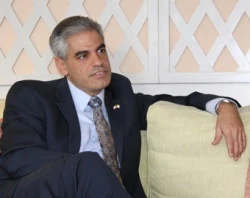
Rome, Italy, Jan 20, 2011 / 04:37 pm (CNA/EWTN News).- America’s ambassador to the Holy See says the two sides are working to rebuild trust following the leak of embarrassing diplomatic cables late last year.
“What brings us together is far, far, far more than what sets us apart, and I want to focus on that," Ambassador Miguel H. Diaz told CNA in a wide-ranging interview at his hilltop residence in Rome Jan. 19.
Ambassador Diaz said that during his 16 months in Rome he has seen “significant signs that show the ongoing commitment of this President, the White House, and our government in general to fostering and deepening this relationship.”
He said the scandal of the U.S. diplomatic cables, released on the website WikiLeaks has not effected the Vatican-U.S. working relationship.
According to an analysis by CNA, more than 700 cables from the U.S. embassy to the Vatican were among the 250,000 State Department cables obtained by WikiLeaks.
To date, only a handful of them has been released. But some of those have proven embarrassing, including one in which a U.S. embassy staffer poked fun at the “poor communications culture” in the Vatican and another in which Vatican Secretary of State Tarcisio Bertone was described as “yes man.”
The WikiLeaks affair has been a bump in the road in an otherwise easy and low-key relationship between the Vatican and the administration of U.S. President Barack Obama, during his first two years in office.
Ambassador Diaz is credited with running a smooth diplomatic operation — especially considering that prior to this he has had no previous diplomatic experience.
The 45-year old Cuban-American was a professor of theology at the College of Saint Benedict and Saint John's University in Minnesota when the call came from the White House in May 2009, five months after President Obama was inaugurated.
Reportedly, he was not first on the list for the position. However, the president’s top choices had to be rejected because they favored abortion or embryonic stem cell research — positions that would have made their appointment appear to be a snub to the Vatican.
The U.S. Senate confirmed Ambassador Diaz in August 2009, and since then he and his wife, also a theology professor, have been living with their four children in the ambassador's residence atop Rome’s Janiculum Hill.
When Pope Benedict XVI received Ambassador Diaz for the first time to accept his credentials, he did so warmly. But he made a point of emphasizing the Church’s differences with the U.S. administration.
“I think particularly of the need for a clear discernment with regard to issues touching the protection of human dignity and respect for the inalienable right to life from the moment of conception to natural death, as well as the protection of the right to conscientious objection on the part of health care workers, and indeed all citizens,” the Pope told the new ambassador.
Despite broad disagreements on basic policies, Ambassador Diaz said he is focusing on the values and the interests the two sides share.
"I think it's important to recognize that there are differences,” he said. “But I think it's important not to be paralyzed by those differences. The things that we have in common far exceed the things that divide us," said Ambassador Diaz.
As the ninth U.S. ambassador, Diaz said he is really "standing on the shoulders" of the "giants" that have gone before him.
Unofficial relations between the two states go back to the birth of America, when President George Washington assured Pope Pius VI that the Pope would have full freedom to appoint bishops in the new land.
It would take until President Ronald Reagan in 1984 for the U.S. to establish its first official embassy here. At that time, it was widely perceived that the U.S. president saw the Vatican and then-Pope John Paul II as an important ally in the fight against communism.
The embassy recently celebrated its 27th anniversary. Ambassador Diaz has as a staff of 19 — a formidable presence for promoting U.S. foreign policy at the world's smallest state.
"The size is really inversely proportional to the scope of influence," said Ambassador Diaz. “You can't just think of the Holy See as boxed with the Vatican City walls. We have to think of it as this vast network."
Since his Senate confirmation hearings, Ambassador Diaz has spoken of his vision for the embassy as one of “building bridges.”
And he has pursued that strategy during his 16-month tenure. He has worked diligently to build relationships not only with Vatican officials, but also with the wider institutions of the universal Church — pontifical universities, religious communities, even hospitals, non-profits and humanitarian agencies.
The embassy has sponsored several high-profile meetings to highlight areas of mutual interest.
An embassy-sponsored conference in 2009 brought professionals to the city to raise awareness of the need to stop mother-child transmission of AIDS. The embassy co-sponsored a concert with the Church aid agency Caritas to raise money for Haitian earthquake victims.
An embassy-sponsored conference at the Pontifical Gregorian University last October encouraged members of different faith traditions to come together in "building bridges." At the event, the director of the White House's Office of Faith-Based and Neighborhood Partnerships, Joshua DuBois, gave the keynote address.
But Ambassador Diaz said much of his diplomatic work is done in one-on-one conversations — what he called "diplomacy at the table" during luncheons and dinners, and "targeted diplomacy" with Vatican contacts through more formal channels.
The issues of concern to the U.S. and the Vatican are broad and far-reaching.
"One of the greatest challenges,” he said, was how the “human family” is going to “reconcile” its “incredible diversity” of religions and cultures. This diversity, he said, “increasingly threatens to tear us apart.”
On that note, Ambassador Diaz called Pope Benedict’s annual speech to diplomats Jan. 10 “ambitious.”
The Pope used strong language to condemn religious discrimination and persecution around globe, especially in the Middle East, North Africa and China.
"The task of building bridges is essential if we are to bring about reconciliation and peace, and if we are going to tackle ongoing problems such as the trafficking of persons and basic violations of human dignity — including violations for persons to exercise a right to religious freedom," Ambassador Diaz said.
He sees a "bridge-building" opportunity in Pope Benedict's call for world religious leaders to gather in Assisi next October to pray for peace. It is fitting that such an encounter should take place in the birthplace of St. Francis, whose name is associated with peace and reconciliation.
In an "interconnected" world, St. Francis’ message that all things are tied together is important, Ambassador Diaz said. The day of prayer called by the Pope has the potential to "do what religion is intended to do — bring people together and not drive them apart."
"In this interdependent world, civic leaders cannot act alone, no nation can act alone, and the contribution of religious leaders is essential in the building of peace, the defending of human dignity, the fight against any type of abuse. And certainly the religious leaders have a central role to play in that outgoing, noble task," Ambassador Diaz said.
He identified ending human trafficking and promoting education and migration issues as the embassy's top priorities.
"There are so many different areas that wherever the dignity of the human person is violated, that persons … and organizations associated with the Church can help," he explained.
"I think that's where the effective work of building those bridges and defending that dignity would come in, the day-to-day exercise of this relationship."
He does not downplay the continued differences between the U.S. and the Holy See on issues such as abortion, embryonic stem cell research, the homosexual lifestyle, and the promotion of condoms for AIDS prevention.
No diplomatic relationship finds both sides seeing eye-to-eye on every issue, Ambassador Diaz noted. "That's the ideal, the ideal will never be there."
He prefers to concentrate on his responsibility as President Obama's personal representative to the Holy See.
"As a person of integrity, I would not be sitting here if I did not believe that there was a significant convergence in my ability to carry out this duty here at the Holy See,” he said. “I'm defending the dignity of human persons in different ways. I am building bridges. And these are fundamental tenets of this administration and fundamental tenets of who I am as a person.”
He would like his time as ambassador to be remembered as one in which U.S. foreign policy and the common interests of the Holy See were united "to advance the common good of the human family."
"If I can do that, even if it's just in little ways, during my tenure here, then I'll call it a success,” he said. “I'll be happy that I did my job, which is to answer the call — certainly of President Obama and of my country, to serve it — and also the call of the human family and the Church to advance the common good."
Tuesday, January 18, 2011
Catholic Figures Played Major Role in START Treaty
The Vatican has worked hard to spread the ideas of nuclear non-proliferation.
And why is that?
Because the Vatican doesn't have nuclear weapons -- it wants to level the political playing field.
This article comes from the National Catholic Reporter.
------------------------------
Catholics had a major role in passing nuclear treaty
By Dennis Sadowski
WASHINGTON -- As Democratic and Republican senators pressed their divergent views on the New START agreement with Russia outlining the next phase of nuclear disarmament during final debate in December, a wide array of Catholics played a major role in getting the pact ratified.
From political insiders to people in the pews, Catholics provided a moral perspective on the need for the treaty, helping build the final 71-26 margin for ratification, several people working on the issue told Catholic News Service.
The effort by Catholics also helped keep the vote on schedule, preventing it from being pushed into 2011 when the likelihood of ratification would have been dimmer because of the loss of six Democratic seats in the Senate.
Both houses of the Russian parliament are reviewing the treaty and are expected to ratify it in the coming weeks.
No one contacted by CNS said that without the Catholic effort the treaty would have failed. But they acknowledged that the involvement of such a broad array of Catholic voices -- from Archbishop Edwin F. O'Brien of Baltimore, who formerly headed the U.S. Archdiocese for the Military Services, to Dave Robinson, executive director of Pax Christi USA -- ratification became much easier to accomplish in an era where bipartisan cooperation in Congress is almost nonexistent.
David Culp, legislative representative for the Quaker Friends Committee on National Legislation, heaped high praise on Catholics. He pointed to the efforts by the U.S. Conference of Catholic Bishops as well as key Catholic members of Congress and the Obama administration for leading the way.
"(Catholics) definitely have been the most active and most important faith-based group working on this," Culp said. "This has been an amazing effort (by Catholics) from top to bottom."
Pax Christi's Robinson described the Catholic effort as one that has naturally evolved given the church's increasingly stronger stance against nuclear weapons.
"This is an example of people both on the inside and the outside able to apply their values and faith traditions on a really important public policy matter that is going to enhance security and move us down to the road to a nuclear weapons-free world," he said.
The new treaty calls for both countries to reduce their strategic arsenals -- weapons deployed on long-range missiles, bombers and submarines -- to 1,550 each. Under the previous START pact, which expired in December 2009, both countries reduced their strategic arsenals to 2,200 weapons each.
Key Catholic insiders working for the treaty's ratification included the likes of Vice President Joe Biden and aide Brian McKeon; Sen. John Kerry, D-Mass., chairman of the Committee on Foreign Relations; Denis McDonough, deputy national security adviser; and Rose E. Gottemoeller, assistant secretary in the Department of State's Bureau of Verification, Compliance and Implementation, who was the lead U.S. negotiator of the agreement.
Gottemoeller, who holds a degree in Russian from Georgetown University, told CNS she welcomed the "high level of interest" in nuclear disarmament among people of faith, especially Catholics and evangelicals.
"It was important to engage people's interest and to have the Catholic bishops of the United States and Catholic organizations to step forward and speak about the importance of the issue and engage the public," she said.
At the White House, two staffers speaking on background, said their work was motivated by the president's desire to get the treaty ratified as opposed to adhering to the teaching of any particular faith. Both welcomed the comments of people of faith, saying those views were "taken into account" as strategies for approaching senators sitting on the fence were formed.
Stephen Colecchi, director of the USCCB's Office of International Justice and Peace, explained that the bishops staked out their position on the treaty soon after Obama announced April 8 in Prague that he and Russian President Dmitry Medvedev signed the arms reduction pact.
"The fact that Catholics were leading the effort is not a surprise to me," Colecchi said.
He said 30 bishops -- a much larger number than on most legislative issues other than same-sex marriage, abortion and health care -- contacted senators at various times in 2010.
Leading the way was Bishop Howard J. Hubbard of Albany, N.Y., chairman of the bishops' Committee on International Justice and Peace. He regularly joined teleconferences and sent letters to the Senate on behalf of the conference.
The bishops were backed by hundreds of letters from religious orders as well as average Catholics who responded to a series of legislative alerts issued by Colecchi's office.
"The church's teaching on this is very clear and it's very clear on the issue of protecting human life and human dignity," Colecchi said, explaining why large numbers of people responded to the arms control issue.
Outside of the conference, as expected, organizations such as the Maryknoll Office of Global Concerns and Network, a Catholic social justice lobbying organization, also made their voices heard.
This time though, they were joined by the National Association of Evangelicals and organizations such as the Two Futures Project, headed by the Rev. Tyler Wigg-Stevenson, whose influence on social issues is gaining favor rapidly among more traditionally conservative Christians.
"This is an example of where the church's teaching formed and motivated people," Colecchi said. "I think we can be very proud of our church and very proud of our bishops."
Friday, January 14, 2011
Vatican Reshapes Socialist Vocabulary for American Audience
The Vatican is committed to promoting Catholic socialism all over the world. Despite the affirmations of Cardinal Turkson, the Catholic socialism is indeed a form of socialism not very different from other forms. The only difference is that the Roman Catholic Church holds the nucleus of power as opposed to some politburo or party apparatus.
I encourage my readers to look closely at Benedict XVI's most recent encyclical, Caritas in Veritate, and discern exactly what kind of political and economic world system he preaches.
This article comes from the Catholic News Agency.
---------------------------------
Vatican official: Church’s justice teachings need new 'vocabulary' for some US audiences
Vatican City, Jan 13, 2011 / 05:33 pm (CNA/EWTN News).- When he travels to the United States next month, Cardinal Peter Kodwo Appiah Turkson is aware that he may have to make some adjustments in the way he talks about the Church’s social teaching.
As president of the Pontifical Council for Justice and Peace, the Ghanaian cardinal, 62, is charged with making the Church’s social teaching more widely known and practiced around the world.
He will be in Washington to deliver the plenary address of the 2011 Catholic Social Ministry Gathering, Feb. 13-16. The gathering, on the theme of “Protecting Human Life and Dignity: Promoting a Just Economy,” is sponsored by 19 Catholic organizations, including the U.S. Catholic bishops.
In a recent interview with CNA, Cardinal Turkson said he has learned from past experience that the Church’s justice and peace terminology often needs clarification for an American Catholic audience. Key terms used by the Vatican — such as “social justice” and “gift” — are not always understood the way the Vatican intends, he said.
"We found out that some of the vocabulary which is just taken for granted and used freely may not always have the same sense or may have had some nuances which sometimes are missed because of the way the terms are used in the American political context,” Cardinal Turkson said in a Jan. 12 interview at the council’s offices in Rome.
Pope Benedict XVI appointed Cardinal Turkson to his post in Oct. 2009, just months after the Pope released his blueprint for the Church’s social teaching, “Caritas in Veritate” (Charity in Truth). The council has since made promotion of the Pope’s vision a top priority.
The encyclical outlines Pope Benedict’s plan for "integral human development" in economics, society and politics through the principles of charity and truth.
Cardinal Turkson said the Vatican is pleased by response to the document. But he said reaction from some sections of the audience in the United States was unexpected.
The council has been surprised to find that common terms were misunderstood or misinterpreted. He emphasized that the misunderstanding was not a general or widespread problem among American Catholics. But, he said, "in certain circles ... there is a difficulty."
For instance, the Pope's teaching on themes of "social justice" have been mistakenly connected to "socialism" and "communism." As a result, he indicated, the Pope is mistakenly seen as promoting socialist or big-government solutions to social problems.
The council has also learned that words like "social" and "solidarity" may have been dismissed by American readers for their perceived connection with communist regimes such as the Soviet Union, he said.
Cardinal Turkson explained that in the Church’s thinking, social justice involves citizens’ obligations and responsibilities to ensure fairness and opportunity in their communities and societies.
While this may include the adoption of specific government policies and programs, the emphasis in Catholic social teaching is on the obligations that flow from citizens' relationships in societies.
"Respecting, understanding and fulfilling those demands constitute our justice," he said. "It would be useful if we just observed our sense of justice as our ability to fulfill the demands of the relationships in which we stand."
This is in contrast to socialism, he explained, which is an ideology in which private property and private interests are totally placed in the service of government policies.
What the Pope proposes in “Caritas in Veritate,” said Cardinal Turkson, is "achieving the common good without sacrificing personal, private interests, aspirations and desires."
Cardinal Turkson said the Council was also surprised that the Pope’s concept of the “gift,” was perceived in some circles as encouraging government welfare handouts.
In "Caritas in Veritate," Pope Benedict described the concept of “gift” as a way to understand God’s love for men and women in his gift of life and his gift of Jesus.
"Truth is the light that gives meaning and value to charity," the Pope wrote. "That light is both the light of reason and the light of faith, through which the intellect attains to the natural and supernatural truth of charity: it grasps its meaning as gift, acceptance, and communion."
Gift, Cardinal Turkson explained, is "a very basic, deep theological expression of God's relation or the motivation for whatever God does in the world, and it's not quite the same as a handout."
"If we ever need to talk about this in a society where the sense of gift is that of a handout ... it doesn't quite express the sense of gift in this regard," he added.
While it is too late to add any explanations to the encyclical, the Council might tailor its language differently in future documents.
"We just realized that probably in the future, when ... this dicastery takes up the task of diffusing, presenting and talking about this it might be necessary to provide a footnote in which some of these expressions can be given an awareness of the different senses of expressions in different cultures and settings,” he said. We thought something like that would be useful and helpful to the readers."
Cardinal Turkson urged American Catholics and government and economic leaders to give a conscientious reading of "Caritas in Veritate."
The encyclical, he said, invites us "to go back or to remind about the centrality of the human person, his well being, his common good within everything that we do.”
Another important message, Cardinal Turkson said, is that “we must not sacrifice the good of the human person for anything that we aspire after or want to do with technology, business, economics or whatever."
The key to an authentically human vision of development is to consider the full ethical character of the individual in all decisions, he said.
"In details," he concluded, "it may be for food security and shelter for all persons, but at the end of the day we are looking at whether things that we are doing in the world as government, as a Church and all of that help advance the good of the individual person."
Sunday, January 9, 2011
Ten Percent of US Congress Educated by Jesuits
A sobering statistic indeed.
Does this mean that 10% of our elected representatives are working for the Vatican? No. However, it does suggest that 10% of our elected representatives perform their political work with a mindset uniquely influenced by Jesuit ideology and remain more open to Vatican influence than other members of Congress.
This post comes from National Jesuit News.
------------------------------
Graduates of Jesuit Institutions Well Represented in the 112th U.S. Congress
8 January 2011Ten percent of the 112th U.S. Congress are Jesuit college and university alumni/ae. Among the 535 Members of this Congress, 53 of them are alumni/ae of Jesuit institutions. At least 30 alums also serve in appointed positions in the Obama Administration.
“With the many challenges facing our nation, we are happy that our Jesuit college and university alumni/ae continue to play important roles in Congress and the Administration,” said AJCU President Fr. Charles Currie, S.J. “Their commitment to lead and to serve is in the best Jesuit tradition.”
There are 12 Jesuit alumni/ae in the Senate and 41 in the House of Representatives. Among the top leadership, Congressmen John Boehner (R-OH) is the first Jesuit alumnus to serve as the Speaker of the House of Representatives. Congressman Steny Hoyer (D-MD) serves as the House Minority Whip. In the Senate, Senator Richard Durbin (D-IL) continues as the Assistant Majority Leader.
Of these 53 alumni/ae, 35 received graduate or professional degrees from Jesuit universities. There are 18 Jesuit institutions represented by alumni/ae in the U.S. Congress. Georgetown University has the most alumni/ae with a total of 18; followed by Boston College with seven; the College of the Holy Cross with four; while Creighton University, Fordham University, Marquette University, and the University of Detroit Mercy each have three.
For a full listing of Jesuit alumni/ae, click here.
Wednesday, January 5, 2011
Panelists: Laity the Future of the Catholic Church
This article comes from the National Catholic Reporter.
-------------------------------------------
Saying bishops 'scared,' panelists urge laity to take lead
By Jerry Filteau
Panelists at a recent Woodstock forum in Philadelphia urged lay Catholics to grab the reins and set the course for the church’s future.
“We are becoming a do-it-yourself church” for the laity, said Jesuit Fr. Thomas J. Reese, one of three senior fellows of the Woodstock Theological Center in Washington who spoke at “The Future of the Church: A Woodstock Forum on Sources of Hope,” held at St. Joseph’s University in Philadelphia Dec. 5.
The U.S. Catholic hierarchy today is fearful and defensive, a far cry from the collaborative, pastorally transformed hierarchy that emerged during and after the Second Vatican Council, said Dolores R. Leckey, former longtime head of the U.S. Conference of Catholic Bishops’ Secretariat for Laity, Family, Women and Youth, and a noted writer on spirituality.
It’s up to the laity to take responsibility for where the church goes in the years to come, Leckey, Reese, and Fr. Raymond Kemp, a Washington diocesan priest and director of Woodstock’s “Preaching the Just Word” program, said during the two-hour session with nearly 300 Philadelphia-area Catholics. (This reporter did not attend the forum but later requested and was given access to a video recording of it.)
Reese, a political scientist, nationally known media consultant and former editor of America, a Jesuit-run national magazine, said, “Personally, as a social scientist, I tend to be a pessimist when looking at the church. But as a Christian, I think I have to be an optimist. That’s part of our DNA as Christians. After all, our religion is based on someone who died and rose from the dead.”
A recent Pew Forum study showed that about one-third of American adults who were raised Catholic are no longer Catholic, he said, and the number of priests and religious in the U.S. church has declined dramatically, with new vocations few and far between.
“At 65, I’m considered a young priest,” he said, adding that the Catholic priesthood may be the only profession in the country today where someone who dies of old age is still considered “young.” Because of the church’s sacramental theology linked to ordination, lack of priests means lack of access to the Eucharist and other sacraments, weakening the entire institutional structure, he said.
He said that for him the most depressing finding of the Pew study was that 71 percent of former Catholics said the reason they left the church was “that my spiritual needs were not met by the church -- in other words, our fundamental product failed.”
Another major negative factor in U.S. Catholic membership trends, Reese said, is that in the United States today, many of those leaving are women.
“In the 19th century we lost men in Europe. We didn’t lose the women,” he said. “Today we’re losing women too. ... Mothers are more important to the Catholic church than priests, because they are the ones that pass the faith on to the next generation. They are the ones who teach the kids how to pray, answer their questions about God, etc. Women are absolutely essential. If we lose women, we might as well close shop. And then the worst thing about this is that the more educated a woman becomes, the more alienated she tends to become from the Catholic church.”
Reese said that for church leaders to blame the exodus of Catholics from the church on sinfulness, dissent, lack of commitment, or other factors among those who leave is ignoring a major issue. “If this was a retail outlet, we’d say we’re blaming the customers -- and that’s not a way to make your bottom line,” he said.
He said a welcoming attitude, implemented in concrete welcoming practices, is lacking in most Catholic parishes and is one of the major weaknesses in U.S. Catholic practice today.
“When was the last time you entered a Catholic church and actually were welcomed?” he asked. “Our churches and our liturgies are boring. That, I think, more than theology, is what is driving our people away from our church.
“What you need is good music, good preaching, programs for kids and a welcoming community,” he said. “If you have that, you will have a full church.”
He called the Catholic church today “a lazy monopoly” around which evangelical churches “are running circles.”
As signs of hope, he said, the church “is much better today than it was” in the 1950s, and it is a church “that always changes.”
He cited the return to biblical scholarship and spirituality among the major causes for hope in the Catholic church today.
The Catholic focus on social justice attracts young Catholics, “especially when this work is seen not just as kind of an appendix to Christianity, as being a Catholic, but is integrated into our spirituality, as part of who we are, so it becomes part of who we are as Christians -- for many young Catholics this becomes attractive,” he said.
On the church’s immediate prospects for the future, “maybe God knows what she’s doing,” he said. “If you don’t have clergy, maybe the job’s yours.”
Leckey and Kemp struck similar notes on lay responsibility for the church’s future.
Leckey, who recently completed a book, The Laity and Christian Education, in the Paulist Press “Rediscovering Vatican II” series, said the Second Vatican Council in the 1960s is one of the chief reasons for her hope for the future of the church.
“What happened there was a monumental conversion of consciousness” among the world’s 2,500 Catholic bishops, she said, and one key area of that was recognition of the role of the laity, by virtue of their baptism, in the church’s mission of ministry and spreading the Gospel in the world.
She contrasted the conciliar view of the laity with the prevailing preconciliar view best expressed by Pope Pius X in the early 20th century when he said, “The one duty of the laity is to allow themselves to be led like a docile flock, to follow their pastors.”
Besides re-envisioning the church as the pilgrim people of God, the council stressed the universal call to holiness and changed the ongoing narrative of the church’s life, making it more biblically and liturgically centered, she said.
Today, she noted, 85 percent of the ministers in U.S. parishes are laity, most of them women.
Kemp said a key to a hopeful future for the church is a vital parish -- a parish that welcomes people and calls on them to contribute their time and talents. He cited Old St. Patrick’s Parish in Chicago as an exemplar, saying it has some 120 peer ministry groups and attracts young adults from across the city.
Another sign of hope for the church’s future in the United States, he said, is its involvement in works of charity and justice.
“We have a story to tell that attracts people who are not Catholic,” he said. “Where are we? We’re at the borders. Where are we? We’re at the AIDS hospice in Africa. Where are we? We are the ones that are walking the undocumented through the process. Where are we? We are the ones that are in the detention centers. We’re the ones that are building houses or founding houses outside the detention centers so that families can meet with their folks before they’re deported. Where are we? We as a church educate, feed, house, clothe, resettle more of those who do find their way here than any other NGO [nongovernmental organization] in this country.”
That is the kind of institution that attracts young people who want to make a difference in the world, he said.
During a question-and-answer session after their presentations, all three panelists stressed the need for laypeople to take the initiative if they want to see things happen in the church.
When she was asked how laypeople can engage in a dialogue with their bishops on issues that matter to them, Leckey suggested that the growing collaboration of religious and laypeople -- many religious communities have established lay associate programs -- could serve as a model and a means of developing such a dialogue.
It is difficult to get today’s bishops to enter into such a dialogue because they do not trust in the laity as they did after the council, she said.
“Our bishops are scared,” she said. “You don’t act defensively like that unless you’re scared to death. Their defenses are high. They weren’t high in the days right after the council.”
[Jerry Filteau is NCR Washington correspondent.]
Tuesday, December 21, 2010
Canon Lawyer: Bishops Have Authority Over the Word "Catholic"
This article comes from the In the Light of the Law blog.
---------------------------------------
Lisa Fullam's dangerous advice should be ignored
When informed that the Vatican would oppose him, Joseph Stalin shrugged and asked “How many troops does the pope have?” To the dictator, the only views that mattered were those backed-up by men with guns.
Lisa Fullam has offered authorities at Catholic Healthcare West / St. Joseph's Hospital in Phoenix similarly myopic, even dangerous, advice when she suggested that, because the word “Catholic” is not copyright-able, the enterprise should continue to call itself “Catholic” despite Bp. Thomas Olmsted’s threatened prohibition of such use, and simply “let the canonical chips fall where they may.” Apparently Fullam believes that, since men with badges will never show up to enforce a cease-and-desist order (that will never be issued) by a civil court regarding the word “Catholic”, Catholic hospital officials need not worry about bishops tossing a few “canonical chips” their way.
I strongly suggest that St. Joseph's seek advice from another expert.
If the only criterion for authentic Catholic conduct is “what Church rules are enforceable by civil courts?”, then there won’t be much left of Catholic codes of conduct. Thank God. I don’t want states being the final arbiter of what is acceptable Catholic conduct and what is not, and I would hope that Fullam doesn’t want that, either.
But if Fullam’s point is that a bishop’s authority over the use of the label “Catholic” is, absent state enforcement options, nugatory, then she needs to study up on some elementary canon law (and ecclesiology, for that matter). A bishop’s authority over the use of the word “Catholic” is reflected in, e.g., 1983 CIC 216 and 300, and those norms just get the conversation started. Canons 1319 comes next to mind, but an exploration of those options goes beyond what I can cover in blog post.
Fullam’s nonchalance about ecclesiastical authority notwithstanding, I suggest that Catholic Healthcare West / St. Joseph's Hospital officials put a careful reading of these and related canons on the agenda for their next meeting.
I’m pretty sure that Bp. Olmsted has them memorized.
DREAM Act Fails in Senate
This article comes from America.
-----------------------------------------
DREAM Act Fails to Pass 111th Congress; Back in 112th?
The Senate's inability to overcome a threatened filibuster Dec. 18 scuttled passage of the DREAM Act, prompting immigrant advocates to pledge to push forward on immigration reform next year with a new Congress and fight for what one immigrant leader termed the "respect we deserve."
The bill would have given young people brought to the United States as children by their undocumented parents a path to citizenship under a strict set of requirements. Under the measure, an estimated 2.1 million children of undocumented parents would have had an opportunity to go to college or join the military and legalize their status.
The U.S. bishops had long been supporters of the Development, Relief and Education for Alien Minors Act, which passed the House Dec. 9. Four U.S. bishops, including Cardinal Roger M. Mahony of Los Angeles, took part in a Dec. 17 conference call with reporters to argue for passage in the Senate.
The Senate needed 60 votes to break the filibuster, but fell five short, with 55 against it and 41 for it.
"Catholic Charities USA is deeply disappointed that the Senate rejected the vote on this important piece of legislation," said a Dec. 20 statement from Father Larry Snyder, Catholic Charities' president and CEO.
"Honor students, class presidents, athletes and responsible community members who desire a brighter future by continuing their education came up short this past weekend. Now, having entered our country as small children, they will continue to be cast into the shadows until, as a nation, we can find a way to address our broken immigration system," Father Snyder said.
"Today's vote on the DREAM Act, which ironically was held on the very day in which migrant communities around the world commemorate international migrant's day, represents the latest example of a failed political and legislative strategy when it comes to immigrant rights and immigration policy," said Oscar Chacon, executive director of the National Alliance for Latin American and Caribbean Communities, in a Dec. 18 statement.
"In particular, Latino immigrant communities must be creative and effective when it comes to our own organizing, empowerment and alliance building capacity in order to achieve the respect we deserve, but that so far has been denied to us," Chacon said.
Republican opponents of the DREAM Act saw the measure was a backdoor into granting amnesty for all illegal immigrants. "Treating the symptoms of the problem might make us feel better ... but it can allow the underlying problem to metastasize. Unfortunately, that's what's happening at our border," said Sen. Jon Kyl, R-Ariz, said in a statement.
But Kjersten Forseth, executive director of ProgressNow Colorado, said: "The DREAM Act is a sensible and compassionate solution to a major problem in American immigration law, which has been routinely held hostage by the right wing and used in their campaign to demonize their political opponents."
"Fixing unintended problems in the law with regard to children in America, so they can attend college or serve our country, is good for our economy," Forseth said in a Dec. 18 statement.
The 55-41 Senate vote was largely along party lines. Five Democrats voted to support the filibuster, and three Republicans voted to block it.
AFL-CIO president Richard Trumka call the filibuster "a disappointing endorsement of injustice and inequality."
US Bishop Revokes Hospital's Catholic Status
This article comes from the Catholic News Service.
-----------------------------------------
Bishop Olmsted revokes Phoenix hospital's status as Catholic facility
By J.D. Long-Garcia
Catholic News Service
PHOENIX (CNS) -- St. Joseph's Hospital and Medical Center in Phoenix can no longer identify itself as "Catholic," Bishop Thomas J. Olmsted announced during a Dec. 21 news conference in Phoenix at the Diocesan Pastoral Center.
The Phoenix bishop issued a decree revoking the 115-year-old hospital's affiliation with the Catholic Church. In the decree, the bishop wrote that he could not verify that the hospital provides health care consistent with "authentic Catholic moral teaching."
"I really want to have Catholic health care," Bishop Olmsted said during the news conference. "We should be working together, not against each other."
Still, he said it was his duty to strip St. Joseph's Hospital of its Catholic identity because its leadership, as well as that of its parent organization, San Francisco-based Catholic Healthcare West, is not committed to "following the teachings of the Catholic Church."
To demonstrate that the hospital is no longer Catholic, Bishop Olmsted is prohibiting the celebration of Mass on the hospital's campus and will have the Blessed Sacrament removed from the hospital's chapel.
Linda Hunt, president of St. Joseph's, said in a statement after the bishop's news conference that the hospital was "deeply disappointed" by the action but would "continue through our words and deeds to carry out the healing ministry of Jesus."
In May, officials at St. Joseph's publicly acknowledged that an abortion occurred at the hospital in late 2009. The Arizona Republic, in its initial story on the matter, also revealed that Mercy Sister Margaret McBride had incurred an automatic excommunication because of her role on the ethics committee that sanctioned the abortion.
"Consistent with our values of dignity and justice, if we are presented with a situation in which a pregnancy threatens a woman's life, our first priority is to save both patients," Hunt said in her statement. "If that is not possible, we will always save the life we can save, and that is what we did in this case.
"We continue to stand by the decision, which was made in collaboration with the patient, her family, her caregivers and our ethics committee," she added. "Morally, ethically and legally we simply cannot stand by and let someone die whose life we might be able to save."
The public scandal resulting from the 2009 abortion isn't the first time Bishop Olmsted took issue with Catholic Healthcare West's adherence to the "Ethical and Religious Directives for Catholic Health Care Services," to which all Catholic hospitals in the United States are required to adhere.
Seven years ago, the bishop learned that Catholic Healthcare West did not comply with these directives at Chandler Regional Hospital.
"I have continued to insist that this scandalous situation needed to change," the bishop said. "Sadly, over the course of these years, CHW has chosen not to comply."
During the news conference, Bishop Olmsted detailed other Catholic Healthcare West facility violations of the U.S. bishops' directives.
St. Joseph's Hospital is involved with the Mercy Care Plan -- an organization that provides health care through Arizona's Medicaid program. By virtue of its involvement in the plan, the hospital has been "formally cooperating with a number of medical procedures" against Catholic teaching -- a fact that the bishop said he learned about in the past few weeks.
This cooperation included setting up a structure through which patients receive procedures -- such as abortions and sterilizations -- which are against church teaching, according to Father John Ehrich, director of medical ethics for the Phoenix Diocese.
Learning about the Mercy Care Plan was the "tipping point" in Bishop Olmsted's relationship with the hospital, Father Ehrich said.
The Mercy Care Plan, the largest provider of Medicaid in Arizona, has been in existence for 26 years. In meetings with diocesan leadership, the hospital said it had learned of Mercy Care Plan's cooperation with unethical procedures 16 months ago.
"They hid it from the bishop for a year and a half," Father Ehrich said. The hospital, he said, promised to address the issue but had signed contracts good through 2013.
"It's a systemic problem," Father Ehrich said. "We're not talking about one isolated incident."
Through its involvement in the Mercy Care Plan, the bishop said Catholic Healthcare West has been responsible for a litany of practices in direct conflict with Catholic teaching. These include: contraceptive counseling, provision of various forms of contraception, voluntary sterilization and abortions "due to the mental or physical health of the mother or when the pregnancy is the result of rape or incest."
"The Catholic faithful are free to seek care or to offer care at St. Joseph's Hospital," the bishop said. "But I cannot guarantee that the care provided will be in full accord with the teachings of the church."
Bishop Olmsted, explaining his authority to revoke the Catholic identity of St. Joseph's Hospital, cited Canon 216, which states: "No undertaking is to claim the name Catholic without the consent of competent ecclesiastical authority."
"I have hoped and prayed that this day would not come," the bishop said. "However, the faithful of the diocese have a right to know whether institutions of this importance are indeed Catholic in identity and practice."
After learning about the abortion earlier in the year, Bishop Olmsted met with hospital officials to learn more about the particular case, he said at the news conference.
"It became clear that, in their decision to abort, the equal dignity of mother and her baby were not both upheld," he said. The baby "was directly killed," which is a violation of the ethical and religious directives.
Throughout the process, St. Joseph's Hospital and Catholic Healthcare West have maintained that the intention was to save "the only life that could be saved," the mother's, according to the hospital.
The bishop responded to the claim in a May 14 statement, reiterating that "the direct killing of an unborn child is always immoral, no matter the circumstances, and it cannot be permitted in any institution that claims to be authentically Catholic."
The U.S. bishops' Committee on Doctrine also weighed in on the issue with a June 23 statement.
"No circumstance, no purpose, no law whatsoever can ever make licit an act which is intrinsically illicit, since it is contrary to the law of God which is written in every human heart, knowable by reason itself and proclaimed by the church," the committee said.
The withdrawal of a hospital's Catholic identification is not without precedent.
Bishop Robert F. Vasa of Baker, Ore., announced in February that St. Charles Medical Center in Bend had "gradually moved away" from the church's ethical directives and can no longer be called Catholic.
As a result of that decision, Mass is no longer celebrated in the hospital's chapel and all items considered Catholic were removed from the hospital and returned to the church. The hospital retained the St. Charles name and a cross remains atop the building.
Sunday, December 19, 2010
Chaput Throws Weight Behind DREAM Act
This article comes from the Catholic News Agency.
----------------------------------------------------
Archbishop Chaput lends his support to the DREAM Act
Washington D.C., Dec 17, 2010 / 07:24 pm (CNA).- Archbishop Charles J. Chaput joined his brother bishops in expressing support for the controversial DREAM Act – a bill that would grant citizenship to many children brought to the U.S. illegally by their parents. The bill is expected to be voted on by the Senate on Dec. 18.
Joining coadjutor Archbishop Jose Gomez of Los Angeles in endorsing the legislation, Archbishop Chaput issued a statement on Dec. 17 urging Catholics to contact their local lawmakers to vote in favor of the measure.
The act's full title is the Development, Relief, and Education for Alien Minors Act. It would allow young people who entered the United States before the age of 16 to apply for legal permanent residence and eventual citizenship, as long as they have finished high school, have no criminal record, have lived in the U.S. for more than five years and have completed two years of college or military service.
While Democrats largely support the measure, Republicans have criticized it for encouraging illegal immigrants to bring their children across unsecured borders. The House has already passed the act, but the Senate vote on Saturday is expected to be close.
Archbishop Chaput said the bill “is about fairness to high school graduates who were brought to this country unlawfully through no fault of their own, since they came with their parents.”
He added that those who would benefit from the act are “talented, intelligent and dedicated young persons who know only the United States as their home.”
He called the bill “a practical, fair and compassionate solution for thousands of young persons in our nation who simply want to reach their God-given potential and contribute to the well-being of our nation.”
“This important piece of legislation is critical for the lives and hopes of thousands of young people across America,” the Denver archbishop said, urging people to contact their federal senators and representatives. Voting in favor of the act “is the right and just thing to do,” he said.
Adding to Archbishop Chaput's support of the bill, several U.S. bishops held a teleconference on Dec. 17 urging Congress to pass the legislation.
Those who participated in the conference included: Cardinal Roger Cardinal Mahony of Los Angeles, Archbishop Gomez, Bishop John C. Wester of Salt Lake City and Bishop Edward J. Burns of Juneau, Alaska.
Saturday, December 18, 2010
US Bishop Threatens to Revoke Hospital's Catholic Status
With this post, I begin a new category of news items on The Vatican Lobby entitled "Vatican Discipline."
Since I started this blog over a year ago, I have received several comments from readers challenging my statements about Vatican control. "The Catholic Church is a lot more than just the Vatican," they say. "The Vatican is a figurehead. The Church is actually controlled by the different priests and bishops in all the different churches of the world. It is simply a lie that the Vatican controls the entire Church from Rome."
For my official response to these comments, see the tabbed page above marked "Vatican Authority?"
The new "Vatican Discipline" category will highlight how the Vatican uses a variety of punishments -- all of them effective -- to maintain tight control of its worldwide dominion.
I call this punishment "De-Catholicization." Bishops use it when they want to make a particularly strong point. Needless to say, they operate under explicit Vatican authority and guidelines when they do so.
This article comes from the Catholic News Service.
--------------------------------------------------------------
Bishop extends deadline on threat to hospital's Catholic identity
By Nancy Frazier O'Brien
Catholic News Service
WASHINGTON (CNS) -- Citing "ongoing communication and attempts to rectify the situation," Phoenix Bishop Thomas J. Olmsted extended from Dec. 17 to Dec. 21 a deadline he had set for a local Catholic hospital to comply with three demands related to the church's ethical directives for health care.
The bishop set the new deadline for Catholic Healthcare West, the San Francisco-based health system that includes St. Joseph's Hospital in Phoenix, to agree that the termination of a pregnancy at the hospital in late 2009 violated the "Ethical and Religious Directives for Catholic Health Care Services" and "so will never occur again" there.
The other requirements outlined in a Nov. 22 letter were for Catholic Healthcare West to agree to "a review and certification process" concerning its compliance with the ethical directives and for the medical staff of St. Joseph's to receive "ongoing formation" on the directives, overseen by the National Catholic Bioethics Center or the diocese's medical ethics board.
If the requirements were not met by Dec. 17, Bishop Olmsted said in the November letter, he would be forced "to notify the Catholic faithful that St. Joseph's Hospital no longer qualifies as a 'Catholic' hospital because of its failure to acknowledge the bishop's right and duty to judge whether the (directives) are interpreted and implemented correctly."
After the letter from Bishop Olmsted to Lloyd H. Dean, president of Catholic Healthcare West, was published Dec. 15 by the Arizona Republic newspaper, the Diocese of Phoenix neither confirmed nor disputed the contents of the letter, saying it was "considered to be private and confidential."
"The bishop and his staff are working together with Catholic Healthcare West and St. Joseph's Hospital to find the best way to provide authentic Catholic health care in accordance with the church's teaching," the Dec. 15 statement said.
The case under discussion in the dispute involved a woman, who has not been identified, who was 11 weeks pregnant and suffering from pulmonary hypertension, a condition that the hospital said carried a near-certain risk of death for the mother if the pregnancy continued.
A nun who concurred in an ethics committee's decision to abort the child was "automatically excommunicated" by her action, Bishop Olmsted said in May.
Mercy Sister Margaret Mary McBride also was reassigned from her position as vice president of mission integration at the hospital after news surfaced about the abortion. She remains at the hospital but has declined to comment on the case.
St. Joseph's Hospital said in a Dec. 15 statement that dialogue with the bishop was continuing "and we hope to achieve a resolution."
"We believe that all life is sacred. In this case, we saved the only life we could save, which was the mother's," the statement added.
The withdrawal of a hospital's Catholic identification would not be unprecedented.
Bishop Robert F. Vasa of Baker, Ore., announced in February that St. Charles Medical Center in Bend had "gradually moved away" from the church's ethical directives and can no longer be called Catholic.
As a result of that decision, Mass is no longer celebrated in the hospital's chapel and all items considered Catholic were removed from the hospital and returned to the church. The hospital retained the St. Charles name and a cross remains atop the building.
In his November letter, Bishop Olmsted outlined similar consequences.
"A revocation of my endorsement of St. Joseph's Hospital would necessitate the following actions:
-- "Removal of the Blessed Sacrament from all chapels and tabernacles at St. Joseph's Medical Center.
-- "Prohibition of all Masses celebrated in chapels within St. Joseph's Medical Center.
-- "Public advisory from the bishop's office issued through the Catholic Sun newspaper and website that St. Joseph's no longer qualifies as a 'Catholic' hospital."
Bishop Olmsted said "priestly ministry and other ministry to the sick will most certainly continue with St. Joseph's Hospital, as it does in any hospital when the sacraments or pastoral care are requested by patients."
Although the correspondence from Dean to Bishop Olmsted was not made public, the bishop indicated in his response that Dean had included a lengthy moral analysis of the case by moral theologian M. Therese Lysaught of Marquette University with his Oct. 27 letter to the bishop.
"Undoubtedly, the assessment from Dr. Lysaught is extensive and I appreciate the diligence with which it was drafted," Bishop Olmsted wrote. "At the same time, however, I disagree with her conclusion."
"In effect, you would have me believe that we will merely have to agree to disagree," the bishop told Dean. "But this resolution is unacceptable because it disregards my authority and responsibility to interpret the moral law and to teach the Catholic faith as a successor of the apostles."
Bishop Olmsted also cited problems with Chandler Regional Hospital in Chandler, Ariz., which is not Catholic but is operated by Catholic Healthcare West. He said he found it "deeply troubling" that voluntary sterilizations were performed at Chandler.
"I recognize that my objections to how Chandler Regional operates are more involved, but I would foresee us needing to address those directly in the near future," he said.
Wednesday, December 15, 2010
Vatican Security Sought US Training for Terrorist Threats
This article comes from the Catholic News Agency.
-------------------------------------------------
Al-Qaida hatred for Pope caused US worries about Vatican security
Rome, Italy, Dec 14, 2010 / 04:55 pm (CNA/EWTN News).- Speaking frankly about “the known al-Qaida antipathy to the Pope,” American embassy officials in 2008 asked the U.S. State Department to consider an effort to help Vatican security forces deal with terrorist threats.
The WikiLeaks website recently published a Dec. 19, 2008 State Department cable reputedly from the U.S. Embassy in Rome. The cable, classified as “secret,” documented a request from the U.S. Vatican Embassy to plan and fund a “crisis management tabletop exercise” with Vatican security services.
The stated purpose of this effort was to enhance the Vatican’s crisis response abilities and to “foster a dialogue with the Vatican on counter-terrorism.”
“Al-Qaida has publicly identified the Pope and the Catholic Church as an enemy (‘Crusaders’), and Vatican City attracts hundreds of thousands of American citizen visitors each year, both tourists and pilgrims,” the cable continued.
According to the cable, the head of the Vatican Gendarme Corps Domenico Giani had sought specific security training from the FBI, including explosives ordinance training for Vatican Gendarmerie members at the Quantico Marine Corps base in Virginia. However, the cable reported, Giani has been “reluctant to engage in a comprehensive dialogue with the United States about Vatican capabilities and preparedness to respond to a terrorist attack.”
While the famous Swiss Guard provides security for the Pope and visiting dignitaries, the Gendarme Corps is responsible for general security and law enforcement at the Vatican.
During a November 2008 conversation about al-Qaida’s threat to the Vatican, U.S. Vatican Embassy official Julieta Valls Noyes proposed to Giani a joint tabletop exercise on crisis management, to which he reportedly responded “positively.”
The Rome Embassy cable noted the Holy See’s sensitivity about appearing to be too close to any one state, which the embassy described as a challenge to fostering dialogue about security. Another challenge was “the Vatican’s conviction that its facilities must be easily accessible to all Catholics.”
According to the cable’s analysis, Giani’s interest in a crisis management exercise was an opportunity to better position the U.S. to help the Vatican prepare to respond to terrorist threats.
The cable appears to be WikiLeaks’ first release of a Vatican-related document that did not originate with the U.S. Embassy to the Holy See. The cable’s authorship is attributed to U.S. Ambassador to Italy Ronald Spogli.
More than 700 WikiLeaks cables originate at the U.S. Vatican Embassy, while about 100 others originate at other American embassies and consulates.
In a Dec. 3 response to CNA inquiries, the U.S. Vatican Embassy said it could not address the authenticity of any documents provided to the press. The embassy also condemned “in the strongest terms” the unauthorized disclosure of classified information.
For their part, Vatican officials have also advised “great prudence” in examining the WikiLeaks cables. Vatican spokesman Fr. Federico Lombardi said the reports reflect “the perceptions and opinions of those who wrote them” and cannot be considered as expressions of the Holy See or as exact quotations of its officials.
Monday, December 13, 2010
US Bishops Praise Illegal Immigrant Bill
This article comes from the HeadlineBistro blog.
------------------------------------------------------------------
Bishops Support Route to Legal Citizenship
A bill that would help integrate immigrant children into the United States by granting them legal status made it through the House of Representatives last week. The Development, Relief and Education for Alien Minors act, or the DREAM Act, has been a goal for some legislators for the past decade, and as it just cleared the House by a vote of 216 to 198, it awaits a vote from the Senate later this month.
“We can give them a chance to serve,” Senator Richard J. Durbin of Illinois, the lead supported of the bill, told the New York Times last Wednesday about the undocumented immigrants who would benefit from the bill. “We can put them on a road where it will be difficult but no more difficult than what they’ve gone through in their lives. Or we can say, no, wait for another day.”
If passed, the DREAM Act would give undocumented immigrants who meet certain criteria a six-year window of temporary immigration status to complete two years of college or the same amount of military service. Criteria to participate require that applicants prove that they entered the United States before they were 16 years old; prove that they have lived in the U.S. for the past five years; are between 12 and 30 years old when the bill passes; have graduated from an American high school, received a GED or are accepted into college; and be of “good moral character.” If they complete the two years of either college or military in the six-year period, they are granted permanent residency status, which would help them achieve citizenship.
People are taking their usual sides on the bill -- some deriding it as amnesty and others clearly convinced of its value for children who were brought to the U.S. by parents at a young age -- and a number of bishops are openly supporting the bill calling it the right thing to do.
Some critics of the bill see it as another amnesty measure, while others look at the long-term demographic impact of legalizing a large number of Latinos, which they say would bolster the Democratic voting base. One cable news network called the bill a nightmare for Republicans while it flashed a string of clips of young Latino men climbing a fence in the dark of night.
Nearly four of every five Americans agree that immigration reform can both secure the borders and protect the rights of immigrants, according to a Knights of Columbus/Marist College poll in July 2010.
The Catholic Church in the United States is largely Hispanic, about 39 percent, and at least 44 percent of Catholics under 10 years old are Hispanic. Also, according to the United States Conference of Catholic Bishops, 71 percent of growth of the U.S. Catholic population since 1960 has been because of the increase in the overall Hispanic population.
The migration office of the United States Catholic Bishops fully supports the bill, and sees it as a way to ensure the future of “talented, intelligent, and dedicated young persons” who were brought to the United States.
Archbishop José H. Gomez of Los Angeles, chairman of the USCCB migration committee, wrote a letter to Congress expressing the bishops’ support of the bill. “It is important to note that these young persons entered the United States with their parents at a young age, and therefore did not enter without inspection on their own volition,” he wrote.
“We would all do the same thing in a similar situation. The United States is the only country that they know. They have incredible talent and energy and are awaiting a chance to fully contribute their talents to our nation. We would be foolhardy to deny them that chance.”
Bishop Robert W. Finn of Kansas City-St. Joseph similarly wrote a letter to Senator Claire McCaskill in support of the bill. In his letter to Senator McCaskill, who should vote on the DREAM act in the coming month, Bishop Finn wrote: “Simply put, it is the right thing to do.” He noted that he and fellow bishops weren’t able to support past attempts to pass the DREAM act because they were packaged with less favorable bills that, for example, supported abortion in military hospitals, but since the act is being introduced alone, he and the other bishops are able to throw their support behind the measure.
- Brian Dowling
Subscribe to:
Posts (Atom)