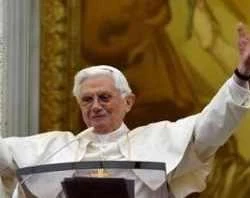
VATICAN CITY, DEC. 16, 2010 (Zenit.org).- Here is the the text of Benedict XVI's message for the 44th World Day of Peace, which will be observed Jan. 1. The theme for the day will be: "Religious Freedom, the Path to Peace." The Vatican press office released the message today.
* * *
1. At the beginning of the new year I offer good wishes to each and all for serenity and prosperity, but especially for peace. Sadly, the year now ending has again been marked by persecution, discrimination, terrible acts of violence and religious intolerance.
My thoughts turn in a special way to the beloved country of Iraq, which continues to be a theatre of violence and strife as it makes its way towards a future of stability and reconciliation. I think of the recent sufferings of the Christian community, and in particular the reprehensible attack on the Syro-Catholic Cathedral of Our Lady of Perpetual Help in Baghdad, where on 31 October two priests and over fifty faithful were killed as they gathered for the celebration of Holy Mass. In the days that followed, other attacks ensued, even on private homes, spreading fear within the Christian community and a desire on the part of many to emigrate in search of a better life. I assure them of my own closeness and that of the entire Church, a closeness which found concrete expression in the recent Special Assembly for the Middle East of the Synod of Bishops. The Synod encouraged the Catholic communities in Iraq and throughout the Middle East to live in communion and to continue to offer a courageous witness of faith in those lands.
I offer heartfelt thanks to those Governments which are working to alleviate the sufferings of these, our brothers and sisters in the human family, and I ask all Catholics for their prayers and support for their brethren in the faith who are victims of violence and intolerance. In this context, I have felt it particularly appropriate to share some reflections on religious freedom as the path to peace. It is painful to think that in some areas of the world it is impossible to profess one’s religion freely except at the risk of life and personal liberty. In other areas we see more subtle and sophisticated forms of prejudice and hostility towards believers and religious symbols. At present, Christians are the religious group which suffers most from persecution on account of its faith. Many Christians experience daily affronts and often live in fear because of their pursuit of truth, their faith in Jesus Christ and their heartfelt plea for respect for religious freedom. This situation is unacceptable, since it represents an insult to God and to human dignity; furthermore, it is a threat to security and peace, and an obstacle to the achievement of authentic and integral human development.[1]
Religious freedom expresses what is unique about the human person, for it allows us to direct our personal and social life to God, in whose light the identity, meaning and purpose of the person are fully understood. To deny or arbitrarily restrict this freedom is to foster a reductive vision of the human person; to eclipse the public role of religion is to create a society which is unjust, inasmuch as it fails to take account of the true nature of the human person; it is to stifle the growth of the authentic and lasting peace of the whole human family.
For this reason, I implore all men and women of good will to renew their commitment to building a world where all are free to profess their religion or faith, and to express their love of God with all their heart, with all their soul and with all their mind (cf. Mt 22:37). This is the sentiment which inspires and directs this Message for the XLIV World Day of Peace, devoted to the theme: Religious Freedom, the Path to Peace.
A sacred right to life and to a spiritual life
2. The right to religious freedom is rooted in the very dignity of the human person,[2] whose transcendent nature must not be ignored or overlooked. God created man and woman in his own image and likeness (cf. Gen 1:27). For this reason each person is endowed with the sacred right to a full life, also from a spiritual standpoint. Without the acknowledgement of his spiritual being, without openness to the transcendent, the human person withdraws within himself, fails to find answers to the heart’s deepest questions about life’s meaning, fails to appropriate lasting ethical values and principles, and fails even to experience authentic freedom and to build a just society.[3]
Sacred Scripture, in harmony with our own experience, reveals the profound value of human dignity: "When I look at your heavens, the work of your fingers, the moon and the stars which you have established, what is man that you are mindful of him, and the son of man, that you care for him? Yet you have made him little less than God, and crowned him with glory and honour. You have given him dominion over the works of your hands; you have put all things under his feet" (Ps 8:3-6).
Contemplating the sublime reality of human nature, we can experience the same amazement felt by the Psalmist. Our nature appears as openness to the Mystery, a capacity to ask deep questions about ourselves and the origin of the universe, and a profound echo of the supreme Love of God, the beginning and end of all things, of every person and people.[4] The transcendent dignity of the person is an essential value of Judeo-Christian wisdom, yet thanks to the use of reason, it can be recognized by all. This dignity, understood as a capacity to transcend one’s own materiality and to seek truth, must be acknowledged as a universal good, indispensable for the building of a society directed to human fulfilment. Respect for essential elements of human dignity, such as the right to life and the right to religious freedom, is a condition for the moral legitimacy of every social and legal norm.
Religious freedom and mutual respect
3. Religious freedom is at the origin of moral freedom. Openness to truth and perfect goodness, openness to God, is rooted in human nature; it confers full dignity on each individual and is the guarantee of full mutual respect between persons. Religious freedom should be understood, then, not merely as immunity from coercion, but even more fundamentally as an ability to order one’s own choices in accordance with truth.
Freedom and respect are inseparable; indeed, "in exercising their rights, individuals and social groups are bound by the moral law to have regard for the rights of others, their own duties to others and the common good of all".[5]
A freedom which is hostile or indifferent to God becomes self-negating and does not guarantee full respect for others. A will which believes itself radically incapable of seeking truth and goodness has no objective reasons or motives for acting save those imposed by its fleeting and contingent interests; it does not have an "identity" to safeguard and build up through truly free and conscious decisions. As a result, it cannot demand respect from other "wills", which are themselves detached from their own deepest being and thus capable of imposing other "reasons" or, for that matter, no "reason" at all. The illusion that moral relativism provides the key for peaceful coexistence is actually the origin of divisions and the denial of the dignity of human beings. Hence we can see the need for recognition of a twofold dimension within the unity of the human person: a religious dimension and a social dimension. In this regard, "it is inconceivable that believers should have to suppress a part of themselves – their faith – in order to be active citizens. It should never be necessary to deny God in order to enjoy one’s rights".[6]
The family, the school of freedom and peace
4. If religious freedom is the path to peace, religious education is the highway which leads new generations to see others as their brothers and sisters, with whom they are called to journey and work together so that all will feel that they are living members of the one human family, from which no one is to be excluded.
The family founded on marriage, as the expression of the close union and complementarity between a man and a woman, finds its place here as the first school for the social, cultural, moral and spiritual formation and growth of children, who should always be able to see in their father and mother the first witnesses of a life directed to the pursuit of truth and the love of God. Parents must be always free to transmit to their children, responsibly and without constraints, their heritage of faith, values and culture. The family, the first cell of human society, remains the primary training ground for harmonious relations at every level of coexistence, human, national and international. Wisdom suggests that this is the road to building a strong and fraternal social fabric, in which young people can be prepared to assume their proper responsibilities in life, in a free society, and in a spirit of understanding and peace.
A common patrimony
5. It could be said that among the fundamental rights and freedoms rooted in the dignity of the person, religious freedom enjoys a special status. When religious freedom is acknowledged, the dignity of the human person is respected at its root, and the ethos and institutions of peoples are strengthened. On the other hand, whenever religious freedom is denied, and attempts are made to hinder people from professing their religion or faith and living accordingly, human dignity is offended, with a resulting threat to justice and peace, which are grounded in that right social order established in the light of Supreme Truth and Supreme Goodness.
Religious freedom is, in this sense, also an achievement of a sound political and juridical culture. It is an essential good: each person must be able freely to exercise the right to profess and manifest, individually or in community, his or her own religion or faith, in public and in private, in teaching, in practice, in publications, in worship and in ritual observances. There should be no obstacles should he or she eventually wish to belong to another religion or profess none at all. In this context, international law is a model and an essential point of reference for states, insofar as it allows no derogation from religious freedom, as long as the just requirements of public order are observed.[7] The international order thus recognizes that rights of a religious nature have the same status as the right to life and to personal freedom, as proof of the fact that they belong to the essential core of human rights, to those universal and natural rights which human law can never deny.
Religious freedom is not the exclusive patrimony of believers, but of the whole family of the earth’s peoples. It is an essential element of a constitutional state; it cannot be denied without at the same time encroaching on all fundamental rights and freedoms, since it is their synthesis and keystone. It is "the litmus test for the respect of all the other human rights".[8] While it favours the exercise of our most specifically human faculties, it creates the necessary premises for the attainment of an integral development which concerns the whole of the person in every single dimension.[9]
The public dimension of religion
6. Religious freedom, like every freedom, proceeds from the personal sphere and is achieved in relationship with others. Freedom without relationship is not full freedom. Religious freedom is not limited to the individual dimension alone, but is attained within one’s community and in society, in a way consistent with the relational being of the person and the public nature of religion.
Relationship is a decisive component in religious freedom, which impels the community of believers to practise solidarity for the common good. In this communitarian dimension, each person remains unique and unrepeatable, while at the same time finding completion and full realization.
The contribution of religious communities to society is undeniable. Numerous charitable and cultural institutions testify to the constructive role played by believers in the life of society. More important still is religion’s ethical contribution in the political sphere. Religion should not be marginalized or prohibited, but seen as making an effective contribution to the promotion of the common good. In this context mention should be made of the religious dimension of culture, built up over centuries thanks to the social and especially ethical contributions of religion. This dimension is in no way discriminatory towards those who do not share its beliefs, but instead reinforces social cohesion, integration and solidarity.
Religious freedom, a force for freedom and civilization: dangers arising from its exploitation
7. The exploitation of religious freedom to disguise hidden interests, such as the subversion of the established order, the hoarding of resources or the grip on power of a single group, can cause enormous harm to societies. Fanaticism, fundamentalism and practices contrary to human dignity can never be justified, even less so in the name of religion. The profession of a religion cannot be exploited or imposed by force. States and the various human communities must never forget that religious freedom is the condition for the pursuit of truth, and truth does not impose itself by violence but "by the force of its own truth".[10] In this sense, religion is a positive driving force for the building of civil and political society.
How can anyone deny the contribution of the world’s great religions to the development of civilization? The sincere search for God has led to greater respect for human dignity. Christian communities, with their patrimony of values and principles, have contributed much to making individuals and peoples aware of their identity and their dignity, the establishment of democratic institutions and the recognition of human rights and their corresponding duties.
Today too, in an increasingly globalized society, Christians are called, not only through their responsible involvement in civic, economic and political life but also through the witness of their charity and faith, to offer a valuable contribution to the laborious and stimulating pursuit of justice, integral human development and the right ordering of human affairs. The exclusion of religion from public life deprives the latter of a dimension open to transcendence. Without this fundamental experience it becomes difficult to guide societies towards universal ethical principles and to establish at the national and international level a legal order which fully recognizes and respects fundamental rights and freedoms as these are set forth in the goals – sadly still disregarded or contradicted – of the 1948 Universal Declaration of Human Rights.
An issue of justice and civility: fundamentalism and hostility to believers compromise the positive secularity of states
8. The same determination that condemns every form of fanaticism and religious fundamentalism must also oppose every form of hostility to religion that would restrict the public role of believers in civil and political life.
It should be clear that religious fundamentalism and secularism are alike in that both represent extreme forms of a rejection of legitimate pluralism and the principle of secularity. Both absolutize a reductive and partial vision of the human person, favouring in the one case forms of religious integralism and, in the other, of rationalism. A society that would violently impose or, on the contrary, reject religion is not only unjust to individuals and to God, but also to itself. God beckons humanity with a loving plan that, while engaging the whole person in his or her natural and spiritual dimensions, calls for a free and responsible answer which engages the whole heart and being, individual and communitarian. Society too, as an expression of the person and of all his or her constitutive dimensions, must live and organize itself in a way that favours openness to transcendence. Precisely for this reason, the laws and institutions of a society cannot be shaped in such a way as to ignore the religious dimension of its citizens or to prescind completely from it. Through the democratic activity of citizens conscious of their lofty calling, those laws and institutions must adequately reflect the authentic nature of the person and support its religious dimension. Since the latter is not a creation of the state, it cannot be manipulated by the state, but must rather be acknowledged and respected by it.
Whenever the legal system at any level, national or international, allows or tolerates religious or antireligious fanaticism, it fails in its mission, which is to protect and promote justice and the rights of all. These matters cannot be left to the discretion of the legislator or the majority since, as Cicero once pointed out, justice is something more than a mere act which produces and applies law. It entails acknowledging the dignity of each person[11] which, unless religious freedom is guaranteed and lived in its essence, ends up being curtailed and offended, exposed to the risk of falling under the sway of idols, of relative goods which then become absolute. All this exposes society to the risk of forms of political and ideological totalitarianism which emphasize public power while demeaning and restricting freedom of conscience, thought and religion as potential competitors.
Dialogue between civil and religious institutions
9. The patrimony of principles and values expressed by an authentic religiosity is a source of enrichment for peoples and their ethos. It speaks directly to the conscience and mind of men and women, it recalls the need for moral conversion, and it encourages the practice of the virtues and a loving approach to others as brothers and sisters, as members of the larger human family.[12]
With due respect for the positive secularity of state institutions, the public dimension of religion must always be acknowledged. A healthy dialogue between civil and religious institutions is fundamental for the integral development of the human person and social harmony.
Living in love and in truth
10. In a globalized world marked by increasingly multi-ethnic and multi-religious societies, the great religions can serve as an important factor of unity and peace for the human family. On the basis of their religious convictions and their reasoned pursuit of the common good, their followers are called to give responsible expression to their commitment within a context of religious freedom. Amid the variety of religious cultures, there is a need to value those elements which foster civil coexistence, while rejecting whatever is contrary to the dignity of men and women.
The public space which the international community makes available for the religions and their proposal of what constitutes a "good life" helps to create a measure of agreement about truth and goodness, and a moral consensus; both of these are fundamental to a just and peaceful coexistence. The leaders of the great religions, thanks to their position, their influence and their authority in their respective communities, are the first ones called to mutual respect and dialogue.
Christians, for their part, are spurred by their faith in God, the Father of the Lord Jesus Christ, to live as brothers and sisters who encounter one another in the Church and work together in building a world where individuals and peoples "shall not hurt or destroy … for the earth shall be full of the knowledge of the Lord as the waters cover the sea" (Is 11:9).
Dialogue as a shared pursuit
11. For the Church, dialogue between the followers of the different religions represents an important means of cooperating with all religious communities for the common good. The Church herself rejects nothing of what is true and holy in the various religions. "She has a high regard for those ways of life and conduct, precepts and doctrines which, although differing in many ways from her own teaching, nevertheless often reflect a ray of that truth which enlightens all men and women".[13]
The path to take is not the way of relativism or religious syncretism. The Church, in fact, "proclaims, and is in duty bound to proclaim without fail, Christ who is the way, the truth and the life (Jn 14:6); in Christ, in whom God reconciled all things to himself, people find the fullness of the religious life".[14] Yet this in no way excludes dialogue and the common pursuit of truth in different areas of life, since, as Saint Thomas Aquinas would say, "every truth, whoever utters it, comes from the Holy Spirit".[15]
The year 2011 marks the twenty-fifth anniversary of the World Day of Prayer for Peace convened in Assisi in 1986 by Pope John Paul II. On that occasion the leaders of the great world religions testified to the fact that religion is a factor of union and peace, and not of division and conflict. The memory of that experience gives reason to hope for a future in which all believers will see themselves, and will actually be, agents of justice and peace.
Moral truth in politics and diplomacy
12. Politics and diplomacy should look to the moral and spiritual patrimony offered by the great religions of the world in order to acknowledge and affirm universal truths, principles and values which cannot be denied without denying the dignity of the human person. But what does it mean, in practical terms, to promote moral truth in the world of politics and diplomacy? It means acting in a responsible way on the basis of an objective and integral knowledge of the facts; it means deconstructing political ideologies which end up supplanting truth and human dignity in order to promote pseudo-values under the pretext of peace, development and human rights; it means fostering an unswerving commitment to base positive law on the principles of the natural law.[16] All this is necessary and consistent with the respect for the dignity and worth of the human person enshrined by the world’s peoples in the 1945 Charter of the United Nations, which presents universal values and moral principles as a point of reference for the norms, institutions and systems governing coexistence on the national and international levels.
Beyond hatred and prejudice
13. Despite the lessons of history and the efforts of states, international and regional organizations, non-governmental organizations and the many men and women of good will who daily work to protect fundamental rights and freedoms, today’s world also witnesses cases of persecution, discrimination, acts of violence and intolerance based on religion. In a particular way, in Asia and in Africa, the chief victims are the members of religious minorities, who are prevented from freely professing or changing their religion by forms of intimidation and the violation of their rights, basic freedoms and essential goods, including the loss of personal freedom and life itself.
There also exist – as I have said – more sophisticated forms of hostility to religion which, in Western countries, occasionally find expression in a denial of history and the rejection of religious symbols which reflect the identity and the culture of the majority of citizens. Often these forms of hostility also foster hatred and prejudice; they are inconsistent with a serene and balanced vision of pluralism and the secularity of institutions, to say nothing of the fact that coming generations risk losing contact with the priceless spiritual heritage of their countries.
Religion is defended by defending the rights and freedoms of religious communities. The leaders of the great world religions and the leaders of nations should therefore renew their commitment to promoting and protecting religious freedom, and in particular to defending religious minorities; these do not represent a threat to the identity of the majority but rather an opportunity for dialogue and mutual cultural enrichment. Defending them is the ideal way to consolidate the spirit of good will, openness and reciprocity which can ensure the protection of fundamental rights and freedoms in all areas and regions of the world.
Religious freedom in the world
14. Finally I wish to say a word to the Christian communities suffering from persecution, discrimination, violence and intolerance, particularly in Asia, in Africa, in the Middle East and especially in the Holy Land, a place chosen and blessed by God. I assure them once more of my paternal affection and prayers, and I ask all those in authority to act promptly to end every injustice against the Christians living in those lands. In the face of present difficulties, may Christ’s followers not lose heart, for witnessing to the Gospel is, and always will be, a sign of contradiction.
Let us take to heart the words of the Lord Jesus: "Blessed are those who mourn, for they shall be comforted … Blessed are those who hunger and thirst for righteousness, for they shall be satisfied … Blessed are you when men revile you and persecute you and utter all kinds of evil against you falsely on my account. Rejoice and be glad, for your reward is great in heaven" (Mt 5:4-12). Then let us renew "the pledge we give to be forgiving and to pardon when we invoke God’s forgiveness in the Our Father. We ourselves lay down the condition and the extent of the mercy we ask for when we say: ‘And forgive us our debts, as we have forgiven those who are in debt to us’ (Mt 6:12)".[17] Violence is not overcome by violence. May our cries of pain always be accompanied by faith, by hope and by the witness of our love of God. I also express my hope that in the West, and especially in Europe, there will be an end to hostility and prejudice against Christians because they are resolved to orient their lives in a way consistent with the values and principles expressed in the Gospel. May Europe rather be reconciled to its own Christian roots, which are fundamental for understanding its past, present and future role in history; in this way it will come to experience justice, concord and peace by cultivating a sincere dialogue with all peoples.
Religious freedom, the path to peace
15. The world needs God. It needs universal, shared ethical and spiritual values, and religion can offer a precious contribution to their pursuit, for the building of a just and peaceful social order at the national and international levels.
Peace is a gift of God and at the same time a task which is never fully completed. A society reconciled with God is closer to peace, which is not the mere absence of war or the result of military or economic supremacy, much less deceptive ploys or clever manipulation. Rather, peace is the result of a process of purification and of cultural, moral and spiritual elevation involving each individual and people, a process in which human dignity is fully respected. I invite all those who wish to be peacemakers, especially the young, to heed the voice speaking within their hearts and thus to find in God the stable point of reference for attaining authentic freedom, the inexhaustible force which can give the world a new direction and spirit, and overcome the mistakes of the past. In the words of Pope Paul VI, to whose wisdom and farsightedness we owe the institution of the World Day of Peace: "It is necessary before all else to provide peace with other weapons – different from those destined to kill and exterminate mankind. What are needed above all are moral weapons, those which give strength and prestige to international law – the weapon, in the first place, of the observance of pacts".[18] Religious freedom is an authentic weapon of peace, with an historical and prophetic mission. Peace brings to full fruition the deepest qualities and potentials of the human person, the qualities which can change the world and make it better. It gives hope for a future of justice and peace, even in the face of grave injustice and material and moral poverty. May all men and women, and societies at every level and in every part of the earth, soon be able to experience religious freedom, the path to peace!
From the Vatican, 8 December 2010
BENEDICTUS PP XVI
NOTES
[1] Cf. BENEDICT XVI, Encyclical Letter Caritas in Veritate, 29, 55-57.
[2] Cf. SECOND VATICAN ECUMENICAL COUNCIL, Declaration on Religious Freedom Dignitatis Humanae, 2.
[3] Cf. BENEDICT XVI, Encyclical Letter Caritas in Veritate, 78.
[4] Cf. SECOND VATICAN ECUMENICAL COUNCIL, Declaration on the Relation of the Church to Non-Christian Religions Nostra Aetate, 1.
[5] ID., Declaration on Religious Freedom Dignitatis Humanae, 7.
[6] BENEDICT XVI, Address to the General Assembly of the United Nations (18 April 2008): AAS 100 (2008), 337.
[7] Cf. SECOND VATICAN ECUMENICAL COUNCIL, Declaration on Religious Freedom Dignitatis Humanae, 2.
[8] JOHN PAUL II, Address to Participants in the Parliamentary Assembly of the Organization for Security and Cooperation in Europe (OSCE) (10 October 2003), 1: AAS 96 (2004), 111.
[9] Cf. BENEDICT XVI, Encyclical Letter Caritas in Veritate, 11.
[10] Cf. SECOND VATICAN ECUMENICAL COUNCIL, Declaration on Religious Freedom Dignitatis Humanae, 1.
[11] Cf. CICERO, De Inventione, II, 160.
[12] Cf. BENEDICT XVI, Address to Representatives of Other Religions in the United Kingdom (17 September 2010): L’Osservatore Romano (18 September 2010), p. 12.
[13] Cf. SECOND VATICAN ECUMENICAL COUNCIL, Declaration on the Relation of the Church to Non-Christian Religions Nostra Aetate, 2.
[14] Ibid.
[15] Super Evangelium Joannis, I, 3.
[16] Cf. BENEDICT XVI, Address to Civil Authorities and the Diplomatic Corps in Cyprus (4 June 2010): L’Osservatore Romano (6 June 2010), p. 8; INTERNATIONAL THEOLOGICAL COMMISSION, The Search for Universal Ethics: A New Look at Natural Law, Vatican City, 2009.
[17] PAUL VI, Message for the 1976 World Day of Peace: AAS 67 (1975), 671.
[18] Ibid., p. 668.
© Copyright 2010 -- Libreria Editrice Vaticana
|
|
|---|
Showing posts with label Global Governance. Show all posts
Saturday, January 22, 2011
Vatican Bank Chief Issues Economic Warning
about US, European economic policies
.- Current fiscal and monetary policies in the United States and Europe risk increasing government control over national economies, resulting in weakened political strength throughout “the whole of the western world,” the Vatican’s top banking expert said.
Ettore Gotti Tedeschi has been head of the Vatican's bank, known as the Institute for Religious Works, since 2009. He has a long career in finance, having served as the head of Banco Santander, the largest private bank in Europe, as well as on the boards of some of the continent’s leading financial institutions.
He is known as a staunch capitalist with a deep concern for the Church’s social teaching. He is also a former professor of financial ethics at the Catholic University of Milan.
Writing in the Jan. 14 edition of the Vatican newspaper, L’Osservatore Romano, Tedeschi warned of the growing influence of “Keynesian” economic theory on both sides of the Atlantic.
John Maynard Keynes was a prominent 20th-century economist whose theories were widely embraced by world powers to jump-start their economies after World War II.
Tedeschi cited a 2009 book, "Where Keynes Went Wrong: And Why World Governments keep creating Inflation, Bubbles and Busts," by the American economist and philosopher Hunter Lewis.
He said Lewis had spelled out the "doctrinal errors and practical disasters" of Keynes' theories.
In simple terms, Keynes taught that in times of economic crisis, consumer demand must be stimulated by government investment and an "attitude of saving" must be discouraged,
Tedeschi wrote.
He said Keynes' crisis-averting tactics can be seen in the U.S., where government economic policy has focused on increasing public expenditures – and public debt – in order to stimulate private economic activity, including consumer demand and employment.
In addition, also following Keynesian wisdom, the U.S. is printing more money and has looked at increasing taxes in an effort to generate more public revenues.
Tedeschi warned that these policies are leading to a "nationalization" of private debt in the U.S. He also criticized the government bailouts of private banks that offered too much credit without adequate guarantees. This too is leading to increased government control of the economy in the U.S. — a “nationalization” that is being paid for with newly printed currency.
In Europe, he said, the issue is the opposite. Because of the lack of widespread private debt, a "privatization" effort is being enacted to absorb the large public debt of banks and businesses.
This also is Keynesian policy, which "perseveres against the scorned savings," Tedeschi said.
Governments on both sides of the Atlantic, he said, are committed to Keynes' policy of increasing public debt to sustain levels of economic production, consumption, and employment.
He said artificially low interest rates are another key to the strategy of increasing spending and discouraging saving. With no incentive to keep money in the bank, those who would have otherwise been savers are pushed to spend.
"Zero interest rates factually equal a de facto transfer of wealth from he who was a virtuous saver (although not for Keynes) to he who has become virtuously (for Keynes) indebted," he said.
"Practically, it's about a hidden tax on poor savers, a tax transferred to the wealthy, (that is), over-indebted states, business people and bankers.”
Although the alternative to zero interest in such a situation is economic collapse and eventual default, the zero-rates "are not sustainable and are dangerous," Tedeschi warned.
"They destroy savings, which is an essential resource to create the base for bank credit; they promote speculation on real estate and securities, create illusory artificial values rather than scaling them down; they push consumption to more risky debt; they alter the market with artificial values and thus lead to belief that the very markets do not know how to correct themselves."
The biggest danger, Tedeschi said, is that zero interest rates "permit, or impose governments into management of the economy, without correcting inefficiency and facilitating distortions in the competition."
He warned that the greatest economic impacts may be on the way.
In the future, he said, inflation might be used as the "maneuver" to absorb the enormous debt in both the U.S. and Europe. Debt levels are now three times as large as the gross domestic product in most countries, he observed. Governments have thus far been able to control inflation by controlling consumption rates.
"Someone," he said, "is hoping for new taxes to sustain a new statism that reinforces a rather weak political class in the whole western world."
Tuesday, January 18, 2011
Catholic Figures Played Major Role in START Treaty
The Vatican has worked hard to spread the ideas of nuclear non-proliferation.
And why is that?
Because the Vatican doesn't have nuclear weapons -- it wants to level the political playing field.
This article comes from the National Catholic Reporter.
------------------------------
Catholics had a major role in passing nuclear treaty
By Dennis Sadowski
WASHINGTON -- As Democratic and Republican senators pressed their divergent views on the New START agreement with Russia outlining the next phase of nuclear disarmament during final debate in December, a wide array of Catholics played a major role in getting the pact ratified.
From political insiders to people in the pews, Catholics provided a moral perspective on the need for the treaty, helping build the final 71-26 margin for ratification, several people working on the issue told Catholic News Service.
The effort by Catholics also helped keep the vote on schedule, preventing it from being pushed into 2011 when the likelihood of ratification would have been dimmer because of the loss of six Democratic seats in the Senate.
Both houses of the Russian parliament are reviewing the treaty and are expected to ratify it in the coming weeks.
No one contacted by CNS said that without the Catholic effort the treaty would have failed. But they acknowledged that the involvement of such a broad array of Catholic voices -- from Archbishop Edwin F. O'Brien of Baltimore, who formerly headed the U.S. Archdiocese for the Military Services, to Dave Robinson, executive director of Pax Christi USA -- ratification became much easier to accomplish in an era where bipartisan cooperation in Congress is almost nonexistent.
David Culp, legislative representative for the Quaker Friends Committee on National Legislation, heaped high praise on Catholics. He pointed to the efforts by the U.S. Conference of Catholic Bishops as well as key Catholic members of Congress and the Obama administration for leading the way.
"(Catholics) definitely have been the most active and most important faith-based group working on this," Culp said. "This has been an amazing effort (by Catholics) from top to bottom."
Pax Christi's Robinson described the Catholic effort as one that has naturally evolved given the church's increasingly stronger stance against nuclear weapons.
"This is an example of people both on the inside and the outside able to apply their values and faith traditions on a really important public policy matter that is going to enhance security and move us down to the road to a nuclear weapons-free world," he said.
The new treaty calls for both countries to reduce their strategic arsenals -- weapons deployed on long-range missiles, bombers and submarines -- to 1,550 each. Under the previous START pact, which expired in December 2009, both countries reduced their strategic arsenals to 2,200 weapons each.
Key Catholic insiders working for the treaty's ratification included the likes of Vice President Joe Biden and aide Brian McKeon; Sen. John Kerry, D-Mass., chairman of the Committee on Foreign Relations; Denis McDonough, deputy national security adviser; and Rose E. Gottemoeller, assistant secretary in the Department of State's Bureau of Verification, Compliance and Implementation, who was the lead U.S. negotiator of the agreement.
Gottemoeller, who holds a degree in Russian from Georgetown University, told CNS she welcomed the "high level of interest" in nuclear disarmament among people of faith, especially Catholics and evangelicals.
"It was important to engage people's interest and to have the Catholic bishops of the United States and Catholic organizations to step forward and speak about the importance of the issue and engage the public," she said.
At the White House, two staffers speaking on background, said their work was motivated by the president's desire to get the treaty ratified as opposed to adhering to the teaching of any particular faith. Both welcomed the comments of people of faith, saying those views were "taken into account" as strategies for approaching senators sitting on the fence were formed.
Stephen Colecchi, director of the USCCB's Office of International Justice and Peace, explained that the bishops staked out their position on the treaty soon after Obama announced April 8 in Prague that he and Russian President Dmitry Medvedev signed the arms reduction pact.
"The fact that Catholics were leading the effort is not a surprise to me," Colecchi said.
He said 30 bishops -- a much larger number than on most legislative issues other than same-sex marriage, abortion and health care -- contacted senators at various times in 2010.
Leading the way was Bishop Howard J. Hubbard of Albany, N.Y., chairman of the bishops' Committee on International Justice and Peace. He regularly joined teleconferences and sent letters to the Senate on behalf of the conference.
The bishops were backed by hundreds of letters from religious orders as well as average Catholics who responded to a series of legislative alerts issued by Colecchi's office.
"The church's teaching on this is very clear and it's very clear on the issue of protecting human life and human dignity," Colecchi said, explaining why large numbers of people responded to the arms control issue.
Outside of the conference, as expected, organizations such as the Maryknoll Office of Global Concerns and Network, a Catholic social justice lobbying organization, also made their voices heard.
This time though, they were joined by the National Association of Evangelicals and organizations such as the Two Futures Project, headed by the Rev. Tyler Wigg-Stevenson, whose influence on social issues is gaining favor rapidly among more traditionally conservative Christians.
"This is an example of where the church's teaching formed and motivated people," Colecchi said. "I think we can be very proud of our church and very proud of our bishops."
Monday, January 17, 2011
Pope Meets UNESCO Director
This article comes from Zenit.
-----------------------
Holy Father Greets UNESCO Director
VATICAN CITY, JAN. 17, 2011 (Zenit.org).- Benedict XVI received in audience today Irina Bokova, director-general of the United Nations Educational, Scientific and Cultural Organisation (UNESCO).
A communique of the Vatican press office reported that the "cordial discussions provided an opportunity for a fruitful exchange of opinions on UNESCO's efforts in the field of education, sciences and culture, which are also of particular interest to the Holy See as it participates actively in the work of the organization."
"On this topic," the noted continued, "emphasis was given to the need to ensure integral human development, and to the importance of guaranteeing quality education for everyone."
The Vatican reported that the discussion also addressed "certain aspects of protecting world cultural heritage, and of defending the environment, as well as to the importance of dialogue between cultures."
Bokova subsequently went on to meet with Cardinal Tarcisio Bertone, the Holy Father's secretary of state, who was accompanied by Archbishop Dominique Mamberti, secretary for relations with states.
Sunday, January 16, 2011
Pope Our Goal is to Form "One Human Family"
This article comes from the Catholic News Agency.
-------------------------------
Pope prays for the 'one human family' desired by Christ
By Alan Holdren, Rome Correspondent
Vatican City, Jan 16, 2011 / 10:33 am (CNA/EWTN News).- Marking the 97th World Day of Migrants and Refugees on Sunday, Pope Benedict XVI spoke of the "migration experience" of the Church and hoped for a future where all people consider themselves part of "one human family."
The Son of God was a refugee himself, said the Pope in his message before the noon Angelus prayer on Jan. 16, a beautiful spring-like day in Rome.
Beginning from when Jesus was born and his parents fled to Egypt to protect his life, the Church has always lived the "migration experience," he said.
He pointed out that the World Day of Migrants and Refugees invites reflection on the experience of the many people today who abandon their nations "often ... in dramatic conditions" in search of better lives.
Christians sometimes "feel forced to leave" their homes but in other cases their voluntary movements from one place to another become a source of "missionary dynamism" for God's message, "traversing peoples and cultures and reaching new frontiers."
The international day to remember those in movement, he said, is also a day to think to "the goal of the great voyage of humanity."
The goal, he said, is that of "forming a single family ... with all the differences that enrich it, but without barriers, recognizing ourselves all as brothers."
He cited a pair of quotes from Second Vatican Council documents to illustrate the Church's vision. Quoting "Nostra aetate," the Pope said, “one is the community of all peoples, one their origin, for God made the whole human race to live over the face of the earth."
"The Church," he continued, with a passage from the document "Lumen gentium,” "in Christ like a sacrament or as a sign and instrument both of a very closely knit union with God and of the unity of the whole human race."
"For this," he said, "it is fundamental that Christians, despite being dispersed through the world and ... diverse by culture and traditions, be a single thing, as the Lord wishes."
He pointed to the Jan. 18-25 Week of Prayer for Christian Unity as an initiative with this scope in mind. The Day of Jewish-Christian dialogue on Jan. 17 is also a "very meaningful" occasion that serves as a call back to "the importance of the common roots that unite Jews and Christians," he said.
He concluded his pre-Angelus address with a prayer that Mary intercede to bring about the full unity of all those who follow Christ.
Following the prayer, the Pope expressed his joy for the May 1 beatification of his predecessor, Pope John Paul II, and prayed for all those affected by recent flooding in Australia, Brazil, the Philippines and Sri Lanka.
Thursday, December 23, 2010
The Donation of Constantine and Papal Ambition
Today I publish an ancient Latin document from the first millennium AD. It is called the Donation of Constantine.
Sometime in the eighth century, Pope Stephen II ordered his secretaries to forge a document in the name of the Roman Emperor Constantine (who had been dead for hundreds of years) bequeathing the city of Rome to the Roman popes based on their spiritual kingship over the earth. Stephen used the document to exercise sovereign authority over the barbarian kings, and subsequent popes over the next seven centuries used it to dominate their worlds as well.
It was not until 1440 that a Catholic priest named Lorenzo Valla proved that the document was a fake.
There are a few reasons I post this document:
1. It demonstrates that the Roman Catholic Church has been engaging in international politics for over a thousand years, making it the oldest continuously operating "state" in the world.
2. It shows that the Church has been using deceptive and illicit tactics for a very long time.
3. It reveals what the Roman popes desired and how they wanted the people to view them in medieval Europe.
The end of the document contains most of the interesting stuff. If you only read the yellow highlighted parts, you won't miss anything.
In the next few days I will publish parts of Lorenzo Valla's Discourse on the Forgery of the Alleged Donation of Constantine.
This document comes from the Fordham Medieval Sourcebook.
---------------------------------------
The Donation of Constantine (c.750-800)
This is perhaps the most famous forgery in history. For centuries, until Lorenzo Valla proved it was forgery during the Renaissance it provided the basis for papal territorial and jurisdictional claims in Italy. Probably at least a first draft of it was made shortly after the middle of the eighth century in order to assist Pope Stephen II in his negotiations with the Frankish Mayor of the Palace, Pepin the Short. The Pope crossed the Alps to anoint the latter as king in 754, thereby enabling, the Carolingian family, to which Pepin belonged, to supplant the old Merovingian royal line which had become decadent and powerless and to become in law as well as in fact rulers of the Franks. In return, Pepin seems to have promised to give to the Pope those lands in Italy which the Lombards had taken from Byzantium. The promise was fulfilled in 756. Constantine's alleged gift made it possible to interpret Pepin's grant not as a benefaction but as a restoration.
In the name of the holy and indivisible Trinity, the Father, namely, and the Son and the Holy Spirit. The emperor Caesar Flavius Constantine in Christ Jesus, the Lord I God our Saviour, one of that same holy Trinity,-faithful merciful, supreme, beneficent, Alamannic, Gothic, Sarmatic, Germanic, Britannic, Hunic, pious, fortunate, victor and triumpher, always august:
To the most holy and blessed father of fathers Sylvester, bishop of the city of and to all his successors the pontiffs , who are about to sit upon Rome and pope, the chair of St. Peter until the end of time - also to all the most reverend and of God beloved catholic bishops, subjected by this our imperial decree throughout the whole world to this same holy, Roman church, who have been established now and in all previous times-grace, peace, charitv, rejoicing, long-suffering, mercv, be with you all from God the Father almighty and from Jesus Christ his Son and from the Holy Ghost.
Our most gracious serenity desires, in clear discourse, through the page of this our imperial decree, to bring to the knowledge of all the people in the whole world what things our Saviour and Redeemer the Lord Jesus Christ, the Son of the most High Father, has most wonderfully seen fit to bring about through his holy apostles Peter and Paul and by the intervention of our father Sylvester, the highest pontiff and the universal pope. First, indeed, putting forth, with the inmost confession of our heart, for the purpose of instructing the mind of all of you, our creed which we have learned from the aforesaid most blessed father and our confessor, Svlvester the universal pontiff; and then at length announcing the mercy of God which has been poured upon us.
For we wish you to know, as we have signified through our former imperial decree, that we have gone away, from the worship of idols, from mute and deaf images made by hand, from devilish contrivances and from all the pomps of Satan; and have arrived at the pure faith of the Christians, which is the true light and everlasting life. Believing, according to what he-that same one, our revered supreme father and teacher, the pontiff Sylvester - has taught us, in God the Father, the almighty maker of Heaven and earth, of all things visible and invisible; and in Jesus Christ, his only Son, our Lord God, through whom all things are created; and in the Holy Spirit, the Lord and vivifier of the whole creature. We confess these, the Father and the Son and the Holy Spirit, in such way that, in the perfect Trinity, there shall also be a fulness of divinity and a unity of power. The Father is God, the Son is God, and the Holy Spirit is God; and these three are one in Jesus Christ.
There are therefore three forms but one power. For God, wise in all previous time, gave forth from himself the word through which all future ages were to be born; and when, by that sole word of His wisdom, He formed the whole creation from nothing, He was with it, arranging all things in His mysterious secret place.
Therefore, the virtues of the Heavens and all the material part of the earth having been perfected, by the wise nod of His wisdom first creating man of the clay of the earth in His own image and likeness, He placed him in a paradise of delight. Him the ancient serpent and envious enemy, the devil, through the most bitter taste of the forbidden tree, made an exile from these joys; and, be being expelled, did not cease in many ways to cast his poisonous darts; in order that, turning the human race from the way of truth to the worship of idols, he might persuade it, namely to worship the creature and not the creator; so that, through them (the idols), he might cause those whom he might be able to entrap in his snares to be burned with him in eternal punishment. But our Lord, pitying His creature, sending ahead His holy prophets, announcing through them the light of the future life-the coming,' that is, of His Son our Lord and Saviour Jesus Christ-sent that same only begotten Son and Word of wisdom: He descending from Heaven on account of our salvation, being born of the Holy Spirit and of the Virgin Mary,-the word was made flesh and d welt among us. He did not cease to be what He had been, but began to be what He had not been, perfect God and perfect man: as God, performing miracles; as man, sustaining human sufferings. We so learned Him to be very man and very God by the preaching of our father Sylvester, the supreme pontiff, that we can in no wise doubt that He was very, God and very man. And, having chosen twelve apostles, He shone with miracles before them and an innumerable multitude of people. We confess that this same Lord Jesus Christ fulfilled the law and the prophets; that He suffered, was crucified, on the third day arose from the dead according to the Scriptures; was received into Heaven, and sitteth on the right hand of the Father. Whence He shall come to judge the quick and the dead, whose kingdom shall have no end. For this is our orthodox creed, placed before us by our most blessed father Sylvester, the supreme pontiff. We exhort, therefore, all people, and all the different nations, to hold, cherish and preach this faith; and, in the name of the Holy Trinity, to obtain the grace of baptism; and, with devaout heart, to adore the Lord Jesus Christ our Saviour, who with the Father and the Holy Spirit, lives and reigns through infinite ages; whom Sylvester our father, the universal pontiff, preaches. For He himself, our Lord God, having pity on me a sinner, sent His holy apostles to visit us, and caused the light of his splendour to shine upon us. And do ye rejoice that I, having been withdrawn from the shadow, have come to the true light and to the knowledge of truth. For, at a time when a mighty and filthy leprosy had invaded all the flesh of my, body, and the care was administered of many physicians who came together, nor by that of any one of them did I achieve health: there came hither the priests of the Capitol, saving to me that a font should be made on the Capitol, and that I should fill this with the blood of innocent infants; and that, if I bathed in it while it was warm, I might be cleansed. And very many innocent infants having been brought together according to their words, when the sacrilegious priests of the pagans wished them to be slaughtered and the font to be filled with their blood: Our Serenity perceiving the tears of the mothers, I straightway abhorred the deed. And, pitying them, I ordered their own sons to be restored to them; and, giving them vehicles and gifts, sent them off rejoicing to their own. That day having passed therefore-the silence of night having come upon us-when the time of sleep had arrived, the apostles St. Peter and Paul appear, saying to me: "Since thou hast placed a term to thy vices, and hast abhorred the pouring forth of innocent blood, we are sent by, Christ the Lord our God, to give to thee a plan for recovering thy health. Hear, therefore, our warning, and do what we indicate to thee. Sylvester - the bishop of the city of Rome - on Mount Serapte, fleeing they persecutions, cherishes the darkness with his clergy in the caverns of the rocks. This one, when thou shalt have led him to thyself, will himself show thee a pool of piety; in which, when he shall have dipped thee for the third time, all that strength of the leprosy will desert thee. And, when this shall have been done, make this return to thy Saviour, that by thy order through the whole world the churches may be restored. Purify thyself, moreover, in this way, that, leaving all the superstition of idols, thou do adore and cherish the living and true God -- who is alone and true -- and that thou attain to the doing of His will.
Rising, therefore, from sleep, straightway I did according to that which I bad been advised to do by, the holy apostles; and, having summoned that excellent and benignant father and our enlightener - Svlvester the universal pope-I told him all the words that had been taught me by the holy apostles; and asked him who where those gods Peter and Paul. But he said that they where not really called gods, but apostles of our Saviour the Lord God Jesus Christ. And again we began to ask that same most blessed pope whether he had some express image of those apostles; so that, from their likeness, we might learn that they were those whom revelation bad shown to us. Then that same venerable father ordered the images of those same apostles to be shown by his deacon. And, when I had looked at them, and recognized, represented in those images, the countenances of those whom I had seen in my dream: with a great noise, before all my satraps*, I confessed that they were those whom I had seen in my dream.
[* there were no such Roman officials]
Hereupon that same most blessed Sylvester our father, bishop of the city of Rome, imposed upon us a time of penance-within our Lateran palace, in the chapel, in a hair garment,-so that I might obtain pardon from our Lord God Jesus Christ our Saviour by vigils, fasts, and tears and prayers, for all things that had been impiously done and unjustly ordered by me. Then through the imposition of the hands of the clergy, I came to the bishop himself; and there, renouncing the pomps of Satan and his works, and all idols made by hands, of my own will before all the people I confessed: that I believed in God the Father almighty, maker of Heaven and earth, and of all things visible and invisible; and in Jesus Christ, His only Son our Lord, who was born of the Holy Spirit and of the Virgin Mary. And, the font having been blessed, the wave of salvation purified me there with a triple immersion. For there 1, being placed at the bottom of the font, saw with my own eyes a band from Heaven touching me; whence rising, clean, know that I was cleansed from all the squalor of leprosy. And, I being raised from the venerable font-putting on white raiment, be administered to me the sign of the seven-fold holy Spirit, the unction of the holy oil; and he traced the sign of the holy cross on my brow, saying: God seals thee with the seal of His faith in the name of the Father and the Son and the Holy Spirit, to signalize thy faith. All the clergy replied: "Amen." The bishop added, "peace be with thee."
And so, on the first day after receiving the mystery of the holy baptism, and after the cure of my body from the squalor of the leprosy, I recognized that there was no other God save the Father and the Son and the Holy Spirit; whom the most blessed Sylvester the pope doth preach; a trinity in one, a unity in three. For all the gods of the nations, whom I have worshipped up to this time, are proved to be demons; works made by the hand of men; inasmuch as that same venerable father told to us most clearly how much power in Heaven and on earth He, our Saviour, conferred on his apostle St. Peter, when finding him faithful after questioning him He said: "Thou art Peter, and upon this rock (petrani) shall I build My Church, and the gates of bell shall not prevail against it." Give heed ye powerful, and incline the ear of .your hearts to that which the good Lord and Master added to His disciple, saying: and I will give thee the keys of the kingdom of Heaven; and whatever thou shalt bind on earth shall be bound also in Heaven, and whatever thou shalt loose on earth shall be loosed also in Heaven." This is very wonderful and glorious, to bind and loose on earth and to have it bound and loosed in Heaven.
And when, the blessed Sylvester preaching them, I perceived these things, and learned that by the kindness of St. Peter himself I had been entirely restored to health: I together with all our satraps and the whole senate and the nobles and all the Roman people, who are subject to the glory of our rule -considered it advisable that, as on earth he (Peter) is seen to have been constituted vicar of the Son of God, so the pontiffs, who are the representatives of that same chief of the apostles, should obtain from us and our empire the power of a supremacy greater than the earthly clemency of our imperial serenity is seen to have had conceded to it,-we choosing that same prince of the apostles, or his vicars, to be our constant intercessors with God. And, to the extent of our earthly imperial power, we decree that his holy Roman church shall be honoured with veneration; and that, more than our empire and earthly throne, the most sacred seat of St. Peter shall be gloriously exalted; we giving to it the imperial power, and dignity of glory, and vigour and honour.
And we ordain and decree that he shall have the supremacy as well over the four chief seats Antioch, Alexandria, Constantinople* and Jerusalem, as also over all the churches of God in the -whole world. And he who for the time being shall be pontiff of that holy Roman church shall be more exalted than, and chief over, all the priests of the whole world; and, according to his judgment, everything which is to be provided for the service of God or the stability of the faith of the Christians is to be administered. It is indeed just, that there the holy law should have the seat of its rule where the founder of holy laws, our Saviour, told St. Peter to take the chair of the apostleship; where also, sustaining the cross, he blissfully took the cup of death and appeared as imitator of his Lord and Master; and that there the people should bend their necks at the confession of Christ's name, where their teacher, St. Paul the apostle, extending his neck for Christ, was crowned with martyrdom. There, until the end, let them seek a teacher, where the holy body of the teacher lies; and there, prone and humiliated, let them perform I the service of the heavenly king, God our Saviour Jesus Christ, where the proud were accustomed to serve under the rule of an earthly king.
[*at the time of the supposed date of the document, Constantinople had not been founded. Its position as "chief seat" was two centuries away.]
Meanwhile we wish all the people, of all the races and nations throughout the whole world, to know: that we have constructed within our Lateran palace, to the same Saviour our Lord God Jesus Christ, a church with a baptistry from the foundations. And know that we have carried on our own shoulders from its foundations, twelve baskets weighted with earth, according to the number of the holy apostles. Which holy church we command to be spoken of, cherished, venerated and preached of, as the head and summit of all the churches in the whole world-as we have commanded through our other imperial decrees. We have also constructed the churches of St. Peter and St. Paul, chiefs of the apostles, which we have enriched with gold and silver; where also, placing their most sacred bodies with great honour, we have constructed their caskets of electrum, against which no force of the elements prevails. And we have placed a cross of purest gold and precious gems on each of their caskets, and fastened them with golden keys. And on these churches for the endowing of divine services we have conferred estates, and have enriched them with different objects; and, through our sacred imperial decrees, we have granted them our gift of land in the East as well as in the West; and even on the northern and southern coast;-namely in Judea, Greece, Asia, Thrace, Africa and Italy and the various islands: under this condition indeed, that all shall be administered by the hand of our most blessed father the pontiff Sylvester and his successors.
For let all the people and the nations of the races in the whole world rejoice with us; we exhorting all of you to give unbounded thanks, together with us, to our Lord and Saviour Jesus Christ. For He is God in Heaven above and on earth below, who, visiting us through His holy apostles, made us worthy to receive the holy sacrament of baptism and health of body. In return for which, to those same holy apostles, my masters, St. Peter and St. Paul; and, through them, also to St. Sylvester, our father,-the chief pontiff and universal pope of the city of Rome,-and to all the pontiffs his successors, who until the end of the world shall be about to sit in the seat of St. Peter: we concede and, by this present, do confer, our imperial Lateran palace, which is preferred to, and ranks above, all the palaces in the whole world; then a diadem, that is, the crown of our head, and at the same time the tiara; and, also, the shoulder band,-that is, the collar that usually surrounds our imperial neck; and also the purple mantle, and crimson tunic, and all the imperial raiment; and the same rank as those presiding over the imperial cavalry; conferring also the imperial sceptres, and, at the same time, the spears and standards; also the banners and different imperial ornaments, and all the advantage of our high imperial position, and the glory of our power.
And we decree, as to those most reverend men, the clergy who serve, in different orders, that same holy Roman church, that they shall have the same advantage, distinction, power and excellence by the glory of which our most illustrious senate is adorned; that is, that they shall be made patricians and consuls,-we commanding that they shall also be decorated with the other imperial dignities. And even as the imperial soldiery, so, we decree, shall the clergy of the holy Roman church be adorned. And I even as the imperial power is adorned by different offices-by the distinction, that is, of chamberlains, and door keepers, and all the guards,-so we wish the holy Roman church to be adorned. And, in order that the pontifical glory may shine forth more fully, we decree this also: that the clergy of this same holy Roman church may use saddle cloths of linen of the whitest colour; namely that their horses may be adorned and so be ridden, and that, as our senate uses shoes with goats' hair, so they may be distinguished by gleaming linen; in order that, as the celestial beings, so the terrestrial may be adorned to the glory of God. Above all things, moreover, we give permission to that same most holy one our father Sylvester, bishop of the city of Rome and pope, and to all the most blessed pontiffs who shall come after him and succeed him in all future times-for the honour and glory of Jesus Christ our Lord,-to receive into that great Catholic and apostolic church of God, even into the number of the monastic clergy, any one from our senate, who, in free choice, of his own accord, may wish to become- a cleric; no one at all presuming thereby to act in a haughty manner.
We also decreed this, that this same venerable one our father Sylvester, the supreme pontiff, and all the pontiffs his successors, might use and bear upon their heads-to the Praise of God and for the honour of St. Peter-the diadem; that is, the crown which we have granted him from our own head, of purest gold and precious gems. But he, the most holy pope, did not at all allow that crown of gold to be used over the clerical crown which he wears to the glory of St. Peter; but we placed upon his most holy head, with our own hands, a tiara of gleaming splendour representing the glorious resurrection of our Lord. And, holding the bridle of his horse, out of reverence for St. Peter we performed for him the duty of groom; decreeing that all the pontiffs his successors, and they alone, may use that tiara in processions.
In imitation of our own power, in order that for that cause the supreme pontificate may not deteriorate, but may rather be adorned with power and glory even more than is the dignity of an earthly rule: behold we-giving over to the oft-mentioned most blessed pontiff, our father Sylvester the universal pope, as well our palace, as has been said, as also the city of Rome and all the provinces, districts and cities of Italy or of the western regions; and relinquishing them, by our inviolable gift, to the power and sway of himself or the pontiffs his successors-do decree, by this our godlike charter and imperial constitution, that it shall be (so) arranged; and do concede that they (the palaces, provinces etc.) shall lawfully remain with the holy Roman church.
Wherefore we have perceived it to be fitting that our empire and the power of our kingdom should be transferred and changed to the regions of the East; and that, in the province of Byzantium, in a most fitting place, a city should be built in our name; and that our empire should there be established. For, where the supremacy of priests and the bead of the Christian religion has been established by a heavenly ruler, it is not just that there an earthly ruler should have jurisdiction.
We decree, moreover, that all these things which, through this our imperial charter and through other godlike commands, we have established and confirmed, shall remain uninjured and unshaken until the end of the world. Wherefore, before the living God, who commanded us to reign, and in the face of his terrible judgment, we conjure, through this our imperial decree, all the emperors our successors, and all our nobles, the satraps also and the most glorious senate, and all the people in the whole world now and in all times previously subject to our rule: that no one of them, in any way allow himself to oppose or disregard, or in any way seize, these things which, by our imperial sanction, have been conceded to the holy Roman church and to all its pontiffs. If anyone, moreover,-which we do not believe - prove a scorner or despiser in this matter, he shall be subject and bound over to eternal damnation; and shall feel that the holy chiefs of the apostles of God, Peter and Paul, will be opposed to him in the present and in the future life. And, being burned in the nethermost hell, he shall perish with the devil and all the impious.
The page, moreover, of this our imperial decree, we, confirming it with our own hands, did place above the venerable body of St. Peter chief of the apostles; and there, promising to that same apostle of God that we would preserve inviolably all its provisions, and would leave in our commands to all the emperors our successors to preserve them, we did hand it over, to be enduringly and happily possessed, to our most blessed father Sylvester the supreme pontiff and universal pope, and, through him, to all the pontiffs his successors -God our Lord and our Saviour Jesus Christ consenting.
And the imperial subscription: May the Divinity preserve you for many years, oh most holy and blessed fathers.
Given at Rome on the third day before the Kalends of April, our master the august Flavius Constantine, for the fourth time, and Galligano, most illustrious men, being consuls.
(From Zeumer's edition, published in Berlin in 1888, v. Brunner-Zeumer: "Die Constantinische Schenkungsurkunde") translated in Ernest F. Henderson, , Select Historical Documents of the Middle Ages , (London: George Bell, 1910), pp. 319-329
Tuesday, December 21, 2010
Pope Calls for Universal Brotherhood
This article comes from Zenit.
------------------------------------------
Globalization Can't Make Us Brothers, Says Pope
Addresses Ambassadors on Value of Fraternity
VATICAN CITY, DEC. 20, 2010 (Zenit.org) - Though the process of globalization brings human beings closer to one another, it cannot make them brothers, says Benedict XVI.
The Pope made this observation on Thursday when he received letters of credence from the new ambassadors to the Holy See of Nepal, Zambia, Andorra, the Seychelles and Mali.
The Holy Father noted how the international community responds to natural disasters, such as the earthquake in Haiti. This is aid, he said, that "it would be appropriate to continue and to intensify."
Still, he continued, the "beautiful ideal of fraternity [...] has found in the development of philosophical and political thought less resonance compared with other ideals such as liberty, equality, progress and unity. It is a principle that to a large extent has remained a dead letter in modern and contemporary political societies."
For Christians, the Pontiff said, fraternity has a particular meaning, due to God's design of fraternal love revealed by Christ.
"To live worthily, every human being needs respect: he also needs justice to be done, and his rights recognized in a concrete way," Benedict XVI told the ambassadors. "However, this is not enough to lead a fully human life: in fact, a person also has need of fraternity. This is true not only in close relations but also on a global scale.
"However, although the process of globalization under way brings human beings closer to one another, it does not, because of this, make them brothers. It is an important problem because, as my predecessor Pope Paul VI revealed, 'underdevelopment has as its profound cause the lack of fraternity.'"
A gift
The Pope noted how reason alone is capable of recognizing men as equal, "but it is incapable of instituting fraternity."
"This," he explained, "is a supernatural gift."
"For her part, the Church sees the realization of human fraternity on earth as a vocation contained in God's creative plan, who wishes that she be ever more faithfully the maker of that fraternity, both in the universal ambit and well as the local ambits," the Holy Father stated.
The Church's concern, he said, is not just for "her disciples," but for all people.
The Church "makes an effort to put love and peace at the base of the many human bonds that relate persons among themselves, as God has willed in his creative wisdom," the Pontiff affirmed.
Gratitude and respect
Benedict XVI proposed that fraternity finds a "concrete expression in gratitude and respect." This should be manifested even in economics, he added, "one of the areas of greatest cooperation between men."
The Pope continued: "Every form of gift is, in a word, a sign of the presence of God, because it leads to the fundamental discovery that, at the origin, everything is given. Such an awareness does not make man's conquests less beautiful, but liberates him from the first of all slaveries, that of wishing to create himself.
"On the contrary, in acknowledging what he is given, man can open himself to the action of grace and understand that he is called to develop himself, not against others or at their expense, but with them and in communion with them."
Fraternity, in fact, is "an end in itself," the Holy Father said. "The Church believes in Christ who reveals to us that God is love. She is also convinced that to all those who believe in divine charity, God gives the certainty that 'the way of love is open to all men and that the effort directed to establishing a universal fraternity is not in vain.'"
Monday, December 20, 2010
A "Fundamental Moral Consensus"?
The Pope had many things to say in his speech to the Roman Curia today. The following is my brief analysis.
Benedict began by citing a Latin prayer drawn from the Advent liturgy (translated as "Stir up your power, O Lord, and come"). He suggested that this prayer may have originated during the last days of the Roman Empire, when distressed Catholics looked out over the cultural darkness engulfing their world.
The Pope explained that he has been repeating this prayer often throughout the past year, especially after the shocking revelations that arose in the sex abuse scandal. He admitted that the Church is "stained with dust" and that her "garment is torn." Using a mystical allusion to a vision of St. Hildegard, Benedict seemed to confess before the entire world that the Catholic Church had been found soiled and sinful.
Yet immediately afterward Benedict provided a way out. "The real culprit," he seemed to say, "is this secular world." While Catholics had faced an onslaught of darkness during the decline of the Roman Empire, this darkness was not due to any fault of the Church. "The disintegration of the key principles of law and of the fundamental moral attitudes underpinning them burst open the dams which until that time had protected peaceful coexistence among peoples. The sun was setting over an entire world...There was no power in sight that could put a stop to this decline."
Similarly, the darkness present in the Catholic Church today is not really attributable to the Church's own inherent corruption. "We [cannot] remain silent regarding the context of these times in which these events have come to light," Benedict said. Therefore, it is the context of world culture, he inferred, and not the Church itself that needs to be fixed.r "For all its new hopes and possibilities, our world['s] moral consensus is collapsing, consensus without which juridical and political structures cannot function...[and] the forces mobilized for the defence of such structures seem doomed to failure."
And what is that context that gives rise to all our problems? The secular and national world order, of course.
And what is the alternative?
Quoting Alexis de Tocqueville, the Pope provided the answer: worldwide "fundamental moral consensus." His vision is unclear, but it seems obvious that we are talking about a global system based on religious, cultural, and social unification.
And what would the consensus be based on?
You guessed it -- the "Christian [i.e,. Catholic] heritage" available exclusively from the Roman Catholic Pontiff and his universal kingdom.
Benedict implores his curia to pray for strength so that together they may "order justly the affairs of the world." Later, he explains the mission of the Vatican in today's world: "To resist this eclipse of reason [i.e., the influence of secularism] and to preserve its [reason's] capacity for seeing the essential, for seeing God and man, for seeing what is good and what is true, is the common interest that must unite all people of good will." Benedict ends by assuring his audience that nothing less than "the very future of the world is at stake."
Some questions need to be asked here: What exactly is Benedict advocating for? Is his speech simply a spiritual message, or is he trying to encourage the establishment of a revolutionary new global order?
I leave it to the reader to decide.
This speech comes from the Vatican website.
---------------------------------------------------
ADDRESS OF HIS HOLINESS BENEDICT XVI
ON THE OCCASION OF CHRISTMAS GREETINGS
TO THE ROMAN CURIA
Sala Regia
Monday, 20 December 2010
Dear Cardinals, Brother Bishops and Priests,
Dear Brothers and Sisters,
It gives me great pleasure to be here with you, dear Members of the College of Cardinals and Representatives of the Roman Curia and the Governatorato, for this traditional gathering. I extend a cordial greeting to each one of you, beginning with Cardinal Angelo Sodano, whom I thank for his sentiments of devotion and communion and for the warm good wishes that he expressed to me on behalf of all of you. Prope est jam Dominus, venite, adoremus! As one family let us contemplate the mystery of Emmanuel, God-with-us, as the Cardinal Dean has said. I gladly reciprocate his good wishes and I would like to thank all of you most sincerely, including the Papal Representatives all over the world, for the able and generous contribution that each of you makes to the Vicar of Christ and to the Church.
Excita, Domine, potentiam tuam, et veni. Repeatedly during the season of Advent the Church’s liturgy prays in these or similar words. They are invocations that were probably formulated as the Roman Empire was in decline. The disintegration of the key principles of law and of the fundamental moral attitudes underpinning them burst open the dams which until that time had protected peaceful coexistence among peoples. The sun was setting over an entire world. Frequent natural disasters further increased this sense of insecurity. There was no power in sight that could put a stop to this decline. All the more insistent, then, was the invocation of the power of God: the plea that he might come and protect his people from all these threats.
Excita, Domine, potentiam tuam, et veni. Today too, we have many reasons to associate ourselves with this Advent prayer of the Church. For all its new hopes and possibilities, our world is at the same time troubled by the sense that moral consensus is collapsing, consensus without which juridical and political structures cannot function. Consequently the forces mobilized for the defence of such structures seem doomed to failure.
Excita – the prayer recalls the cry addressed to the Lord who was sleeping in the disciples’ storm-tossed boat as it was close to sinking. When his powerful word had calmed the storm, he rebuked the disciples for their little faith (cf. Mt 8:26 et par.). He wanted to say: it was your faith that was sleeping. He will say the same thing to us. Our faith too is often asleep. Let us ask him, then, to wake us from the sleep of a faith grown tired, and to restore to that faith the power to move mountains – that is, to order justly the affairs of the world.
Excita, Domine, potentiam tuam, et veni: amid the great tribulations to which we have been exposed during the past year, this Advent prayer has frequently been in my mind and on my lips. We had begun the Year for Priests with great joy and, thank God, we were also able to conclude it with great gratitude, despite the fact that it unfolded so differently from the way we had expected. Among us priests and among the lay faithful, especially the young, there was a renewed awareness of what a great gift the Lord has entrusted to us in the priesthood of the Catholic Church. We realized afresh how beautiful it is that human beings are fully authorized to pronounce in God’s name the word of forgiveness, and are thus able to change the world, to change life; we realized how beautiful it is that human beings may utter the words of consecration, through which the Lord draws a part of the world into himself, and so transforms it at one point in its very substance; we realized how beautiful it is to be able, with the Lord’s strength, to be close to people in their joys and sufferings, in the important moments of their lives and in their dark times; how beautiful it is to have as one’s life task not this or that, but simply human life itself – helping people to open themselves to God and to live from God. We were all the more dismayed, then, when in this year of all years and to a degree we could not have imagined, we came to know of abuse of minors committed by priests who twist the sacrament into its antithesis, and under the mantle of the sacred profoundly wound human persons in their childhood, damaging them for a whole lifetime.
In this context, a vision of Saint Hildegard of Bingen came to my mind, a vision which describes in a shocking way what we have lived through this past year. “In the year of our Lord’s incarnation 1170, I had been lying on my sick-bed for a long time when, fully conscious in body and in mind, I had a vision of a woman of such beauty that the human mind is unable to comprehend. She stretched in height from earth to heaven. Her face shone with exceeding brightness and her gaze was fixed on heaven. She was dressed in a dazzling robe of white silk and draped in a cloak, adorned with stones of great price. On her feet she wore shoes of onyx. But her face was stained with dust, her robe was ripped down the right side, her cloak had lost its sheen of beauty and her shoes had been blackened. And she herself, in a voice loud with sorrow, was calling to the heights of heaven, saying, ‘Hear, heaven, how my face is sullied; mourn, earth, that my robe is torn; tremble, abyss, because my shoes are blackened!’
And she continued: ‘I lay hidden in the heart of the Father until the Son of Man, who was conceived and born in virginity, poured out his blood. With that same blood as his dowry, he made me his betrothed.
For my Bridegroom’s wounds remain fresh and open as long as the wounds of men’s sins continue to gape. And Christ’s wounds remain open because of the sins of priests. They tear my robe, since they are violators of the Law, the Gospel and their own priesthood; they darken my cloak by neglecting, in every way, the precepts which they are meant to uphold; my shoes too are blackened, since priests do not keep to the straight paths of justice, which are hard and rugged, or set good examples to those beneath them. Nevertheless, in some of them I find the splendour of truth.’
And I heard a voice from heaven which said: ‘This image represents the Church. For this reason, O you who see all this and who listen to the word of lament, proclaim it to the priests who are destined to offer guidance and instruction to God’s people and to whom, as to the apostles, it was said: go into all the world and preach the Gospel to the whole creation’ (Mk 16:15)” (Letter to Werner von Kirchheim and his Priestly Community: PL 197, 269ff.).
In the vision of Saint Hildegard, the face of the Church is stained with dust, and this is how we have seen it. Her garment is torn – by the sins of priests. The way she saw and expressed it is the way we have experienced it this year. We must accept this humiliation as an exhortation to truth and a call to renewal. Only the truth saves. We must ask ourselves what we can do to repair as much as possible the injustice that has occurred. We must ask ourselves what was wrong in our proclamation, in our whole way of living the Christian life, to allow such a thing to happen. We must discover a new resoluteness in faith and in doing good. We must be capable of doing penance. We must be determined to make every possible effort in priestly formation to prevent anything of the kind from happening again. This is also the moment to offer heartfelt thanks to all those who work to help victims and to restore their trust in the Church, their capacity to believe her message. In my meetings with victims of this sin, I have also always found people who, with great dedication, stand alongside those who suffer and have been damaged. This is also the occasion to thank the many good priests who act as channels of the Lord’s goodness in humility and fidelity and, amid the devastations, bear witness to the unforfeited beauty of the priesthood.
We are well aware of the particular gravity of this sin committed by priests and of our corresponding responsibility. But neither can we remain silent regarding the context of these times in which these events have come to light. There is a market in child pornography that seems in some way to be considered more and more normal by society. The psychological destruction of children, in which human persons are reduced to articles of merchandise, is a terrifying sign of the times. From Bishops of developing countries I hear again and again how sexual tourism threatens an entire generation and damages its freedom and its human dignity. The Book of Revelation includes among the great sins of Babylon – the symbol of the world’s great irreligious cities – the fact that it trades with bodies and souls and treats them as commodities (cf. Rev 18:13). In this context, the problem of drugs also rears its head, and with increasing force extends its octopus tentacles around the entire world – an eloquent expression of the tyranny of mammon which perverts mankind. No pleasure is ever enough, and the excess of deceiving intoxication becomes a violence that tears whole regions apart – and all this in the name of a fatal misunderstanding of freedom which actually undermines man’s freedom and ultimately destroys it.
In order to resist these forces, we must turn our attention to their ideological foundations. In the 1970s, paedophilia was theorized as something fully in conformity with man and even with children. This, however, was part of a fundamental perversion of the concept of ethos. It was maintained – even within the realm of Catholic theology – that there is no such thing as evil in itself or good in itself. There is only a “better than” and a “worse than”. Nothing is good or bad in itself. Everything depends on the circumstances and on the end in view. Anything can be good or also bad, depending upon purposes and circumstances. Morality is replaced by a calculus of consequences, and in the process it ceases to exist. The effects of such theories are evident today. Against them, Pope John Paul II, in his 1993 Encyclical Letter Veritatis Splendor, indicated with prophetic force in the great rational tradition of Christian ethos the essential and permanent foundations of moral action. Today, attention must be focused anew on this text as a path in the formation of conscience. It is our responsibility to make these criteria audible and intelligible once more for people today as paths of true humanity, in the context of our paramount concern for mankind.
As my second point, I should like to say a word about the Synod of the Churches of the Middle East. This began with my journey to Cyprus, where I was able to consign the Instrumentum Laboris of the Synod to the Bishops of those countries who were assembled there. The hospitality of the Orthodox Church was unforgettable, and we experienced it with great gratitude. Even if full communion is not yet granted to us, we have nevertheless established with joy that the basic form of the ancient Church unites us profoundly with one another: the sacramental office of Bishops as the bearer of apostolic tradition, the reading of Scripture according to the hermeneutic of the Regula fidei, the understanding of Scripture in its manifold unity centred on Christ, developed under divine inspiration, and finally, our faith in the central place of the Eucharist in the Church’s life. Thus we experienced a living encounter with the riches of the rites of the ancient Church that are also found within the Catholic Church. We celebrated the liturgy with Maronites and with Melchites, we celebrated in the Latin rite, we experienced moments of ecumenical prayer with the Orthodox, and we witnessed impressive manifestations of the rich Christian culture of the Christian East. But we also saw the problem of the divided country. The wrongs and the deep wounds of the past were all too evident, but so too was the desire for the peace and communion that had existed before. Everyone knows that violence does not bring progress – indeed, it gave rise to the present situation. Only in a spirit of compromise and mutual understanding can unity be re-established. To prepare the people for this attitude of peace is an essential task of pastoral ministry.
During the Synod itself, our gaze was extended over the whole of the Middle East, where the followers of different religions – as well as a variety of traditions and distinct rites – live together. As far as Christians are concerned, there are Pre-Chalcedonian as well as Chalcedonian churches; there are churches in communion with Rome and others that are outside that communion; in both cases, multiple rites exist alongside one another. In the turmoil of recent years, the tradition of peaceful coexistence has been shattered and tensions and divisions have grown, with the result that we witness with increasing alarm acts of violence in which there is no longer any respect for what the other holds sacred, in which on the contrary the most elementary rules of humanity collapse. In the present situation, Christians are the most oppressed and tormented minority. For centuries they lived peacefully together with their Jewish and Muslim neighbours. During the Synod we listened to wise words from the Counsellor of the Mufti of the Republic of Lebanon against acts of violence targeting Christians. He said: when Christians are wounded, we ourselves are wounded. Unfortunately, though, this and similar voices of reason, for which we are profoundly grateful, are too weak. Here too we come up against an unholy alliance between greed for profit and ideological blindness. On the basis of the spirit of faith and its rationality, the Synod developed a grand concept of dialogue, forgiveness and mutual acceptance, a concept that we now want to proclaim to the world. The human being is one, and humanity is one. Whatever damage is done to another in any one place, ends up by damaging everyone. Thus the words and ideas of the Synod must be a clarion call, addressed to all people with political or religious responsibility, to put a stop to Christianophobia; to rise up in defence of refugees and all who are suffering, and to revitalize the spirit of reconciliation. In the final analysis, healing can only come from deep faith in God’s reconciling love. Strengthening this faith, nourishing it and causing it to shine forth is the Church’s principal task at this hour.
I would willingly speak in some detail of my unforgettable journey to the United Kingdom, but I will limit myself to two points that are connected with the theme of the responsibility of Christians at this time and with the Church’s task to proclaim the Gospel. My thoughts go first of all to the encounter with the world of culture in Westminster Hall, an encounter in which awareness of shared responsibility at this moment in history created great attention which, in the final analysis, was directed to the question of truth and faith itself. It was evident to all that the Church has to make her own contribution to this debate. Alexis de Tocqueville, in his day, observed that democracy in America had become possible and had worked because there existed a fundamental moral consensus which, transcending individual denominations, united everyone. Only if there is such a consensus on the essentials can constitutions and law function. This fundamental consensus derived from the Christian heritage is at risk wherever its place, the place of moral reasoning, is taken by the purely instrumental rationality of which I spoke earlier. In reality, this makes reason blind to what is essential. To resist this eclipse of reason and to preserve its capacity for seeing the essential, for seeing God and man, for seeing what is good and what is true, is the common interest that must unite all people of good will. The very future of the world is at stake.
Finally I should like to recall once more the beatification of Cardinal John Henry Newman. Why was he beatified? What does he have to say to us? Many responses could be given to these questions, which were explored in the context of the beatification. I would like to highlight just two aspects which belong together and which, in the final analysis, express the same thing. The first is that we must learn from Newman’s three conversions, because they were steps along a spiritual path that concerns us all. Here I would like to emphasize just the first conversion: to faith in the living God. Until that moment, Newman thought like the average men of his time and indeed like the average men of today, who do not simply exclude the existence of God, but consider it as something uncertain, something with no essential role to play in their lives. What appeared genuinely real to him, as to the men of his and our day, is the empirical, matter that can be grasped. This is the “reality” according to which one finds one’s bearings. The “real” is what can be grasped, it is the things that can be calculated and taken in one’s hand. In his conversion, Newman recognized that it is exactly the other way round: that God and the soul, man’s spiritual identity, constitute what is genuinely real, what counts. These are much more real than objects that can be grasped. This conversion was a Copernican revolution. What had previously seemed unreal and secondary was now revealed to be the genuinely decisive element. Where such a conversion takes place, it is not just a person’s theory that changes: the fundamental shape of life changes. We are all in constant need of such conversion: then we are on the right path.
The driving force that impelled Newman along the path of conversion was conscience. But what does this mean? In modern thinking, the word “conscience” signifies that for moral and religious questions, it is the subjective dimension, the individual, that constitutes the final authority for decision. The world is divided into the realms of the objective and the subjective. To the objective realm belong things that can be calculated and verified by experiment. Religion and morals fall outside the scope of these methods and are therefore considered to lie within the subjective realm. Here, it is said, there are in the final analysis no objective criteria. The ultimate instance that can decide here is therefore the subject alone, and precisely this is what the word “conscience” expresses: in this realm only the individual, with his intuitions and experiences, can decide. Newman’s understanding of conscience is diametrically opposed to this. For him, “conscience” means man’s capacity for truth: the capacity to recognize precisely in the decision-making areas of his life – religion and morals – a truth, the truth. At the same time, conscience – man’s capacity to recognize truth – thereby imposes on him the obligation to set out along the path towards truth, to seek it and to submit to it wherever he finds it. Conscience is both capacity for truth and obedience to the truth which manifests itself to anyone who seeks it with an open heart. The path of Newman’s conversions is a path of conscience – not a path of self-asserting subjectivity but, on the contrary, a path of obedience to the truth that was gradually opening up to him. His third conversion, to Catholicism, required him to give up almost everything that was dear and precious to him: possessions, profession, academic rank, family ties and many friends. The sacrifice demanded of him by obedience to the truth, by his conscience, went further still. Newman had always been aware of having a mission for England. But in the Catholic theology of his time, his voice could hardly make itself heard. It was too foreign in the context of the prevailing form of theological thought and devotion. In January 1863 he wrote in his diary these distressing words: “As a Protestant, I felt my religion dreary, but not my life - but, as a Catholic, my life dreary, not my religion”. He had not yet arrived at the hour when he would be an influential figure. In the humility and darkness of obedience, he had to wait until his message was taken up and understood. In support of the claim that Newman’s concept of conscience matched the modern subjective understanding, people often quote a letter in which he said – should he have to propose a toast – that he would drink first to conscience and then to the Pope. But in this statement, “conscience” does not signify the ultimately binding quality of subjective intuition. It is an expression of the accessibility and the binding force of truth: on this its primacy is based. The second toast can be dedicated to the Pope because it is his task to demand obedience to the truth.
I must refrain from speaking of my remarkable journeys to Malta, Portugal and Spain. In these it once again became evident that the faith is not a thing of the past, but an encounter with the God who lives and acts now. He challenges us and he opposes our indolence, but precisely in this way he opens the path towards true joy.
Excita, Domine, potentiam tuam, et veni. We set out from this plea for the presence of God’s power in our time and from the experience of his apparent absence. If we keep our eyes open as we look back over the year that is coming to an end, we can see clearly that God’s power and goodness are also present today in many different ways. So we all have reason to thank him. Along with thanks to the Lord I renew my thanks to all my co-workers. May God grant to all of us a holy Christmas and may he accompany us with his blessings in the coming year.
I entrust these prayerful sentiments to the intercession of the Holy Virgin, Mother of the Redeemer, and I impart to all of you and to the great family of the Roman Curia a heartfelt Apostolic Blessing. Happy Christmas!
© Copyright 2010 - Libreria Editrice Vaticana
Friday, December 17, 2010
English Text of Pope's World Day of Peace Message
The most ironic part about the Pope's World Day of Peace message is that he is preaching religious tolerance.
Let that sink in for a minute. The Roman Church. Preaching religious tolerance.
The Inquisition? The Crusades? The Counter-Reformation?
Anybody remember that stuff anymore?
-------------------------------------------------------------
Papal Message for 2011 Peace Day
"Religious Freedom Expresses What Is Unique About the Human Person"
Subscribe to:
Posts (Atom)